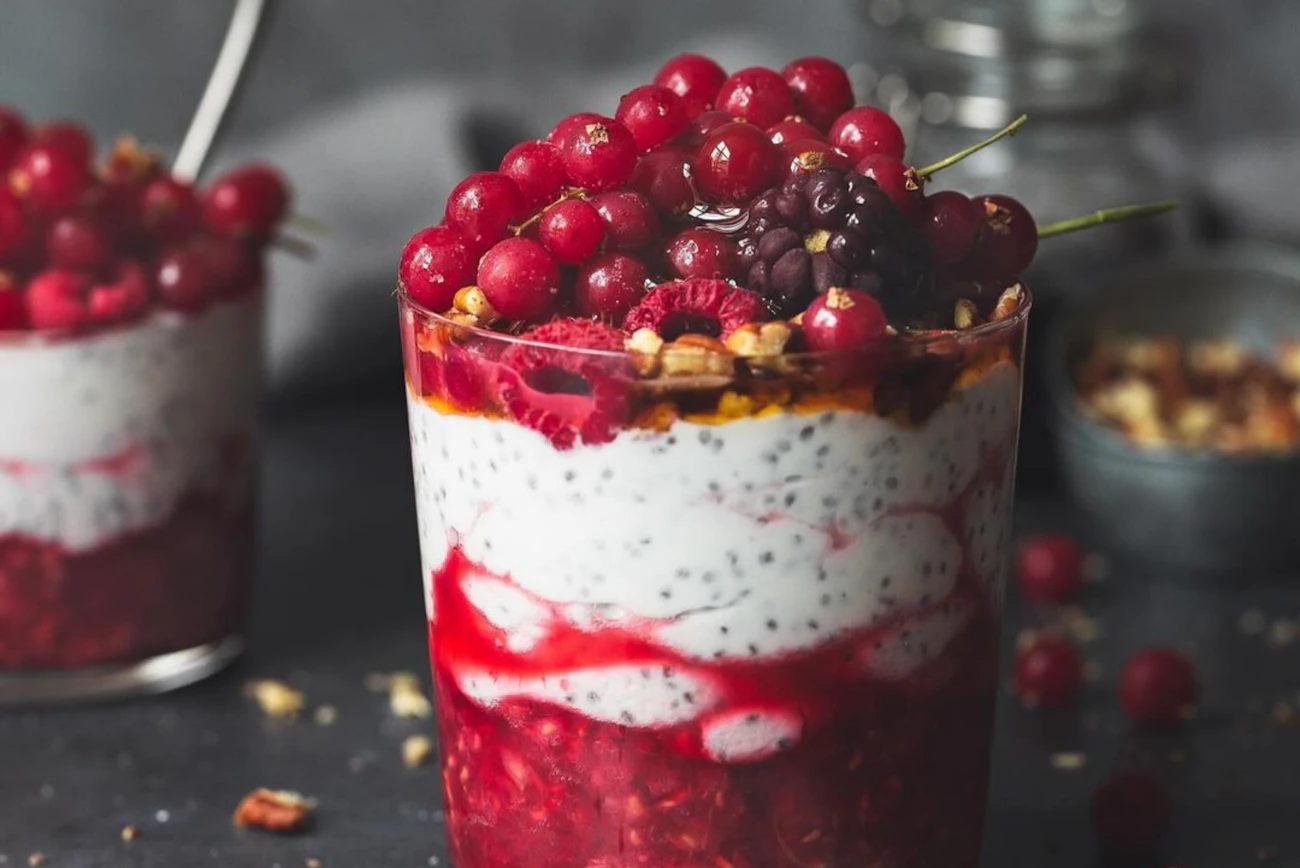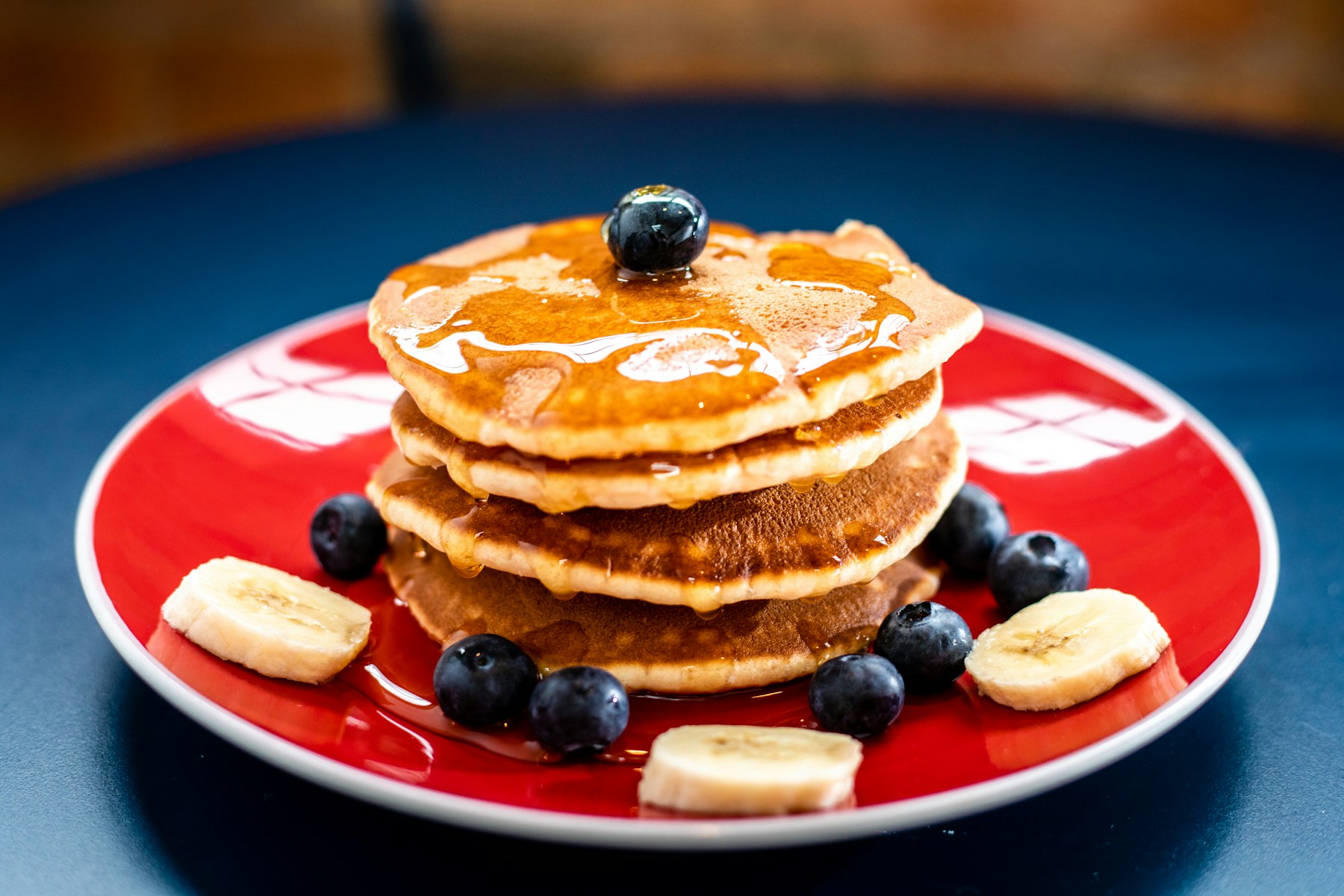
Loma Linda, east of Los Angeles, is the one American region on the Blue Zones map, and it is defined less by a place than by a church. The Blue Zones organisation describes a community of about 9,000 Seventh-day Adventists there as the core of the region. It says Adventists cite Genesis 1:29 in support of “a biblical diet of grains, fruits, nuts, and vegetables”, and that they encourage a “well-balanced diet” including nuts, fruits and legumes, low in sugar, salt and refined grains. These pancakes are not a traditional Adventist recipe, and nobody in Loma Linda handed them down. They are a weekend breakfast made in that spirit: whole oats, a little wholemeal flour, very ripe banana instead of sugar, and a good handful of toasted walnuts.
Mostly whole food doesn’t have to mean worthy, and these are meant to be the pancakes you actually want on a Saturday morning. The difference between a fluffy oat pancake and a dense, gummy one comes down to a few small steps. The rolled oats are blended to a flour, and a little wholemeal flour gives the batter enough structure to rise. The batter rests for 10 minutes so the oats can soak up the milk; skip it and the pancakes spread thin and taste raw in the middle. They are cooked small, on a medium-low heat, because banana sugars brown fast and an oat batter needs a little longer to set than one made with white flour. And they are flipped once, only when the edges look dry and the bubbles on top stay open. Toasting the walnuts first takes five minutes and brings out their flavour, and the cinnamon and vanilla do the rest.
Worked out from USDA FoodData Central values, a serving of three pancakes, before toppings, comes to about 500 calories, 16 g of protein and 9 g of fibre, with 40 g of oats and 15 g of walnuts in each. There is no sugar in the batter at all. The 12 g or so of sugars in a serving come from the banana and the milk, which the FDA does not count as added sugars. A tablespoon of maple syrup on top adds about 52 calories and 12 g of added sugar, roughly a quarter of the FDA’s 50 g Daily Value. With ripe banana in the batter and berries on top, you may find you don’t want it.
Nuts, in Adventists. In the original Adventist Health Study (Fraser and colleagues, Archives of Internal Medicine, 1992), researchers followed non-Hispanic white Seventh-day Adventists in California from 1977 to 1982. After excluding people who already had heart disease or diabetes, 26,473 were left in the analysis. Those who ate nuts five or more times a week (the abstract says “more than four times per week”) had about half the rate of coronary events of those who ate them less than once a week: a relative risk of 0.52 for fatal coronary heart disease (95% CI 0.36–0.76) and 0.49 for non-fatal heart attack (95% CI 0.28–0.85). The authors took account of age, sex, smoking, exercise, relative weight and high blood pressure, and of other foods such as beef and bread. People who usually ate wholemeal rather than white bread also had fewer non-fatal heart attacks (relative risk 0.56, 95% CI 0.35–0.89), though the link with fatal heart disease was not statistically significant. The study counted all nuts together; in a small dietary substudy, walnuts were about 16% of the nuts eaten, behind peanuts (32%) and almonds (29%). This is an observational study of one community, so it shows a link, not proof that the nuts were responsible.
Nuts, more widely. Bao and colleagues (New England Journal of Medicine, 2013) followed 76,464 women in the Nurses’ Health Study from 1980 and 42,498 men in the Health Professionals Follow-up Study from 1986, all free of cancer, heart disease and stroke at the start, until 2010. During that time 16,200 women and 11,229 men died. After adjusting for other risk factors, people who ate nuts (peanuts and tree nuts combined) seven or more times a week had a 20% lower death rate than those who ate none (hazard ratio 0.80, 95% CI 0.73–0.86), and the risk was lower the more often people ate nuts. Nut eating was also linked with fewer deaths from cancer, heart disease and respiratory disease. A serving in the study was 28 g; a plate of these pancakes has about 15 g of walnuts, roughly half that. Again, these are observational findings, and people who eat nuts often may differ in other ways.
The oats. Oats carry an FDA-authorised health claim. Under federal rules, 3 g or more a day of beta-glucan soluble fibre from whole oats or barley, as part of a diet low in saturated fat and cholesterol, may reduce the risk of heart disease. A meta-analysis of 28 randomised controlled trials (Whitehead and colleagues, American Journal of Clinical Nutrition, 2014) found that at least 3 g a day of oat beta-glucan lowered LDL cholesterol by 0.25 mmol/L (about 10 mg/dL) compared with control, and total cholesterol by 0.30 mmol/L. For the claim, rolled oats must provide at least 4% beta-glucan by dry weight; at that level, the 40 g of oats in each serving carries roughly 1.4 g, close to half the daily 3 g. (The pancakes as a whole wouldn’t qualify for the claim on a label, because the walnuts, eggs and oil take them over the low-fat, low-saturated-fat and low-cholesterol limits.) That is a modest, steady effect, not a treatment. If your cholesterol is high, talk to your doctor.
The omega-3. Walnuts are a rich source of the plant omega-3 alpha-linolenic acid (ALA): 9.08 g per 100 g by USDA values, which puts about 1.4 g of ALA in each serving. The NIH Office of Dietary Supplements gives the adequate intake for ALA as 1.6 g a day for men and 1.1 g for women, and explains that ALA is the only omega-3 that is essential in the diet. It also says the body’s conversion of ALA into the longer-chain EPA and DHA found in fish is very limited, with reported rates of less than 15%. So this is about ALA itself, not a stand-in for oily fish.
The Ingredients
- 160g (2 cups)rolled oats (porridge oats), or the same weight of oat flour
- 60g (½ cup)wholemeal (whole-wheat) flour
- 2 tspbaking powder
- 1½ tspground cinnamon
- ⅛ tspfine salt
- 60g (2 oz, about ⅔ cup)walnut halves
- About 225g (8 oz) peeledvery ripe bananas, 2 medium, skins well speckled with brown (about 1 cup mashed)
- 2 largeeggs, or 2 flax eggs for a vegan version (see below)
- 300ml (1¼ cups)milk, or unsweetened soy milk
- 1 tspvanilla extract (optional)
- 1 tbsp (15ml)rapeseed (canola) oil or melted butter, plus about 1 tbsp more for the pan
- To serve: fresh berries, plain or Greek yoghurt, and a little maple syrup, or none
Flax eggs (vegan option). Stir 2 tbsp (14g) ground flaxseed into 6 tbsp (90ml) water and leave for 5 minutes to thicken; this replaces both eggs. Use unsweetened soy milk and oil. Oat flour? Shop-bought oat flour works at the same weight; skip the blending. Gluten: not gluten-free as written, because wholemeal flour is wheat. You can swap it for the same weight of extra oat flour made from oats labelled gluten-free; expect slightly more fragile pancakes.
How to Make It
Tip the walnuts into a dry frying pan over a medium heat and toast them for 4–5 minutes, shaking the pan often, until they smell nutty and have darkened a shade. Watch them; they go from toasted to burnt quickly. Tip them onto a board, let them cool for a minute and chop them roughly, about the size of a pea. Keep a small handful back for the top.
Blitz the oats in a blender or food processor for 30–60 seconds, until they are a fine flour with only a few flecks left. Tip into a large bowl and add the wholemeal flour, baking powder, cinnamon and salt. Whisk well, so the baking powder is evenly spread and you don’t get bitter pockets. If you are making flax eggs, stir the ground flaxseed and water together in a cup now and leave it for 5 minutes to thicken.
In a second bowl, mash the bananas with a fork until almost smooth; a few small lumps are fine and give you pockets of banana. Whisk in the eggs (or the flax eggs), then the milk, vanilla and the 1 tbsp of oil or melted butter.
Pour the wet ingredients into the dry ones and fold them together with a spatula until there is no dry flour left. Don’t beat it; a lumpy batter makes lighter pancakes. Fold in the chopped walnuts. Now leave the batter alone for 10 minutes. The oats soak up the milk, the batter thickens, and the baking powder starts to work, which is what makes these fluffy instead of flat. Meanwhile, heat the oven to its lowest setting, about 95°C (200°F), with a baking tray inside. After resting, the batter should be thick but still drop slowly from a spoon. If it is stiff, stir in 1–2 tbsp more milk.
Heat a heavy non-stick or cast-iron frying pan over a medium-low heat for a couple of minutes, then wipe it with a little oil on a piece of kitchen paper. Scoop a scant ⅓ cup (about 5 tbsp, 70ml) of batter per pancake and nudge it into a round about 10cm (4 in) across. Cook three or four at a time for 2½–3 minutes, until the edges look dry and set, bubbles on the surface pop and stay open, and the underside is deep golden when you lift a corner. Then flip once and cook for 1½–2 minutes more, until the middle springs back when pressed. Break the first one open: the centre should be set and fluffy, with no wet batter. If the outsides brown before the bubbles appear, turn the heat down. The first pancake is a test; adjust the heat and the size after it.
Move each batch to the tray in the low oven in a single layer, uncovered, so the pancakes stay warm without steaming and going soft. Wipe the pan with a little more oil between batches. Serve three pancakes each, with berries, a spoonful of yoghurt, the reserved walnuts and a thin drizzle of maple syrup if you want it.
Getting It Right
- Riper is better. Bananas with skins well speckled or streaked with brown are sweeter and mash easily, which is why the batter needs no sugar. Pale yellow bananas give flat-tasting pancakes.
- Don’t skip the rest. Ten minutes is what turns a thin, gritty batter into a thick, soft one. If it thickens too much, loosen it with a spoonful of milk rather than adding more baking powder.
- Medium-low, and patience. If the outsides colour in under 2 minutes, the pan is too hot. A heavy pan holds an even heat; a thin one gives you burnt patches.
- Flip once, and don’t press. Wait for dry edges and open bubbles. Pressing a pancake with the spatula squeezes out the air you rested the batter for.
- Keep them small. Oat batter has less gluten than white flour, so big pancakes tear when you flip them and stay damp in the middle. About 10 cm (4 in) is right.
- Toppings that work. Blueberries, raspberries or sliced banana; a spoonful of thick yoghurt (plant-based if vegan); the reserved toasted walnuts; a pinch more cinnamon. Maple syrup is optional, and a teaspoon goes a long way.
Questions People Ask
No, and we don’t want to pretend it is. Pancakes are not an Adventist invention, and this is not a family recipe from Loma Linda. It is here because it fits the way that community is known to eat. The Blue Zones organisation says Adventists cite Genesis 1:29 in support of a biblical diet of grains, fruits, nuts and vegetables, and encourage a well-balanced diet including nuts, fruits and legumes, low in sugar, salt and refined grains. Whole oats, banana, walnuts and no sugar in the batter is a breakfast in that spirit. Our Adventist granola has genuine 19th-century Adventist roots, and our Loma Linda overnight oats follow the same pattern.
Yes. Replace the two eggs with two flax eggs: 2 tbsp (14 g) of ground flaxseed stirred into 6 tbsp (90 ml) of water and left for 5 minutes to thicken. Use unsweetened soy milk, and oil rather than butter. Flax eggs give a little less lift, so the pancakes come out slightly flatter and more tender; give the batter the full 10-minute rest and keep them small, because they are more fragile to flip. By USDA values, the vegan version comes to about 460 calories, 13 g of protein and 10 g of fibre a serving.
Usually one of three things. Flat: the batter didn’t rest, was beaten too hard, or your baking powder is old. Gummy in the middle: they were flipped too early, or they are too big. Burnt outside and raw inside: the heat is too high. Banana sugars brown quickly, so this batter needs a lower heat and a little more time than a white-flour pancake. Keep the heat medium-low, make them about 10 cm across, and wait until the edges look dry and the bubbles stay open before you flip.
Not in the batter. The sweetness comes from very ripe banana. By USDA values a serving has about 12 g of sugars, nearly all from the banana and the milk, and the FDA does not count the sugars naturally found in fruit and milk as added sugars. Maple syrup does count. One tablespoon (20 g) adds about 52 calories and 12 g of added sugar, roughly a quarter of the FDA’s Daily Value of 50 g. With fruit and yoghurt on top, you may find you don’t miss it.
Yes, and they reheat well. Let them cool on a rack, then refrigerate within 2 hours. USDA says leftovers can be kept in the refrigerator for 3 to 4 days or frozen for 3 to 4 months. To freeze, lay them flat on a tray until firm, then pack them in a bag with baking paper between the layers so you can take out just a few. Reheat from frozen in a toaster, or in an oven at 180°C (350°F) for 8–10 minutes, until hot all the way through (USDA advises reheating leftovers to 74°C/165°F). The batter is best cooked the same day; it keeps thickening as it stands. You can weigh out the dry ingredients the night before.
Sources
- Blue Zones. Loma Linda, California. bluezones.com
- Fraser GE, Sabaté J, Beeson WL, Strahan TM. A possible protective effect of nut consumption on risk of coronary heart disease: the Adventist Health Study. Arch Intern Med. 1992;152(7):1416–1424. Full text (PDF)
- Bao Y, Han J, Hu FB, Giovannucci EL, Stampfer MJ, Willett WC, Fuchs CS. Association of nut consumption with total and cause-specific mortality. N Engl J Med. 2013;369(21):2001–2011. Article · Author manuscript (PDF)
- US Code of Federal Regulations. 21 CFR 101.81: Health claims: soluble fiber from certain foods and risk of coronary heart disease (CHD). ecfr.gov
- Whitehead A, Beck EJ, Tosh S, Wolever TMS. Cholesterol-lowering effects of oat β-glucan: a meta-analysis of randomized controlled trials. Am J Clin Nutr. 2014;100(6):1413–1421. Record and abstract
- NIH Office of Dietary Supplements. Omega-3 Fatty Acids: Fact Sheet for Health Professionals. ods.od.nih.gov
- US Food and Drug Administration. Added Sugars on the Nutrition Facts Label. fda.gov
- USDA Food Safety and Inspection Service. Leftovers and Food Safety. fsis.usda.gov
- USDA FoodData Central, SR Legacy: Cereals, oats, regular and quick, not fortified, dry (FDC 173904); Wheat flour, whole-grain (FDC 168893); Bananas, raw (FDC 173944); Egg, whole, raw, fresh (FDC 171287); Milk, whole, 3.25% milkfat, with added vitamin D (FDC 171265); Soymilk (all flavors), unsweetened, with added calcium, vitamins A and D (FDC 175215); Nuts, walnuts, english (FDC 170187); Seeds, flaxseed (FDC 169414); Leavening agents, baking powder, double-acting, sodium aluminum sulfate (FDC 172803); Spices, cinnamon, ground (FDC 171320); Salt, table (FDC 173468); Vanilla extract (FDC 173471); Oil, canola (FDC 172336); Syrups, maple (FDC 169661). fdc.nal.usda.gov