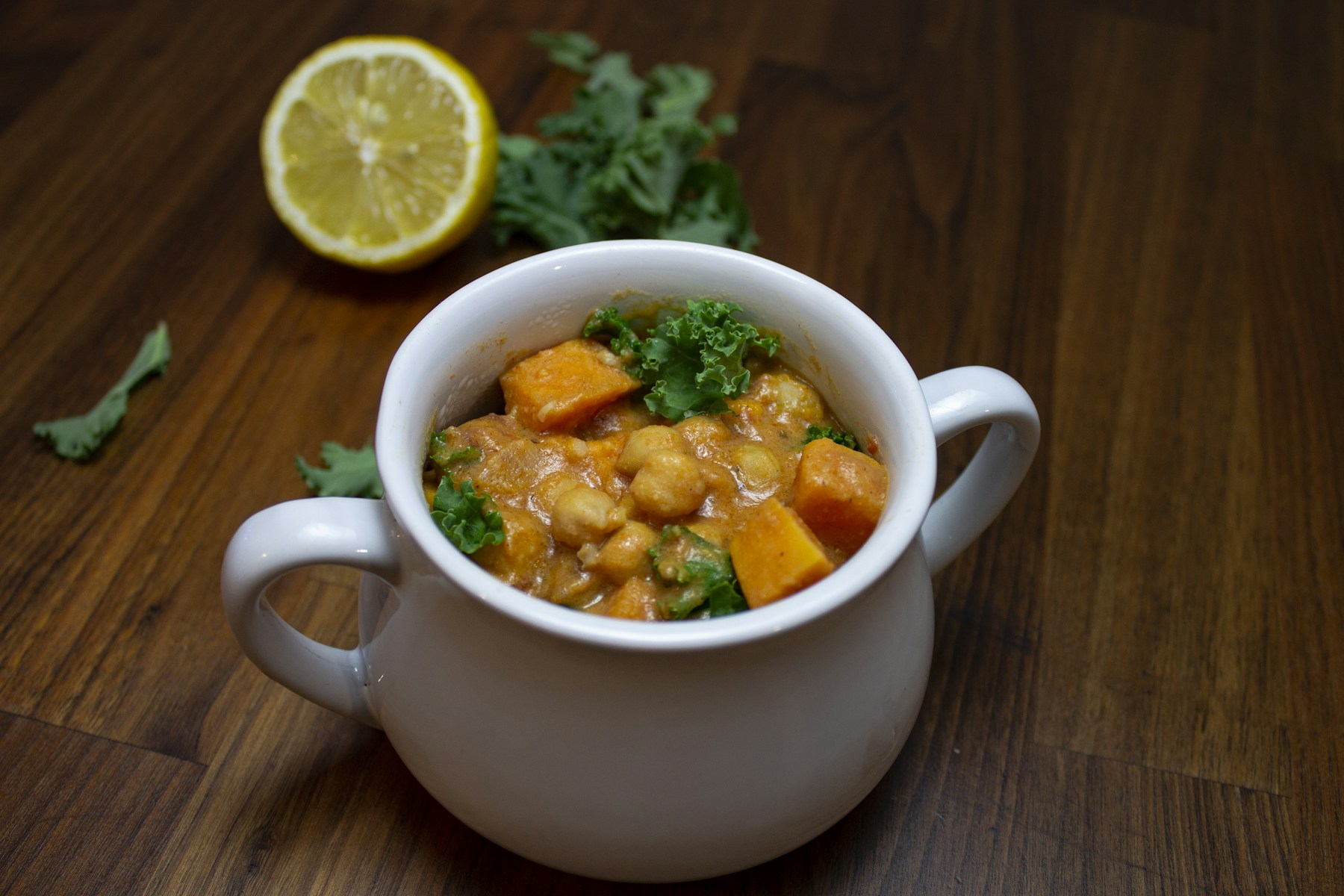
Loma Linda, in Southern California, is the Blue Zones organisation's one American longevity region, and what defines it is not the climate or the soil but a church. According to Blue Zones, a community of about 9,000 Seventh-day Adventists there is the core of the region, and many of them follow a vegetarian diet. This stew is not a heritage dish with a name and a family story attached. It is simply what a weeknight in that kind of kitchen tends to look like: a tin or two of beans, an orange vegetable, a lot of greens, and one pot to wash.
Each bowl carries about 120 g of chickpeas, 125 g of sweet potato and a big handful of kale, close to two cups raw by the USDA's measure. Worked out from USDA FoodData Central, that comes to roughly 390 calories, 13 g of protein and 16 g of fibre a serving, with only 2 tablespoons of olive oil in the whole pot. It is filling without being heavy, and it is one of those dishes that is better the next day.
The Adventist pattern. The Adventist Health Study-2 (Orlich and colleagues, JAMA Internal Medicine, 2013) followed 73,308 Seventh-day Adventist men and women for an average of 5.8 years, during which 2,570 died. After adjusting for other factors, vegetarians as a group had 12% lower all-cause mortality than non-vegetarians (hazard ratio 0.88, 95% CI 0.80–0.97), and the associations were larger in men than in women. This is an observational study of a whole way of eating, so it cannot separate diet from everything else about how these people live, and it says nothing about any single dish. It does suggest that, within this population, the plant-based way of eating this dish represents was linked with lower mortality.
The chickpeas. A 2023 meta-analysis in Advances in Nutrition pooled 32 cohorts and 1,141,793 people and found that higher legume intake was associated with 6% lower all-cause mortality (HR 0.94, 95% CI 0.91–0.98), and that each extra 50 g a day was associated with a similar 6% lower risk. There was no significant link with cardiovascular deaths specifically, and the authors rated the certainty of the evidence low to moderate. A bowl of this stew has about 120 g of chickpeas, more than twice that 50 g step, though the study can't say the benefit keeps growing at that rate.
The kale. In the Memory and Aging Project (Morris and colleagues, Neurology, 2018), 960 people aged 58 to 99 had their thinking tested over an average of 4.7 years. Those in the top fifth for green leafy vegetables, a median of 1.3 servings a day, had a slower rate of cognitive decline, which the authors put as "the equivalent of being 11 years younger in age". They concluded that about one serving a day of leafy greens and foods rich in nutrients such as vitamin K (phylloquinone), lutein and folate "may help to slow cognitive decline with aging". It is observational and needs confirming, but kale is a good way to get there: by USDA values each bowl here has about 146 µg of vitamin K and 2.3 mg of lutein and zeaxanthin.
The sweet potato. This one is about getting enough, not living longer. Using USDA values for raw sweet potato, the 125 g in each bowl carries about 890 µg RAE of vitamin A, almost all of it as beta-carotene. The NIH recommended daily amount is 900 µg RAE for adult men and 700 µg for adult women, so one bowl covers roughly a day's worth. Some is lost in cooking, so treat that as approximate.
The fibre. At about 16 g a bowl, this stew gets you more than halfway to the range that stood out in the review of fibre and carbohydrate quality by Reynolds and colleagues (The Lancet, 2019). Drawing on 135 million person-years of data from prospective studies and 58 clinical trials, they found that observational data suggest a 15–30% decrease in all-cause and cardiovascular mortality, and in the incidence of coronary heart disease, stroke, type 2 diabetes and colorectal cancer, when comparing the highest fibre eaters with the lowest. The reduction in risk was greatest at 25–29 g of fibre a day, and dose-response curves suggested that higher intakes could bring even greater benefit for some of these conditions.
The Ingredients
- 2 tbspolive oil
- 1onion, diced
- 3garlic cloves, finely chopped
- 1 tspground cumin
- 1 tspsmoked paprika
- ½ tspground turmeric
- About 500gsweet potatoes (2–3, depending on size), weighed after peeling, cut into 2cm cubes
- 2 × 400g tinschickpeas, drained and rinsed (about 480g drained)
- 1 × 400g tinchopped tomatoes, no-salt-added if you can find them
- 750mllow-sodium vegetable stock
- 150gkale leaves, weighed after stripping the stems, roughly chopped
- ½lemon, juiced
- Salt and black pepper
How to Make It
Dice the onion, chop the garlic, and peel and cube the sweet potatoes. Tip the chickpeas into a sieve and rinse them well under the tap. Strip the kale leaves from their stems and chop them roughly. Everything goes into one pot, so it pays to have it all to hand.
Warm the olive oil in a large heavy pot over a medium heat. Add the onion with a pinch of salt and cook for 6–8 minutes, stirring now and then, until soft and turning golden at the edges. Add the garlic, cumin, smoked paprika and turmeric and stir for about a minute, until fragrant. Do not let the spices catch.
Add the sweet potato, chickpeas, tomatoes and stock and stir. Bring to the boil, then lower to a steady simmer, half-cover and cook for about 20 minutes, until the sweet potato is tender all the way through when you push a knife into a cube.
With the back of a wooden spoon, crush a few cubes of sweet potato and a spoonful of chickpeas against the side of the pot. This thickens the broth without any flour. Stir in the kale, a handful at a time if the pot is full, and simmer uncovered for another 5 minutes, until it is dark green and tender.
Take the pot off the heat and stir in the lemon juice. Taste before you add salt, because the stock and tins may already have brought plenty. Season with salt and black pepper, then serve hot in deep bowls.
Questions People Ask
Not in the sense of a dish with a fixed name and history. "Loma Linda-style" here means it follows the pattern that region is known for: plant-based, built around legumes, vegetables and greens. Many Adventists follow a vegetarian diet, and a one-pot bean and vegetable stew like this is typical of how that looks on a weeknight.
Most of the sodium in this stew comes from the stock and the tins, not the salt shaker. Rinse the chickpeas, choose no-salt-added tomatoes, use a low-sodium stock, and add salt only at the end after tasting. As a guide, USDA values for an ordinary ready-to-serve vegetable broth would add about 550 mg of sodium to each bowl, so a low-sodium stock makes a real difference. Check the label on yours.
Yes. Use about 480 g of home-cooked chickpeas, the same weight as two drained tins, and add them at the same point. Home-cooked chickpeas without salt also lower the sodium.
Yes. Swiss chard or collard greens work the same way. Spinach is fine too, but it wilts in about a minute, so stir it in just before the lemon.
Yes. It keeps 4 days in the fridge and thickens as it sits, so loosen it with a splash of water or stock when you reheat it. It freezes for 3 months; the kale softens a little but the flavour holds. Add a fresh squeeze of lemon after reheating.
Sources
- Orlich MJ, et al. Vegetarian dietary patterns and mortality in Adventist Health Study 2. JAMA Intern Med. 2013;173(13):1230. Full text
- Zargarzadeh N, et al. Legume consumption and risk of all-cause and cause-specific mortality: a systematic review and dose-response meta-analysis of prospective studies. Adv Nutr. 2023;14(1):64–76. Record and abstract
- Morris MC, et al. Nutrients and bioactives in green leafy vegetables and cognitive decline: prospective study. Neurology. 2018;90(3):e214–e222. Article
- Reynolds A, et al. Carbohydrate quality and human health: a series of systematic reviews and meta-analyses. Lancet. 2019;393(10170):434–445. Article · Accepted manuscript (PDF)
- NIH Office of Dietary Supplements. Vitamin A and Carotenoids: Fact Sheet for Health Professionals. ods.od.nih.gov
- Blue Zones. Loma Linda, California. bluezones.com
- USDA FoodData Central, SR Legacy: Sweet potato, raw, unprepared (FDC 168482); Chickpeas, mature seeds, canned, drained, rinsed in tap water (FDC 173801); Kale, raw (FDC 168421); Tomatoes, red, ripe, canned, packed in tomato juice, no salt added (FDC 170138); Soup, vegetable broth, ready to serve (FDC 171583); Oil, olive, salad or cooking (FDC 171413); Onions, raw (FDC 170000); Garlic, raw (FDC 169230); Lemon juice, raw (FDC 167747); Spices, cumin seed (FDC 170923); Spices, paprika (FDC 171329); Spices, turmeric, ground (FDC 172231). fdc.nal.usda.gov


