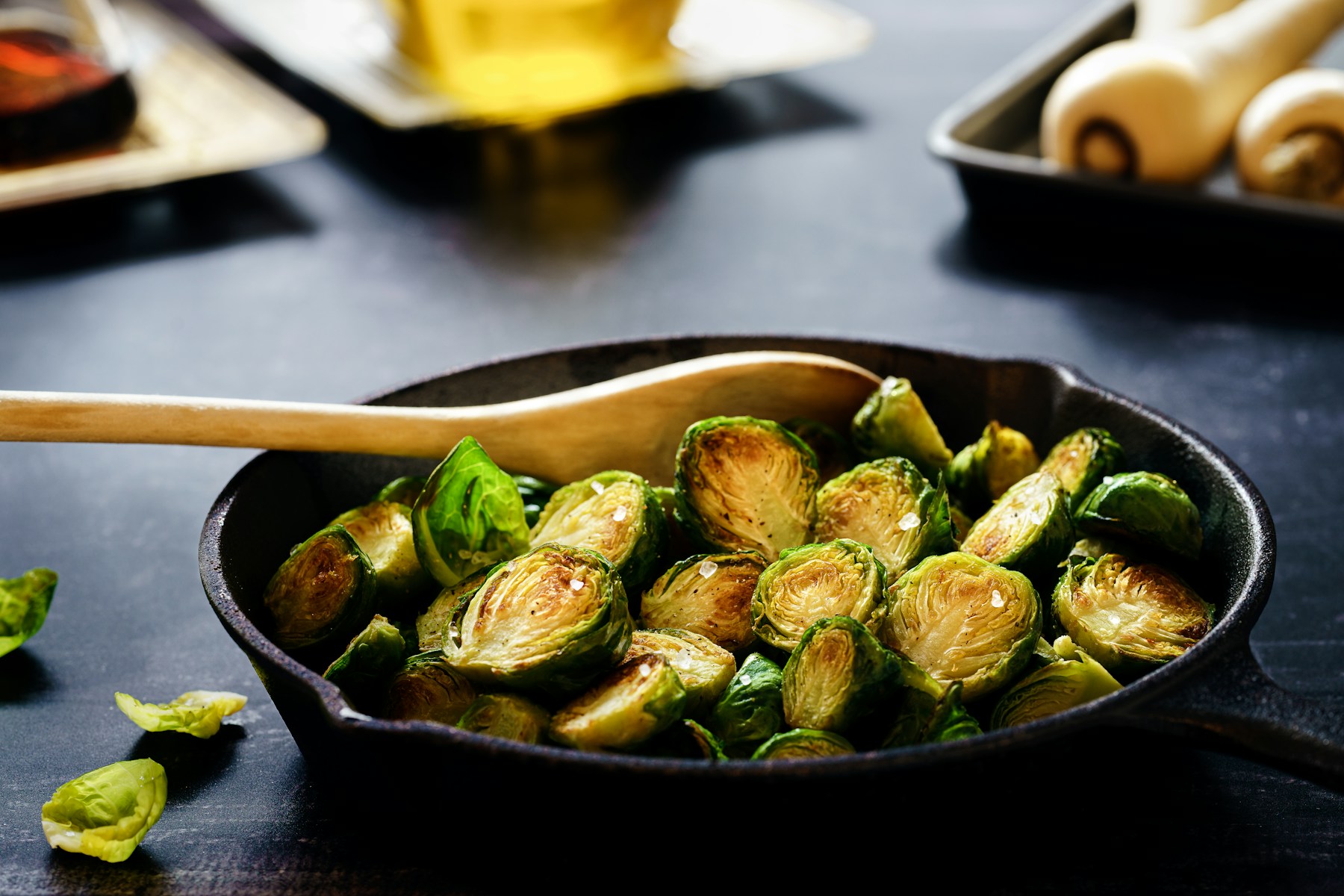
Loma Linda, east of Los Angeles, is what the Blue Zones organisation calls “America’s blue zones region”, and it is defined less by a place than by a church. It describes a community of about 9,000 Seventh-day Adventists there as the core of the region, and says they cite Genesis 1:29 in support of “a biblical diet of grains, fruits, nuts, and vegetables”. This dish is not an Adventist tradition, and nobody in Loma Linda handed it down. It is a holiday side made in that spirit: a tray of vegetables roasted hard, a handful of toasted walnuts, lemon and good olive oil. With Thanksgiving on 26 November, it is also our answer to the bowl of sprouts nobody fights over.
Roasted properly, sprouts are a different vegetable from the boiled ones many of us grew up with. The cut faces go deep brown and sweet, the loose outer leaves turn into crisp, salty flakes, and the middles stay just tender. Getting there is mostly about heat and space: a very hot oven, a tray that has been heating with it, enough oil to coat every cut face, and room on the tray so the sprouts roast instead of steaming. The lemon, garlic and walnuts go on at the end, so nothing burns.
Worked out from USDA FoodData Central values, a serving (one of six) comes to about 220 calories, 6.5 g of protein and 6 g of fibre, with no added sugar unless you choose the maple syrup. Most of the calories come from the olive oil and the walnuts, about 80 each; the numbers for the optional extras are below.
The Adventist link, honestly. The connection to Loma Linda here is the walnuts, not the recipe. In the original Adventist Health Study (Fraser and colleagues, Archives of Internal Medicine, 1992), researchers followed 31,208 non-Hispanic white Seventh-day Adventists in California for six years. After excluding people who had heart disease or diabetes at the start, 26,473 were left in the analysis. Those who ate nuts most often (more than four times a week, according to the abstract; the body of the paper says five or more, or more than five, in different places) had about half the rate of coronary events of those who ate them less than once a week: a relative risk of 0.52 for fatal coronary heart disease (95% CI 0.36–0.76) and 0.49 for non-fatal heart attack (95% CI 0.28–0.85). The study counted all nuts together; in a dietary substudy, walnuts were only 16% of the nuts eaten, behind peanuts (32%) and almonds (29%). It is observational, so frequent nut eaters may have differed in ways the researchers couldn’t measure.
Nuts, more widely. Bao and colleagues (New England Journal of Medicine, 2013) followed 76,464 women in the Nurses’ Health Study from 1980 and 42,498 men in the Health Professionals Follow-up Study from 1986, all free of cancer, heart disease and stroke at the start, until 2010. During that time 16,200 women and 11,229 men died. After adjusting for other risk factors, people who ate nuts seven or more times a week had a 20% lower death rate than those who ate none (hazard ratio 0.80, 95% CI 0.73–0.86). The more often people ate nuts, the lower the risk, with similar results for peanuts and tree nuts. A serving in that study was 28 g; a serving of this side has about 12.5 g of walnuts, a little under half that.
The sprouts. Brussels sprouts are a cruciferous vegetable, in the same family as broccoli, cabbage and cauliflower. A 2017 meta-analysis in the International Journal of Epidemiology (Aune and colleagues) included 95 prospective studies. For fruit and vegetables together (15 studies for this outcome), each extra 200 g a day was associated with a 10% lower risk of death from any cause (summary relative risk 0.90, 95% CI 0.87–0.93), with lower risk seen up to about 800 g a day. Looking at particular types, cruciferous vegetables were among those linked with lower cardiovascular disease and all-cause mortality, and with lower total cancer risk. These are observational studies, and people who eat a lot of vegetables differ in many other ways. Read it as good evidence that vegetables belong at the centre of the plate, not as proof about sprouts in particular.
What’s in a serving. By USDA values for raw sprouts, a serving (about 133 g of trimmed sprouts) carries roughly 240 µg of vitamin K, twice the FDA’s Daily Value of 120 µg, and about 115 mg of vitamin C before cooking, counting the lemon, against a Daily Value of 90 mg. Heat destroys some vitamin C (USDA lists 62 mg per 100 g for boiled sprouts against 85 mg raw), so call it most of a day’s worth. The walnuts bring the plant omega-3 alpha-linolenic acid (ALA), about 1.3 g a serving in all; the NIH adequate intake is 1.6 g a day for men and 1.1 g for women. If you take warfarin, read the vitamin K question in the FAQ below.
The Ingredients
- 900g (2 lb)Brussels sprouts, about 800g (1¾ lb) once trimmed; firm, tight, similar-sized ones if you can choose
- 45ml (3 tbsp)olive oil, for roasting
- ¾ tspfine salt, divided
- 75g (2⅔ oz)walnut halves
- 1unwaxed lemon: finely grated zest and 30ml (2 tbsp) juice, plus more juice to taste
- 2garlic cloves, finely grated or crushed
- 15ml (1 tbsp)extra-virgin olive oil, for the dressing
- Pinchchilli flakes (red pepper flakes), optional
- Black pepper
- To finish, optional: choose one or two
- 1 tbsp (20g)maple syrup, or 1 tbsp balsamic vinegar
- ½ cup (87g)pomegranate seeds, or 40g (1½ oz) dried cranberries
- 25g (1 oz)Parmesan, finely grated (leave it out for a vegan dish)
The tray matters. Use the largest, heaviest rimmed baking tray you own, about 45 × 33cm (18 × 13 in). If yours is smaller, use two. A large cast-iron pan works for about half the quantity.
How to Make It
Put a large, heavy, rimmed baking tray on a shelf just above the middle of the oven and heat it to 220°C (200°C fan, 425°F, gas 7). Give it a full 15–20 minutes so the tray is properly hot, not just the air: a hot tray starts browning the cut faces the moment they touch it.
Slice a thin sliver off the dry base of each sprout and pull away any loose, yellowed or damaged outer leaves. Cut each one in half from top to stem, so both halves hold together. Quarter very large ones and leave tiny ones whole, so everything cooks evenly. If you have washed them, dry them well: surface water turns to steam and stops them browning. Keep any loose green leaves that fall off; they roast into crisp, salty flakes.
Put the sprouts and loose leaves in a large bowl with the 3 tbsp of olive oil, ½ tsp of the salt and a good grind of black pepper. Toss with your hands until every cut face is glossy; dry patches go leathery instead of brown. Do this only once the tray is hot.
Take the tray out, set it on the hob or another heatproof surface and tip the sprouts on. They should sizzle. Working quickly with tongs or a fork, turn as many as you can cut side down, in a single layer with a little space between them, and push the loose leaves to the edges. If they are crowded, split them between two hot trays; crowded sprouts steam instead of roasting.
Roast for 18–22 minutes without stirring, until the cut faces are deep brown and almost black at the edges, the outer leaves are crisp, and a knife slides easily into the thickest sprout. Small sprouts will be ready sooner. If you want them browned all over, give the tray a shake and roast for 3–5 minutes more.
For the last 5–6 minutes of roasting, spread the walnuts on a small tray and put it on the shelf below, or tip them into a gap on the big tray. Check after 4 minutes: they are ready when they smell toasty and have darkened a shade. At this heat they burn quickly. Chop them roughly once they are cool enough to handle.
While the sprouts roast, finely grate the lemon zest into the bowl you used for oiling them (no need to wash it). Add the 2 tbsp of lemon juice, the garlic, the 1 tbsp of extra-virgin olive oil, the remaining ¼ tsp of salt, and the chilli flakes and maple syrup or balsamic if you are using them. Stir and leave it to sit; the lemon juice takes the harsh edge off the raw garlic.
Tip the hot sprouts straight from the tray into the dressing and toss well; the heat mellows the garlic and the sprouts soak up the lemon. Add the walnuts and the pomegranate seeds or cranberries, if using, and toss once more. Taste: it may want more lemon, salt or pepper. Pile onto a warm platter, grate the Parmesan over the top if you are using it, and serve. They are at their crispest in the first 15 minutes.
Your Thanksgiving Plan
Roast at the last minute; do everything else the day before.
- The day before. Trim and halve the sprouts, then keep them in the fridge in a lidded container or bag lined with kitchen paper. Toast the walnuts in a dry frying pan over a medium heat for 4–5 minutes, shaking the pan often, then cool them and keep them airtight at room temperature, and skip step 6 on the day.
- About 45 minutes before dinner. The sprouts need a hot oven for about 25 minutes, plus 15–20 minutes for the tray to heat. The best window is usually while the turkey rests. Turn the oven up to 220°C (200°C fan, 425°F) with the tray inside, then oil and season the sprouts just before they go in.
- If you have to roast them earlier. Roast them up to an hour ahead and leave them uncovered on the tray, because a lid or foil traps steam and softens them. Put them back in a 220°C (425°F) oven for 5 minutes to crisp up, then dress and serve. The USDA says cooked food should go in the fridge within 2 hours, so don’t leave them out longer than that.
Cooking for a Crowd
- Double everything except the tray. 1.8kg (4 lb) of sprouts needs two large trays, both heated in the oven, on shelves in the upper and lower thirds. After 12 minutes, swap the trays between shelves and turn them round, and allow 3–5 minutes longer in all. A fan setting helps two trays brown evenly.
- Three trays or more. Most home ovens won’t brown three trays at once. Roast in batches, keep the first batch uncovered, and put it back in with the last one for 5 minutes to warm and re-crisp.
- The dressing doubles straight. A double batch serves 8–12 as a side.
The Honest Bit About the Extras
The base recipe has no added sugar. Its 3.4 g or so of sugars a serving come from the sprouts themselves, with a little from the walnuts, lemon and garlic. The optional finishes are where that changes, so here is what each one adds, worked out from USDA values.
Maple syrup counts as added sugar under the FDA’s rules. One tablespoon (20 g) adds about 52 calories and 12 g of added sugar to the whole tray: about 2 g a serving for six, or 3 g for four. Against the FDA’s Daily Value of 50 g, that is 4–6% of a day’s allowance. Balsamic vinegar adds less: by USDA values, a tablespoon (about 16 g) brings roughly 14 calories and 2.4 g of sugars to the tray, under half a gram a serving.
Pomegranate seeds: half a cup (87 g) adds about 72 calories and 12 g of sugars in total, about 12 calories and 2 g of sugars a serving, and the FDA doesn’t count the sugars naturally found in fruit as added sugars. Dried cranberries are sweeter. USDA’s entry for dried cranberries puts 40 g at about 123 calories and 29 g of sugars, or about 20 calories and 5 g of sugars a serving. That entry doesn’t separate out added sugar, but most dried cranberries are sweetened, so much of that is likely added sugar; check the “Includes added sugars” line on the label.
Parmesan (25 g) adds about 98 calories and 294 mg of sodium in total, roughly 16 calories and 50 mg of sodium a serving, and makes the dish no longer vegan. If you are vegetarian, check the cheese label for how it was made.
The oil. The 4 tablespoons in this recipe (3 for roasting, 1 in the dressing) come to 54 g and about 477 calories, or 80 a serving for six. Cutting the roasting oil to 2 tablespoons saves about 20 calories a serving, but the sprouts will brown less evenly. If you have been told to watch your calories or fat for a medical reason, talk to your doctor or a dietitian about how dishes like this fit in.
If It Goes Wrong
- Pale and soft, not brown and crisp. The tray was crowded, the sprouts were wet, or the tray wasn’t hot. Spread them out over two trays and give them another 5–10 minutes at 220°C (425°F).
- Burnt outside, still hard inside. The sprouts were too big for the heat. Quarter large ones next time. For now, turn the oven down to 200°C (400°F) and give them a few more minutes.
- Bitter. Usually burnt garlic or scorched walnuts. Keep the garlic in the dressing and watch the walnuts.
- It tastes flat. Add more lemon and salt, toss and taste again.
Questions People Ask
No, and we don’t want to pretend it is. Nobody in Loma Linda handed this recipe down. The Blue Zones organisation says Adventists cite Genesis 1:29 in support of a biblical diet of grains, fruits, nuts and vegetables. A tray of vegetables with a handful of walnuts is a side dish in that spirit, and the nut research from Adventist Health Study participants is one of the reasons it is on this site.
Soggy sprouts have been steamed, not roasted. Dry them well, coat every cut face in oil, heat the tray in the oven before the sprouts go on, lay them cut side down in a single layer with space between them, and don’t stir them for the first 18 minutes. Use two trays rather than one crowded one, and serve them quickly.
Do the prep ahead and the roasting at the last minute. The day before, trim and halve the sprouts and keep them in the fridge in a container lined with kitchen paper, and toast the walnuts. On the day, roast the sprouts just before dinner, for example while the turkey rests. If you must roast them earlier, leave them uncovered for up to an hour, then crisp them in a 220°C (425°F) oven for 5 minutes before dressing them.
Talk to your doctor or anticoagulation clinic first. Brussels sprouts are rich in vitamin K: by USDA values, a serving of this recipe has about 240 micrograms, twice the FDA Daily Value of 120. The NIH says people taking warfarin and similar anticoagulants need to keep their vitamin K intake consistent, so the issue is sudden changes, such as one large holiday helping when you rarely eat greens.
The USDA says leftovers should be refrigerated within 2 hours of cooking and can be kept in the refrigerator for 3 to 4 days. Reheat them until they reach 74°C (165°F). For the best texture, reheat them on a hot tray in a 220°C (425°F) oven, usually 5–8 minutes, until steaming hot right through, and add a fresh squeeze of lemon.
Sources
- Blue Zones. Loma Linda, California. bluezones.com
- Fraser GE, Sabaté J, Beeson WL, Strahan TM. A possible protective effect of nut consumption on risk of coronary heart disease: the Adventist Health Study. Arch Intern Med. 1992;152(7):1416–1424. Full text (PDF)
- Bao Y, Han J, Hu FB, Giovannucci EL, Stampfer MJ, Willett WC, Fuchs CS. Association of nut consumption with total and cause-specific mortality. N Engl J Med. 2013;369(21):2001–2011. Article · Author manuscript (PDF)
- Aune D, Giovannucci E, Boffetta P, et al. Fruit and vegetable intake and the risk of cardiovascular disease, total cancer and all-cause mortality: a systematic review and dose-response meta-analysis of prospective studies. Int J Epidemiol. 2017;46(3):1029–1056. Article · Repository record
- NIH Office of Dietary Supplements. Vitamin K: Fact Sheet for Health Professionals. ods.od.nih.gov
- NIH Office of Dietary Supplements. Omega-3 Fatty Acids: Fact Sheet for Health Professionals. ods.od.nih.gov
- US Food and Drug Administration. Daily Value on the Nutrition and Supplement Facts Labels. fda.gov
- US Food and Drug Administration. Added Sugars on the Nutrition Facts Label. fda.gov
- USDA Food Safety and Inspection Service. Leftovers and Food Safety. fsis.usda.gov
- USDA FoodData Central, SR Legacy: Brussels sprouts, raw (FDC 170383); Brussels sprouts, cooked, boiled, drained, without salt (FDC 169971); Nuts, walnuts, english (FDC 170187); Oil, olive, salad or cooking (FDC 171413); Lemon juice, raw (FDC 167747); Garlic, raw (FDC 169230); Salt, table (FDC 173468); Syrups, maple (FDC 169661); Vinegar, balsamic (FDC 172241); Pomegranates, raw (FDC 169134); Cheese, parmesan, hard (FDC 170848). FNDDS: Cranberries, dried (FDC 2709202). fdc.nal.usda.gov


