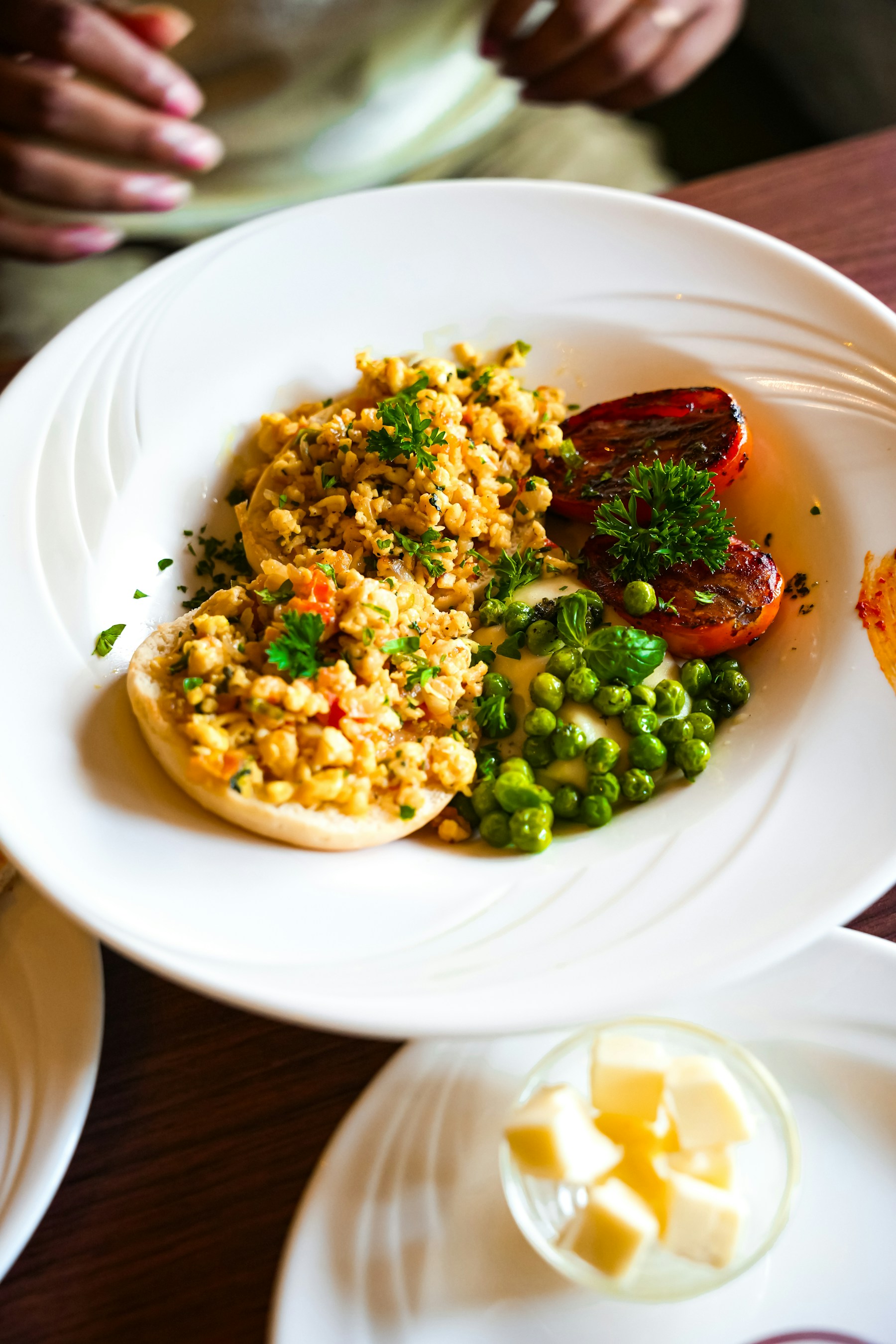
Loma Linda, in Southern California, is the American entry on the Blue Zones map, and the reason is its large Seventh-day Adventist community. Blue Zones notes that many Adventists follow a vegetarian diet, and that they cite Genesis 1:29 for "a biblical diet of grains, fruits, nuts, and vegetables." A tofu scramble is not a named Adventist dish with a history behind it, and we won't pretend it is. It is simply what a plant-based breakfast often looks like in a kitchen that skips eggs: soy in the role of the egg, plus whatever greens and vegetables are to hand.
Each serving, half the pan, carries about 200 g of tofu, a big handful of spinach, peas and tomatoes. Worked out from USDA FoodData Central values for a common type of firm tofu, that comes to roughly 310 calories, 24 g of protein and 7 g of fibre before you add any toast. It is a savoury breakfast that cooks in the time it takes to make coffee, and it works just as well rolled into a tortilla for lunch.
The vegan Adventists. This scramble is fully plant-based, so the most relevant group in the Adventist Health Study-2 mortality analysis (Orlich and colleagues, JAMA Internal Medicine, 2013) is its vegans: 5,548 of the 73,308 US Adventists analysed, defined as eating eggs, dairy, fish and meat less than once a month. Compared with non-vegetarians, their adjusted hazard ratio for death from any cause was 0.85 (95% CI 0.73–1.01) over a mean of 5.8 years. Because that interval just crosses 1.0, the result for vegans as a group was not statistically clear. The split by sex was stark: 0.72 (0.56–0.92) in men but 0.97 (0.78–1.20) in women. Diet was measured once, by questionnaire, in an observational cohort, so this is a link with a way of eating, not proof that any food caused anything.
Soy and LDL cholesterol: smaller than the label once suggested. The FDA authorised a heart-health claim for soy protein in 1999. In 2017 it proposed revoking it, saying "the totality of the evidence is inconsistent and not conclusive." Researchers then pooled the trials the FDA had looked at. In Blanco Mejia and colleagues' meta-analysis (Journal of Nutrition, 2019), 43 of the 46 trials had usable data (41 of them for LDL), covering 2,607 participants. A median 25 g of soy protein a day for a median of 6 weeks lowered LDL cholesterol by 4.76 mg/dL, about 3–4%. That is real but modest, and one co-author is affiliated with the Soy Nutrition Institute, while others reported grants or honoraria from it (the study itself was funded by the Canadian Institutes of Health Research). The FDA's list of authorised claims, last updated in March 2024, still shows the soy claim with the 2017 proposal noted beside it. If it does revoke it, the FDA has said it intends to allow a weaker, qualified claim instead. One serving of this scramble has about 18 g of soy protein from the tofu.
Soy and breast cancer. The worry that soy's plant oestrogens might feed breast cancer has been tested in survivors. The Shanghai Breast Cancer Survival Study (Shu and colleagues, JAMA, 2009) followed 5,042 women for a median of 3.9 years after diagnosis. Women in the top quarter of soy protein intake, above about 15 g a day, had a hazard ratio for death of 0.71 (95% CI 0.54–0.92) and for recurrence of 0.68 (0.54–0.87) compared with the bottom quarter. The link appeared to level off, or even reverse slightly, above about 11 g of soy protein a day, with no added benefit from eating more. This was an observational study in Chinese women, so it shows an association, not cause and effect. The American Institute for Cancer Research concludes that population studies consistently show "no increased risk for breast cancer survivors who consume soyfoods," and it describes 1 to 2 standard servings a day of whole soy foods as moderate, with one serving averaging about 7 g of soy protein. Half this pan has about 18 g, so it counts as roughly 2½ of those servings, a little above AICR's moderate range though within the up to 3 a day it notes in Asian diets. Its advice is about foods such as tofu, not isolated soy protein or isoflavone supplements.
The protein. At about 24 g a serving, this breakfast covers 42% of the 56 g a day the US Dietary Reference Intakes set for a reference adult man, and 52% of the 46 g for a reference woman. Those allowances are based on 0.8 g of protein per kilogram of body weight. The 2025–2030 Dietary Guidelines for Americans, as summarised in American Family Physician, now set a higher target of 1.2 to 1.6 g per kilogram a day. For a 75 kg (165 lb) adult that is 90–120 g, so one serving of this is roughly a fifth to just over a quarter of the day.
The calcium depends on the tofu. Tofu set with a calcium salt is a real calcium food; tofu set with other salts provides little, according to the NIH Office of Dietary Supplements. Using the USDA entry for firm tofu made with calcium sulfate and magnesium chloride, the 200 g in each serving gives about 400 mg of calcium, 40% of the 1,000 mg a day recommended for adults aged 19 to 50 and for men up to 70. Women over 50 and everyone over 70 need 1,200 mg. Don't count on the spinach to help much. NIH notes that calcium absorption from spinach is only about 5%, against 27% from milk, because its oxalic acid binds the mineral. If calcium is the goal, use kale instead.
The Ingredients
- 1 tbsp (15ml)olive oil
- 1 medium (100g)onion, finely chopped
- 2garlic cloves, finely chopped
- 400g (14oz)firm or extra-firm tofu, one block, drained and patted dry
- ½ tspground turmeric
- ½ tspground cumin
- 2 tbspnutritional yeast (optional)
- ¼ tspsalt, plus black pepper
- 3 tbsp (45ml)water or unsweetened soy milk
- 100g (¾ cup)frozen peas
- 150g (1 cup)cherry tomatoes (about 9), halved
- 100g (3 cups)baby spinach, or 80g kale leaves, shredded
- To serve: wholegrain toast or warm tortillas (corn tortillas for gluten-free)
How to Make It
Drain the tofu and pat it dry with a clean tea towel. There is no need to press it for long; a scramble cooks off its water in the pan. Chop the onion and garlic and halve the tomatoes. In a cup, stir the turmeric, cumin, salt, a good grind of pepper and the nutritional yeast, if using, into the 3 tablespoons of water or soy milk.
Warm the olive oil in a large non-stick or well-seasoned frying pan over a medium heat. Cook the onion for 4–5 minutes, stirring now and then, until soft and just starting to colour. Add the garlic and stir for 30 seconds.
Crumble the tofu into the pan with your hands, leaving some pieces the size of a hazelnut and some smaller, the way scrambled egg breaks up. Cook for 5–6 minutes, turning it with a spatula every minute or so, until the water has cooked off and a few edges are turning golden.
Pour the spiced liquid over the tofu and stir until every piece is evenly yellow. It will look wet for a moment, then turn creamy as the tofu soaks it up.
Stir in the frozen peas and cook for 2 minutes, then add the tomatoes and cook for 1 minute more. Pile the spinach on top and fold it through until it has just wilted, about a minute. If you use kale, add it with the peas so it has 3–4 minutes to soften. Taste, adjust the salt and pepper, and serve straight away with toast or a warm tortilla.
Questions People Ask
No. There is no named dish behind it. It is called Loma Linda-style because it fits the eating pattern the Adventist community there is known for: plant-based, with many members vegetarian or vegan. In the Adventist Health Study-2 mortality analysis, 7.6% of the 73,308 US Adventists analysed were vegan and 28.9% were lacto-ovo vegetarian. A soy-based breakfast like this is simply one easy way to eat that way in the morning.
The American Institute for Cancer Research says population studies consistently show no increased risk for breast cancer survivors who eat soy foods. It describes 1 to 2 standard servings a day of whole soy foods such as tofu, each about 7 g of soy protein, as moderate intake. A serving of this scramble has about 18 g, or roughly 2½ of those servings, so if you are keeping to that range, split the pan three ways or eat it on alternate days. AICR does not extend its advice to isolated soy protein or isoflavone supplements. If you have had a hormone-sensitive cancer, talk to your oncologist about your own diet.
Firm or extra-firm. Silken tofu is too soft and turns watery. If you want the calcium, check the ingredients for calcium sulfate or calcium chloride; tofu set only with nigari (magnesium chloride) has much less. According to NIH, tofu processed with other salts "does not provide significant amounts of calcium." Protein and calories also vary a lot between brands, so the label on your block is the best guide.
No. It adds a savoury, slightly cheesy flavour, but the scramble works without it. The nutrition figures on this page leave it out, because brands differ, so check the label on yours if you use it.
Yes. Cool it quickly and keep it covered in the fridge for up to 3 days. Reheat it in a hot pan with a splash of water. The spinach softens further, but the flavour holds. It also works cold, rolled into a tortilla for a packed lunch.
This page is for general information, not medical advice. If you have a medical condition, take medication or have had cancer, talk to your doctor before making big changes to your diet.
Sources
- Orlich MJ, et al. Vegetarian dietary patterns and mortality in Adventist Health Study 2. JAMA Intern Med. 2013;173(13):1230–1238. Full text
- US Food and Drug Administration. Food Labeling: Health Claims; Soy Protein and Coronary Heart Disease (proposed rule). Federal Register, 31 October 2017. federalregister.gov
- US Food and Drug Administration. Authorized Health Claims That Meet the Significant Scientific Agreement (SSA) Standard. Content current as of 28 March 2024. fda.gov
- Blanco Mejia S, et al. A meta-analysis of 46 studies identified by the FDA demonstrates that soy protein decreases circulating LDL and total cholesterol concentrations in adults. J Nutr. 2019;149(6):968–981. Full text (PMC)
- Shu XO, et al. Soy food intake and breast cancer survival. JAMA. 2009;302(22):2437–2443. Article
- American Institute for Cancer Research. Soy: Intake Does Not Increase Risk for Breast Cancer Survivors. aicr.org
- Food and Nutrition Board, Institute of Medicine. Dietary Reference Intakes: Recommended Dietary Allowances and Adequate Intakes, Total Water and Macronutrients. NCBI Bookshelf
- Dietary Guidelines for 2025–2030: Recommendations From the USDA and HHS. Am Fam Physician. July 2026. aafp.org
- NIH Office of Dietary Supplements. Calcium: Fact Sheet for Health Professionals. ods.od.nih.gov
- Blue Zones. Loma Linda, California. bluezones.com
- USDA FoodData Central, SR Legacy: Tofu, firm, prepared with calcium sulfate and magnesium chloride (nigari) (FDC 172448); Tofu, raw, firm, prepared with calcium sulfate (FDC 172475); Tofu, raw, regular, prepared with calcium sulfate (FDC 172476); Oil, olive, salad or cooking (FDC 171413); Onions, raw (FDC 170000); Garlic, raw (FDC 169230); Spices, turmeric, ground (FDC 172231); Spices, cumin seed (FDC 170923); Tomatoes, red, ripe, raw, year round average (FDC 170457); Peas, green, frozen, unprepared (FDC 170016); Spinach, raw (FDC 168462); Kale, raw (FDC 168421); Salt, table (FDC 173468); Bread, whole-wheat, commercially prepared (FDC 172688). fdc.nal.usda.gov