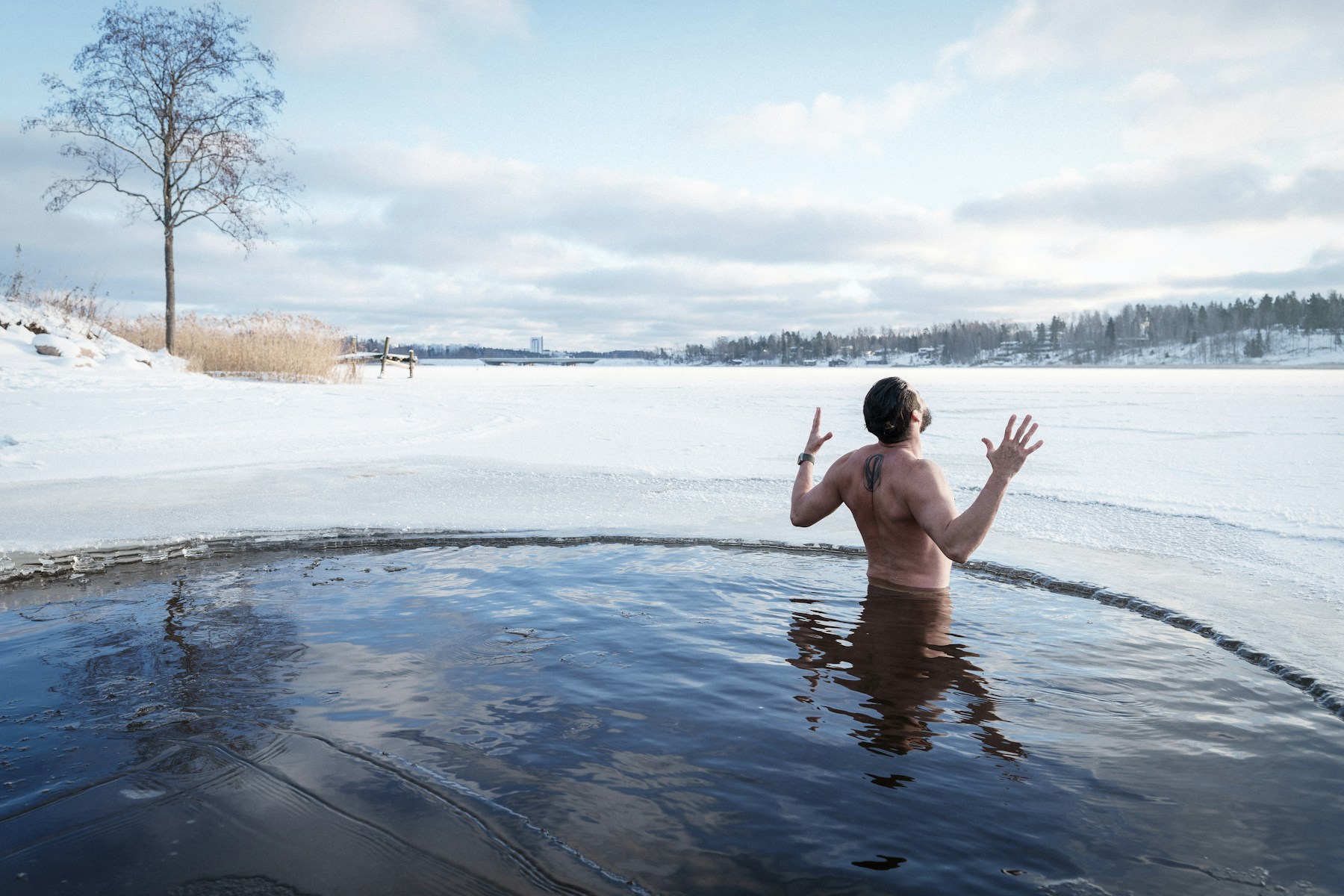
- The best review (11 studies, 3,177 healthy adults) found lower stress 12 hours after cold immersion, a brief rise in inflammation, and no clear effect on immunity
- Cold showers: in a trial of 3,018 adults, a 30 to 90 second cold finish was linked to 29% less self-reported sick leave, but not fewer days ill
- If you lift to build muscle, don't plunge straight afterwards: it reduced strength gains in a meta-analysis of 8 studies
- The famous +250% dopamine came from an hour in 14 °C water, measured in the blood, not the brain
- Cold water stresses the heart. With heart disease, high blood pressure or Raynaud's, talk to your doctor first. Never get into open cold water alone
If you listen to health podcasts, you've heard the pitch: a few minutes in ice water to lift your mood, flood your brain with dopamine, burn fat and toughen your immune system.
Some of this rests on real research; much of it stretches small studies a long way. Here's what the trials found, what they didn't, and how to try it more safely. It isn't medical advice: if you have a heart condition or take blood pressure medication, talk to your doctor first.
What Counts as a Cold Plunge
"Cold plunge", "ice bath" and "cold-water immersion" are used more or less interchangeably: sitting or standing in cold water, usually up to the chest or neck. Cold showers and winter swimming are close cousins.
There's no standard dose. The 2025 review described below included studies with water from 7 °C to 15 °C (about 45 °F to 59 °F), and exposures ranging from 30 seconds to 2 hours (Cain, PLOS ONE 2025). The Royal National Lifeboat Institution (RNLI), the UK's sea-rescue charity, defines anything below 15 °C as cold water (RNLI). So "cold water did X" could mean a 30-second shower or an hour in a tank.
What the Best Review Found
Evidence: Limited — few, small, mostly male studiesIn January 2025, University of South Australia researchers published a systematic review and meta-analysis on cold-water immersion in healthy adults (Cain, PLOS ONE 2025). It included 11 studies with 3,177 participants. Ten used baths and one, which supplied most of the participants, used cold showers. The findings:
- Stress: lower 12 hours after cold immersion (standardised mean difference −1.00). There was no significant change immediately, at 1 hour, at 24 hours or at 48 hours.
- Inflammation: higher immediately after immersion and at 1 hour. Co-author Ben Singh described this as "the body's reaction to the cold as a stressor" (University of South Australia, via Newswise). A short spike, not an anti-inflammatory effect.
- Immunity: no significant changes immediately or at 1 hour. The authors graded this evidence D, meaning inconsistent or inconclusive.
- Sleep: one study in men found better sleep-quality scores than with passive recovery, but it followed heat training, and the authors said the effect "may have been confounded" by that context.
- Quality of life: slightly higher mental-health scores at 30 days in the cold-shower trial, gone by 90 days.
The authors' own summary is that the evidence is "constrained by few RCTs, small sample sizes, and a lack of diversity in study populations." Apart from the shower trial, every study was 100% male. That doesn't make cold plunges useless, but it's a long way from the confident claims online.
The Cold Shower Trial and the Sick Days
Evidence: Moderate — large trial, self-reported, unblinded by natureThe largest study in that review is a Dutch randomised trial from 2016 (Buijze, PLOS ONE 2016). It enrolled 3,018 working adults aged 18 to 65 without serious health conditions who didn't already take cold showers. They were randomly assigned to end their warm shower with 30, 60 or 90 seconds at the coldest available temperature, or to carry on as normal, for 30 days, then could continue at their own discretion for 60 more.
- Sickness absence from work fell 29% in the cold-shower groups combined (incidence rate ratio 0.71).
- Days of illness did not change. "For illness days there was no significant group effect." Days of illness didn't differ significantly between groups; days off work did.
- Longer wasn't better. The authors found no significant difference between the 30, 60 and 90 second groups.
- Exercise mattered too. Regular physical activity was linked to a 35% reduction in sickness absence.
- Quality of life improved slightly early on, but the authors judged the change "too small to be clinically relevant". The benefit people mentioned most was more perceived energy.
- People liked it: 64% kept it up afterwards, with no related serious adverse events.
The caveats: outcomes were self-reported, you can't hide from someone that their shower is cold, and the authors said "a placebo-effect of this intervention cannot be ruled out." About one in five participants (19.6%) were lost to follow-up by 90 days.
Fewer sick days off, not fewer days ill
Buijze et al., PLOS ONE 2016; 3,018 adults aged 18–65. Bars show the reduction in self-reported sickness absence. The 30, 60 and 90 second groups did not differ significantly. A placebo effect cannot be ruled out.
Why Lifters Should Mind the Timing
Evidence: Moderate — trials and meta-analyses point the same wayIce baths are often sold as post-workout recovery. For building muscle, the research points the other way.
In a study in The Journal of Physiology in 2015, 21 physically active men did strength training twice a week for 12 weeks, followed each time by either 10 minutes of cold-water immersion or active recovery (Roberts, J Physiol 2015). Strength and muscle mass increased more in the active-recovery group. The area of their type II (fast-twitch) muscle fibres grew by 17%; in the cold group, it didn't increase. A second experiment in 9 men found cold blunted early muscle-building signals, including satellite cells (muscle stem cells) and a key growth enzyme. The authors suggested rethinking cold immersion as a regular post-workout habit.
Two meta-analyses back this up:
- A 2021 review in Sports Medicine pooled 8 studies and found "a harmful effect" of regular cold immersion on gains in maximal strength and strength endurance (standardised mean difference −0.60) and explosive power (−0.61), but no effect on endurance performance (Malta, Sports Med 2021).
- A 2024 meta-analysis of 8 studies on muscle size found "some evidence" of more growth without cold, though the result was uncertain and could not rule out no effect; the authors concluded that cold immersion right after lifting "may attenuate hypertrophic changes" (Piñero, Eur J Sport Sci 2024).
These studies tested cold after each session. We couldn't find good trials on how long a gap is enough, so if muscle is your priority, keep plunges well away from lifting or on rest days. Our guide to building muscle after 40 covers what actually drives gains.
The Dopamine Number and Where It Came From
Evidence: Real but narrow — one study, an hour-long exposureA figure often repeated in cold-plunge marketing is a 250% rise in dopamine. It comes from a study published in the European Journal of Applied Physiology in 2000 (Šrámek, Eur J Appl Physiol 2000). A group of young men sat in water up to the neck for one hour, in water at 32 °C, 20 °C and 14 °C.
At 14 °C, metabolic rate rose 350%. Plasma noradrenaline (norepinephrine) rose 530% and plasma dopamine 250%. Heart rate rose 5% and systolic and diastolic blood pressure rose 7% and 8%. Adrenaline was unchanged, and cortisol "tended to decrease".
One hour in 14 °C water: what changed
Šrámek P, et al. European Journal of Applied Physiology 2000;81(5):436–442. Young men, one hour immersed to the neck at 14 °C. Bars to scale; hormones measured in blood plasma. Cortisol tended to decrease.
What about mood?
There's some early support for a mood lift. In a 2023 study in Biology, 33 healthy adults aged 20 to 45 (16 of them women), all new to cold-water swimming, were immersed up to the collarbone in water at about 20 °C for 5 minutes (Yankouskaya, Biology 2023). On a standard mood questionnaire, positive feelings rose 7 points and negative feelings fell 4.66. But there was no control group and no randomisation, and the authors said "a replication study is necessary to confirm our results."
Brown Fat and the "11 Minutes" Rule
Evidence: Preliminary — 15 or 16 men, one point in timeBrown fat is a type of fat that burns energy to make heat. A Danish study in Cell Reports Medicine in 2021 compared young male winter swimmers, who combined cold dips with sauna sessions two to three times a week, with 8 controls who didn't (Søberg, Cell Rep Med 2021). Eight swimmers were recruited; the analyses report seven. When cooled, the swimmers showed greater increases in cold-induced heat production. At a comfortable temperature, they had a lower core temperature and no measurable brown fat activity, while most controls showed some.
The widely quoted "11 minutes of cold a week" isn't a recommendation. It's the swimmers' reported habit in the participant table, alongside 57 minutes of sauna a week (full text, PMC). Nobody was assigned to 11 minutes and followed over time.
The authors list the limits: a snapshot can't show winter swimming caused the differences; the controls had more body fat and higher blood glucose after a glucose drink; diet and activity weren't measured; and "the low sample size provides a risk for type 1 and type 2 errors." It doesn't show cold plunges help you lose weight. For the sauna half of that routine, our sauna and longevity guide covers the much larger Finnish data.
What cold water is linked to, and what it isn't
| Claim | Best evidence | Result | Verdict |
|---|---|---|---|
| Lowers stress | 2025 meta-analysis, 11 studies | Lower 12 h after immersion; no change at other times | Some support short-term only |
| Fewer sick days | RCT, 3,018 adults, cold showers | 29% less sickness absence; no change in days ill | Partly self-reported; placebo possible |
| Boosts immunity | 2025 meta-analysis | No significant change in immune markers | Not supported evidence graded D |
| Reduces inflammation | 2025 meta-analysis | Inflammation rose immediately and at 1 h | Not supported short-term rise |
| Better mood | 33 adults, 5 min at about 20 °C | More positive, less negative feeling straight after | Preliminary no control group |
| Better sleep | 1 study in men after heat training | Better sleep-quality scores than passive recovery | Weak confounded |
| "Dopamine +250%" | Young men, 1 h at 14 °C | Blood dopamine +250%, noradrenaline +530% | Real but narrow blood, not brain; 1 hour |
| Burns fat via brown fat | 7–8 winter swimmers vs 8 controls | More cold-induced heat production; no weight-loss data | Preliminary cross-sectional |
| Faster gains after lifting | 12-week RCT; 2 meta-analyses of 8 studies each | Smaller strength gains; possibly less muscle growth | Opposite avoid straight after lifting |
Cain, PLOS ONE 2025; Buijze, PLOS ONE 2016; Yankouskaya, Biology 2023; Šrámek, Eur J Appl Physiol 2000; Søberg, Cell Rep Med 2021; Roberts, J Physiol 2015; Malta, Sports Med 2021; Piñero, Eur J Sport Sci 2024.
The Risks Are Not Hypothetical
The RNLI describes cold water shock: sudden skin cooling causes an involuntary gasp, breathing can change uncontrollably (sometimes increasing as much as tenfold), heart rate rises, the heart has to work harder and blood pressure goes up. "Cold water shock can therefore cause heart attacks, even in the relatively young and healthy," it warns, and it can be the precursor to drowning. The initial effects pass in less than a minute (RNLI).
Heart rhythm is a second concern. In a review in The Journal of Physiology, Shattock and Tipton note that "cold water submersion can induce a high incidence of cardiac arrhythmias in healthy volunteers." They propose that on submersion, the cold shock response (speeding the heart) and the diving response (slowing it) can fire together, and that this "autonomic conflict" may explain some deaths in vulnerable people (Shattock and Tipton, J Physiol 2012).
- Talk to your doctor first if you have heart disease, high blood pressure or a heart rhythm problem. The RNLI advises speaking to your GP before a first open-water swim, especially if you have heart or other underlying health conditions (RNLI, 2025).
- Raynaud's: ask your doctor first. The NHS lists cold as a trigger and advises people with the condition to "try to avoid sudden changes in temperature" (NHS).
- Never go into open cold water alone. The RNLI advises: "Avoid swimming alone, consider going with others," and to tell someone when you expect to be back.
- Don't jump in. The RNLI warns that jumping straight in "can lead to cold water shock." Ease in and let your breathing settle.
- Keep your head above water. The arrhythmia concern above centres on full submersion.
A Sensible Way to Try It
If you're healthy and your doctor has no concerns, here's what the studies used, as a reference point rather than a prescription:
- The gentlest tested option: finish your usual warm shower with 30 to 90 seconds of cold. That's the protocol from the 3,018-person trial, and 90 seconds did no better than 30.
- A short immersion: the mood study used 5 minutes at about 20 °C (68 °F), which is cool rather than icy. The review's studies used 7 °C to 15 °C.
- Mind your training: if muscle is the goal, don't plunge straight after lifting.
- Judge it on how you feel. The best-supported effects (lower stress hours later, more perceived energy) are subjective. If you don't feel better, you're not missing a proven longevity benefit.
- Don't drop the basics for it. In the shower trial, regular exercise was linked to a slightly larger drop in sickness absence (35%) than cold showers were (29%).
Frequently Asked Questions
A bracing habit, not a miracle.
Cold water does real things to the body, and some studies link it to lower stress hours later and fewer sick days. But the trials are small and short, and the claims about dopamine, fat loss and immunity run well ahead of them.
If you enjoy it, it's a reasonable experiment. Keep it away from lifting, never go into open water alone, and with heart disease, high blood pressure or Raynaud's, talk to your doctor first.
Sources
- Cain T, Brinsley J, Bennett H, Nelson M, Maher C, Singh B. Effects of cold-water immersion on health and wellbeing: a systematic review and meta-analysis. PLOS ONE 2025;20(1):e0317615, published 29 January 2025 (doi:10.1371/journal.pone.0317615).
- University of South Australia. The big chill: is cold water immersion good for our health? Via Newswise, 31 January 2025.
- Buijze GA, Sierevelt IN, van der Heijden BCJM, Dijkgraaf MG, Frings-Dresen MHW. The effect of cold showering on health and work: a randomized controlled trial. PLOS ONE 2016;11(9):e0161749 (doi:10.1371/journal.pone.0161749). Correction (2018) adds the data underlying Table 2.
- Roberts LA, Raastad T, Markworth JF, et al. Post-exercise cold water immersion attenuates acute anabolic signalling and long-term adaptations in muscle to strength training. The Journal of Physiology 2015;593(18):4285–4301 (doi:10.1113/JP270570).
- Malta ES, Dutra YM, Broatch J, Bishop D, Zagatto AM. The effects of regular cold-water immersion use on training-induced changes in strength and endurance performance: a systematic review with meta-analysis. Sports Medicine 2021;51(1):161–174 (doi:10.1007/s40279-020-01362-0).
- Piñero A, Burke R, Augustin F, et al. Throwing cold water on muscle growth: a systematic review with meta-analysis of the effects of postexercise cold water immersion on resistance training-induced hypertrophy. European Journal of Sport Science 2024;24(2):177–189 (doi:10.1002/ejsc.12074).
- Šrámek P, Šimečková M, Janský L, et al. Human physiological responses to immersion into water of different temperatures. European Journal of Applied Physiology 2000;81(5):436–442.
- Yankouskaya A, Williamson R, Stacey C, Totman JJ, Massey H. Short-term head-out whole-body cold-water immersion facilitates positive affect and increases interaction between large-scale brain networks. Biology 2023;12(2):211 (doi:10.3390/biology12020211).
- Søberg S, Löfgren J, Philipsen FE, et al. Altered brown fat thermoregulation and enhanced cold-induced thermogenesis in young, healthy, winter-swimming men. Cell Reports Medicine 2021;2(10):100408 (doi:10.1016/j.xcrm.2021.100408). Also the University of Copenhagen news release, October 2021.
- Royal National Lifeboat Institution. Cold water shock.
- Royal National Lifeboat Institution. RNLI offers essential safety advice for cold water dippers this festive period. 15 December 2025.
- Shattock M, Tipton M. 'Autonomic conflict': a different way to die during cold water immersion? The Journal of Physiology 2012;590(14):3219–3230 (doi:10.1113/jphysiol.2012.229864).
- NHS. Raynaud's.