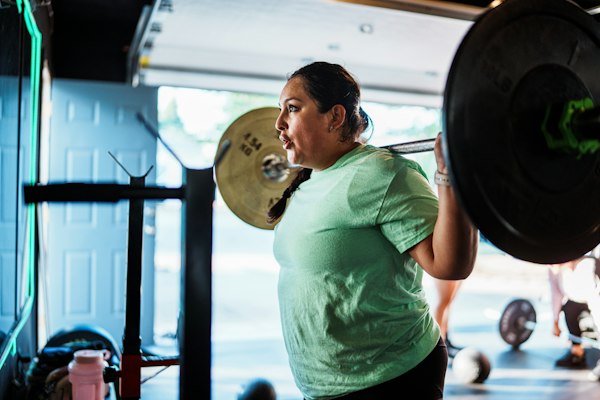
- The muscle case is real and smaller than the internet says. A 2017 meta-analysis of 22 trials found +1.37 kg of lean tissue versus training alone. A stricter 2026 analysis found a reliable strength gain but no significant effect on muscle mass or physical function
- The brain case is actively contested — in the journals, not just online. The main 2026 review of creatine and cognition in older adults drew a published letter challenging its methods, and a 2025 Journal of Nutrition essay argued the marketing has outrun the evidence
- The sleep-deprivation finding is real but oddly dosed. The study everyone cites used a single 0.35 g/kg dose — about 25 g — not the 5 g scoop you're taking
- Bone may be the underrated benefit. In postmenopausal women doing resistance training for a year, creatine slowed femoral neck bone loss to −1.2% versus −3.9% on placebo
- Nothing shows creatine extends human lifespan. It protects the things that track with healthspan — muscle, strength, maybe bone. That's worth having. It isn't a longevity drug
- The hair loss myth is now directly disproven. A 2025 RCT measured hair density and follicle counts in 45 men over 12 weeks and found nothing
- It does close to nothing on its own. Almost every positive finding here comes from creatine plus resistance training. The powder is the smaller half of that sentence
Creatine spent thirty years as the unglamorous powder at the back of the gym bag — well studied, cheap, and boring. In about two years it has been rebranded as a brain supplement, a menopause intervention, and an anti-aging compound. Sales spiked. So did the claims.
Some of that is deserved. Creatine is one of a very small number of supplements with genuinely good evidence behind it, and unlike most of the shelf it doesn't need a marketing department to look respectable. But the gap between what the muscle research supports and what the brain research supports is much wider than the current enthusiasm suggests — and researchers have started saying so in print.
Here is the claim-by-claim version, with the sample sizes attached.
What creatine actually is
Creatine is a compound your body already makes — roughly a gram a day, in the liver and kidneys — and that you eat in meat and fish, at maybe one to two grams a day on a typical omnivorous diet. Around 95% of it sits in skeletal muscle as phosphocreatine, where it functions as a rapid-recharge battery: it donates a phosphate group to regenerate ATP during the first several seconds of hard effort, before other energy systems catch up.
Supplementing raises muscle stores by roughly 20–40%, depending on where you started. That "depending on where you started" is the most useful sentence in this article. People with low baseline stores — vegetarians and vegans above all, since dietary creatine comes almost entirely from animal foods — tend to show the largest responses. People already eating a lot of meat have less room to move, which is part of why individual results vary so much and why some trials find effects that others miss.
Muscle: the strong case, honestly sized
This is where creatine earned its reputation, and it deserves it. But two meta-analyses of the same question reached noticeably different conclusions, and the more recent one is the more careful.
The 2017 analysis pooled 22 randomised trials covering 721 participants aged 57 to 70, training two to three days a week for anywhere from 7 to 52 weeks. Creatine plus resistance training produced 1.37 kg more lean tissue mass (95% CI 0.97–1.76) than training with placebo, along with greater gains in chest press and leg press strength.
The 2026 analysis looked at 11 randomised trials in adults 60 and over, used a three-level model that accounts for multiple outcomes drawn from the same study, and graded the certainty of each result using GRADE. It found:
| Outcome | Effect | Certainty |
|---|---|---|
| Muscle strength | g = 0.31 (95% CI 0.18 to 0.45) — small but statistically reliable | Moderate |
| Muscle mass | g = 0.35 (95% CI −0.09 to 0.78) — not statistically significant | Low |
| Physical function | g = 0.47 (95% CI −0.08 to 1.03), p = 0.086 — not statistically significant | Very low |
Compared with resistance training alone. A confidence interval that crosses zero means the trials, taken together, cannot rule out no effect — it does not mean the effect is absent, only that the evidence isn't strong enough to claim it.
Read those two together rather than picking the one you like. Creatine's strength benefit on top of training is consistent and modest. Its effect on actual muscle mass is probably real but not nailed down. Its effect on how well an older person walks, rises from a chair and climbs stairs — the thing that matters most — has not been demonstrated to statistical significance yet.
And every one of these findings is creatine plus resistance training. If you are taking creatine and not lifting, you are taking the smaller half of the intervention and skipping the larger one. Our strength training guides are the other half of this page.
Bone: the finding nobody talks about
A 12-month randomised trial put postmenopausal women on supervised resistance training three days a week with either creatine at 0.1 g/kg/day or placebo. Forty-seven were randomised; 33 completed and were analysed — a small study, and worth holding loosely.
The creatine group lost femoral neck bone density at −1.2% over the year, against −3.9% in the placebo group, and showed an increase in femoral shaft periosteal width, a structural measure that predicts bone bending strength. Hip fracture is one of the genuinely life-altering events of later life, and the femoral neck is where it happens.
One trial is not a body of evidence, and this needs replication before anyone treats it as established. But it's a more interesting result than most of what creatine is currently being marketed for, and it is a reason the case for creatine is arguably stronger in postmenopausal women than in the young men it was originally studied in — a thread we pick up in creatine for women.
Every creatine claim, scored
Each bar is how strong the evidence is for that specific claim — not how good creatine is. Tap any row for the actual study, the number of people in it, and the size of the effect. Two of these are claims made against creatine, where a short bar is the good news.
The most consistent finding in the literature. A 2026 three-level meta-analysis of 11 randomised trials in adults 60+ found g = 0.31 (95% CI 0.18 to 0.45) versus resistance training alone, graded moderate certainty. A 2017 meta-analysis of 22 trials in 721 older adults found gains in both chest press and leg press strength. The effect is small per unit of effort but it replicates.
Front Nutr 2026 · PMID 42712402 | Open Access J Sports Med 2017 · PMID 29138605Two analyses, two answers. The 2017 pooling of 22 trials found +1.37 kg lean tissue (95% CI 0.97–1.76) over training alone. The stricter 2026 analysis found g = 0.35 but a confidence interval crossing zero (−0.09 to 0.78), graded low certainty — meaning the newer evidence cannot rule out no effect.
Worth knowing: some of the early weight gain on creatine is intracellular water, not contractile tissue. That isn't fake — hydrated muscle cells are doing something — but it inflates short-term scale readings.
PMID 29138605 | PMID 42712402The outcome that matters most, and the weakest result. The 2026 meta-analysis found g = 0.47 (95% CI −0.08 to 1.03), p = 0.086 — not statistically significant — and graded the certainty very low. The direction is encouraging and the evidence is not there yet.
Front Nutr 2026 · PMID 42712402A 12-month randomised trial of resistance training plus creatine at 0.1 g/kg/day. Femoral neck bone density fell 1.2% on creatine versus 3.9% on placebo, with an increase in femoral shaft periosteal width. Forty-seven women randomised, 33 analysed — a small trial that needs replication before this becomes a recommendation.
Med Sci Sports Exerc 2015 · PMID 25386713The most mechanistically convincing brain finding. Subjects under 21 hours of sleep deprivation received a single dose of 0.35 g/kg — roughly 25 g for a 70 kg person — and showed improved cognitive performance and processing speed alongside measured changes in brain phosphocreatine, ATP and pH on MRS. A 2026 randomised trial reproduced the cognitive part of the effect.
The catch nobody mentions: that is five scoops in one sitting, studied acutely. It is not evidence that your daily 5 g does this, and the high dose has not been tested for routine long-term use.
Sci Rep 2024 · PMID 38418482 | Nutrients 2026 · PMID 42075005This is the claim driving the current boom, and it is the one under active dispute in the journals. A 2026 systematic review of creatine and cognition in older adults found 6 studies covering 1,542 people — but only two were supplementation trials; the other four estimated creatine intake from dietary recall. Of the six, one was rated "good" methodological quality, two "fair", and three lower. Five reported a positive relationship.
It then drew a formal published objection titled Concerns Regarding the Methodological Rigor and Interpretation, plus an authors' response. Separately, a 2023 memory meta-analysis attracted a letter alleging double-counting produced false-positive findings, and a 2024 cognitive meta-analysis required a published corrigendum.
In 2025 the Journal of Nutrition ran an essay explicitly about "the growing disconnect between marketing narratives and scientific rigor" here — noting that sales, prescriptions and social media engagement have surged around evidence that has "remained considerably limited."
Nutr Rev 2026 · PMID 40971619 | objection PMID 41405942 | J Nutr 2025 PMID 40744234An 8-week double-blind trial randomised 52 women with major depressive disorder to escitalopram plus either 5 g/day creatine or placebo. The creatine group showed significantly greater improvement on the Hamilton Depression Rating Scale from week 2, sustained at weeks 4 and 8, with no difference in adverse events.
Read the design carefully: this is creatine added to an antidepressant in a small single-sex sample, not creatine as a treatment for depression. It is a real and interesting signal that has not been scaled up.
Am J Psychiatry 2012 · PMID 22864465There is no human trial showing creatine extends lifespan, and there is unlikely to be one in your lifetime — it would take decades and nobody holds a patent worth funding it.
What creatine plausibly does is defend muscle, strength and possibly bone, and those track closely with how independently people live in their eighties. That's a healthspan argument, and it's a decent one. It is not the same claim, and the two get blurred constantly in marketing.
The entire myth rests on one 2009 study of college rugby players that found a shift in the DHT-to-testosterone ratio. It never looked at hair.
In 2025 someone finally ran the direct test: 45 resistance-trained men, 12 weeks, 5 g/day creatine or placebo, with hormones measured alongside hair density, follicular unit counts and cumulative hair thickness via Trichogram and FotoFinder imaging. Thirty-eight completed. No significant group-by-time differences in any hormone or any hair outcome.
JISSN 2025 · PMID 40265319 | the 2009 origin · PMID 19741313Creatine supplementation raises serum creatinine — a breakdown product used to estimate kidney function — without impairing the kidney itself. That lab artifact is the origin of the scare, and it can genuinely confuse a routine blood panel, so tell your doctor you take it.
The International Society of Sports Nutrition position stand concluded that supplementation up to 30 g/day for five years is safe and well tolerated in healthy people and across patient populations from infants to the elderly. Two follow-up reviews address the remaining myths individually.
The exception worth stating: if you have existing kidney disease, this is a question for your nephrologist, not an article.
ISSN position stand 2017 · PMID 28615996 | misconceptions I and IIThe brain story, and why it's being oversold
It is worth spelling out what happened here, because it's a useful case study in how a health claim inflates.
The underlying biology is genuinely plausible. Your brain uses a lot of energy, it runs the same phosphocreatine system your muscles do, and brain creatine levels drop under metabolic stress. If you accept that, "creatine might help the brain under stress" is a reasonable hypothesis rather than a marketing invention.
Then the evidence arrived, and it was thin. The 2024 sleep-deprivation study is the strongest piece and it used a single 25-gram dose in an acute setting. The systematic review that gets cited as proof of cognitive benefit in older adults contained six studies, four of which were dietary questionnaires, and three of the six were rated below "fair" on methodological quality. A memory meta-analysis drew a letter alleging its statistics double-counted participants. A cognition meta-analysis needed a corrigendum. The aging review drew a formal objection.
None of that means creatine does nothing for the brain. It means the evidence currently cannot carry the weight being put on it — which is precisely the argument the Journal of Nutrition published in 2025, calling out the gap between the sales figures and the science.
The pattern across studies is that creatine looks most useful when the system is depleted or stressed — sleep deprivation, vegetarian diets with low baseline stores, and possibly depression, where the mechanism is explicitly bioenergetic. It looks least useful in well-rested, well-fed people with full stores who are hoping for sharper thinking.
If you eat little or no meat, that's the strongest personal case for expecting a cognitive response. If you eat steak four times a week and sleep eight hours, expect the muscle benefits and treat anything else as a bonus that may not arrive.
How to actually take it
| Question | Answer | Why |
|---|---|---|
| Which form | Creatine monohydrate | It is the form in essentially every study cited on this page. HCl, buffered and "advanced" forms cost more and have not beaten it |
| How much | 3–5 g/day | Saturates muscle stores in about three to four weeks. Larger bodies sit at the top of that range |
| Loading? | Optional | About 20 g/day for 5–7 days gets you there faster and raises the chance of stomach upset. Same destination either way |
| Timing | Doesn't much matter | Saturation is what matters, not the hour. Take it when you'll remember — consistency is the whole game |
| With food? | Helpful, not required | Carbohydrate and protein modestly improve uptake. Also reduces nausea for people who get it |
| Cycling off | No reason to | Nothing downregulates. Stores simply drain over about a month if you stop |
| Rest days | Take it anyway | You're maintaining a pool, not fuelling a session |
If you want specific products, our creatine buying guide covers what to look for — but the short version is that monohydrate is monohydrate, and third-party testing matters more than branding.
- Anyone with kidney disease or reduced kidney function — the safety data is in healthy people, and this is a nephrologist's question
- Anyone about to have bloodwork. Creatine raises serum creatinine without harming the kidney, which can make an eGFR look worse than it is. Tell whoever orders the test
- Pregnancy and breastfeeding — under study, not established
- Teenagers — the ISSN reviews address this specifically, but it's a conversation to have with a paediatrician rather than a comment section
A good supplement, currently being sold as a great one.
Creatine is among the very few supplements worth the shelf space. It's cheap, it's one of the most-studied compounds in sports nutrition, the safety record runs to five years at six times the standard dose, and the myths that dogged it for twenty years have now been directly tested and dismissed.
What it does best is make resistance training work slightly better — reliably, modestly, and only if you're actually training. The bone finding in postmenopausal women may turn out to be the most valuable thing on this page, and it rests on one small trial that badly needs a second. The brain claims driving the current boom are running well ahead of the evidence, and the people saying so are publishing it in Nutrition Reviews and the Journal of Nutrition, not on social media.
Take it. Three to five grams, every day, alongside the training that does the heavy lifting. Just don't expect it to think for you.
References
Every figure above traces to one of these. Links go to the published record.
| Muscle, older adults (2026) | Three-level meta-analysis, 11 RCTs in adults 60+, Front Nutr. PMID 42712402 |
| Muscle, older adults (2017) | Chilibeck et al., 22 RCTs, 721 participants, Open Access J Sports Med. PMID 29138605 |
| Upper-limb strength | Systematic review and meta-analysis, Sports Med 2017. PMID 27328852 |
| Bone, postmenopausal women | 12-month RCT, 47 randomised / 33 analysed, Med Sci Sports Exerc 2015. PMID 25386713 |
| Sleep deprivation | Single 0.35 g/kg dose with 31P-MRS, Sci Rep 2024. PMID 38418482 · replication, Nutrients 2026 PMID 42075005 |
| Cognition in aging | Systematic review, 6 studies / 1,542 participants, Nutr Rev 2026. PMID 40971619 |
| — the published objection | Concerns regarding methodological rigor, Nutr Rev 2026. PMID 41405942 · authors' response PMID 41405448 |
| — the critical perspective | Promise, Proof, and Public Perception, J Nutr 2025. PMID 40744234 |
| Cognition meta-analyses | Front Nutr 2024 PMID 39070254 (corrigendum 40034739) · memory, Nutr Rev 2023 PMID 35984306 (letter re double-counting 36644917) |
| Depression augmentation | 52 women with MDD, 8-week RCT, Am J Psychiatry 2012. PMID 22864465 · brain metabolic outcomes PMID 26822799 |
| Safety | ISSN position stand, JISSN 2017. PMID 28615996 |
| Myths, addressed | Common questions and misconceptions, JISSN Part I 2021 and Part II 2025 |
| Hair loss | 12-week RCT, 45 men, direct hair measurement, JISSN 2025. PMID 40265319 · the 2009 DHT study PMID 19741313 |
- This article is educational and is not medical advice. It was written by a layperson who reads the primary literature carefully, not by a physician or dietitian, and it has not been clinically reviewed
- Supplements interact with medications and with existing conditions. Kidney disease in particular changes the calculation here — ask your doctor, not an article
- Tell whoever orders your bloodwork that you take creatine. It raises serum creatinine without harming the kidney, and an unexplained result can lead to unnecessary follow-up