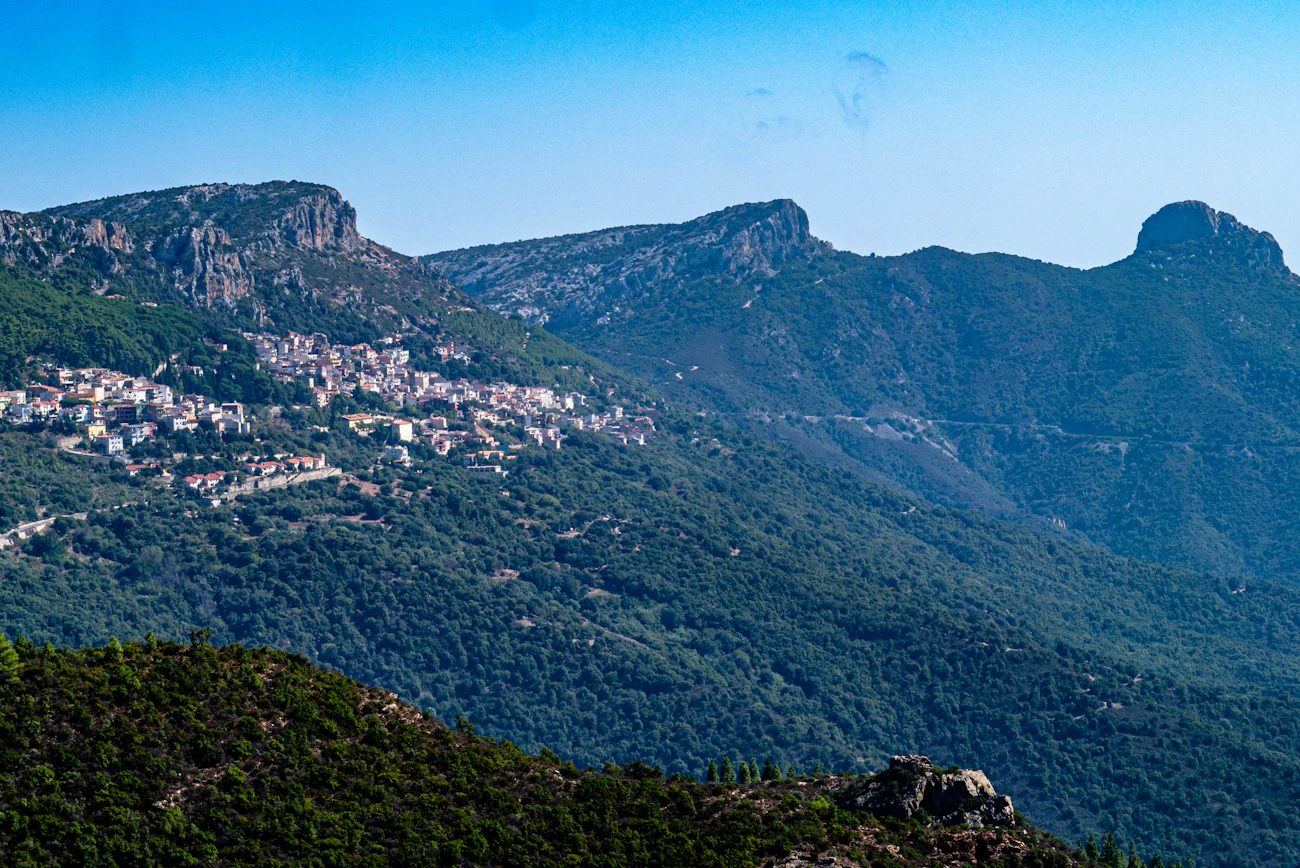
- Sardinia's mountain villages are the original Blue Zone — the term was coined from the blue ink demographers used to circle them on a map
- It is the only documented place where men reach 100 at roughly the same rate as women; elsewhere female centenarians outnumber males around 4–5 to 1
- Most male centenarians were shepherds or farmers — a lifetime of 5+ miles of daily hill walking, never a gym
- The diet is roughly 80% plants: sourdough bread, a daily bean-and-vegetable minestrone, fava beans, pecorino from grass-fed sheep — meat mostly on Sundays
- Cannonau wine is drunk in small amounts, with food and company — the context appears to matter as much as the polyphenols
- Elders live with their families, not in institutions — purpose and daily usefulness are treated by researchers as genuine longevity factors
In the early 2000s, a Belgian demographer named Michel Poulain went to Sardinia to disprove a rumour. An Italian physician, Gianni Pes, had reported a cluster of villages in the island's mountainous interior where men seemed to be living past 100 at rates that made no statistical sense. Extreme-age claims usually dissolve under scrutiny — missing birth records, confused identities, wishful memories. Poulain expected this one to dissolve too.
Instead, the records held. Birth certificates, parish registers, military rolls — the men were exactly as old as they said they were. As Poulain and Pes validated village after village, they circled each confirmed hotspot on their map in blue ink. The circled region became "the blue zone." The name outgrew the map: their 2004 paper in Experimental Gerontology became the template for identifying every longevity region found since — Ikaria, Okinawa, Nicoya, Loma Linda. Sardinia was first.
And Sardinia remains, in one respect, unique. In every other long-lived population on earth, extreme old age belongs overwhelmingly to women — roughly four to five female centenarians for every male. In the villages of the Ogliastra and Barbagia, the ratio approaches one to one. Something in these mountains lets men do what men almost nowhere else can do: grow very, very old.
The Shepherd's Secret
Ask what the long-lived men of the Ogliastra did for a living and the answer is strikingly uniform: they kept sheep. The village of Villagrande Strisaili, which has one of the highest male longevity indexes ever recorded, was a village of shepherds. So was Talana. So was Arzana. Tiny Seulo, in the Barbagia di Seulo, produced twenty centenarians in the twenty years between 1996 and 2016 — from a population of fewer than a thousand.
Shepherding in these mountains was not a job so much as a way of moving through the world. A shepherd walked his flock out in the morning and back at dusk — commonly five miles or more a day, every day, over steep, uneven ground, for sixty or seventy years. No single walk was strenuous. None of it was optional. It is almost a controlled experiment in what exercise scientists now recommend and almost no one achieves: constant, low-intensity, lifelong movement with regular gentle inclines.
The pattern matters more than the intensity. These men never "worked out," never elevated their heart rates to exhaustion, never sat for ten hours and tried to compensate with forty minutes of punishment. The movement was woven into the day so completely that removing it would have required effort. If you want the transferable lesson, it is not "walk five miles" — it is arrange your life so that movement is the default rather than the exception.
What's Actually On the Table
The traditional diet of the Sardinian highlands is easy to romanticise and easier to misread. It is not "Mediterranean" in the beach-resort sense — the Blue Zone villages are in the mountains, historically poor, and their food is peasant food: what could be grown, ground, milked or foraged within walking distance.
Analyses of the traditional diet by Pes and colleagues found it dominated by grains and legumes: sourdough breads made from durum wheat (the flat, crisp pane carasau and the sourdough moddizzosu), potatoes, fava beans and chickpeas, garden vegetables, and — nearly every single day — a slow-simmered vegetable and bean minestrone. Dairy came from animals that walked the same hills as their owners: sheep's-milk pecorino and goat's milk, both from grass-fed animals whose milk carries a meaningfully better fatty-acid profile than grain-fed equivalents. Meat, for most of the twentieth century, was a Sunday and festival food.
If that sounds familiar, it should — it is nearly the same template as Ikaria, fifteen hundred kilometres east: legumes at the centre, plants around them, dairy from grazing animals, meat at the margins. Two isolated populations, no contact, same answer. That convergence is one of the strongest arguments that the pattern itself, and not any single ingredient, is what does the work.
We have both of the everyday staples as full recipes: the Sardinian minestrone with fava beans that anchored the midday meal, and a fregula with chickpeas — the toasted-pasta-and-legume dish that shows how Sardinians made grain and bean into a complete protein without ever hearing the phrase.
The Wine Question
No part of the Sardinia story gets repeated more enthusiastically — or more selectively — than the wine. Cannonau, the local name for grenache, is a deeply pigmented red, and it is true that the traditional shepherds drank it almost daily.
But the details are doing the work. The traditional pattern is small glasses, with food, in company — usually spread across the day, never to intoxication, and never alone. Meanwhile the broader alcohol evidence has hardened considerably: the largest modern analyses find that health risk rises with dose from very low levels, and no serious researcher now recommends starting to drink for longevity. The honest reading of cannonau is this: if you already drink, the Sardinian pattern — small, slow, social, with meals — is plausibly the least harmful way to do it, and the companionship around the glass may be worth more than what's in it. If you don't drink, nothing in the Sardinian data argues you should begin.
"We spend so much effort looking for the ingredient — the wine, the cheese, the bread. The Sardinians would find that funny. Nothing they do is a health intervention. It's just Tuesday." — On the Blue Zone paradox
The Family Architecture
The least glamorous Sardinian longevity factor may be the most powerful. In the Blue Zone villages, old people are not relocated. There are no retirement communities. A ninety-year-old man lives where he always lived — in the family house, with children and grandchildren close, still tending a garden, still walking to the bar in the piazza for the afternoon argument about politics that has been running, with the same participants, for fifty years.
Researchers studying the region consistently emphasise this structure. Older Sardinians remain needed — for childcare, for know-how, for labour, for judgment — and being needed appears repeatedly across longevity research as one of the variables that separates populations that age well from populations that merely age. The inverse is also well documented: loneliness and social isolation carry mortality risks comparable to established clinical risk factors. Sardinia never built the infrastructure of separation in the first place.
There is also the famous Sardinian temperament — the dry, dark, teasing humour the island is known for. It is not a data point exactly. But researchers who spend time in the villages keep remarking on it: a culture that metabolises hardship through laughter rather than rumination is running a very old, very effective stress-management protocol.
The Sardinia Protocol: What Actually Transfers
You cannot move to the Ogliastra, and your commute is not a flock. But the Sardinian pattern decomposes into pieces that transfer surprisingly well.
Make walking non-optional
The shepherd's advantage was never intensity — it was inevitability. Attach walking to things you already must do: walk the school run, walk to the store, take the stairs by default, walk while you take calls. Hills and stairs count double; terrain resistance is part of what made the Sardinian version work.
Put a bean-based soup on weekly rotation
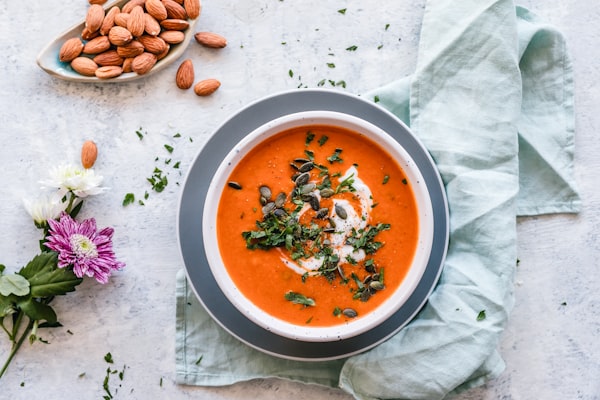
The daily minestrone is the single most concrete Sardinian food habit — and the easiest to copy. One big pot on Sunday covers three or four meals. Start with our Sardinian minestrone, and let legumes hit the table four or more times a week, the frequency seen across every Blue Zone.
Pair your grains with legumes
Bread-and-minestrone, fregula-and-chickpeas: the Sardinian kitchen combines grain and legume at nearly every meal, quietly forming complete protein from plants. Fregula with chickpeas is the one-pot version.
If you drink — drink the Sardinian way
Small, with food, in company, never alone, never to excess. And if you don't drink, don't start; the modern evidence gives no longevity reason to.
Keep older family close — and needed
Proximity is only half of it. The Sardinian structure gives elders daily roles: meals to cook, children to mind, skills to pass on. If you have ageing parents, the research suggests the most protective thing you can offer is not comfort but usefulness.
Defend a daily social ritual
The piazza argument, the afternoon coffee, the same faces at the same bar. A standing, low-effort, recurring social contact — not an event you must plan — is the mechanism. Protect one.
How Much Is Genetic?
Sardinia is an island, its mountain populations were isolated for centuries, and the founder effect on the Sardinian gene pool is real and well studied. So it is fair to ask whether any of this transfers at all — maybe the shepherds simply drew good cards.
The research suggests genes are a minor character. Large heritability studies put the genetic contribution to human lifespan low — likely under 10% once you correct for the fact that long-lived people tend to marry each other. And Sardinia's own history argues the same way: the longevity advantage concentrates in specific villages with specific lifestyles, not across the genetically similar island as a whole, and it is already fading in younger generations as diets and work have modernised — same genes, different habits, disappearing effect. The mountains weren't handing out better DNA. They were enforcing a better way of living.
Curious where your own habits put you? Our Longevity Calculator walks through eleven of the strongest evidence-backed factors — including the family-longevity signal — and shows you which levers move your number most.