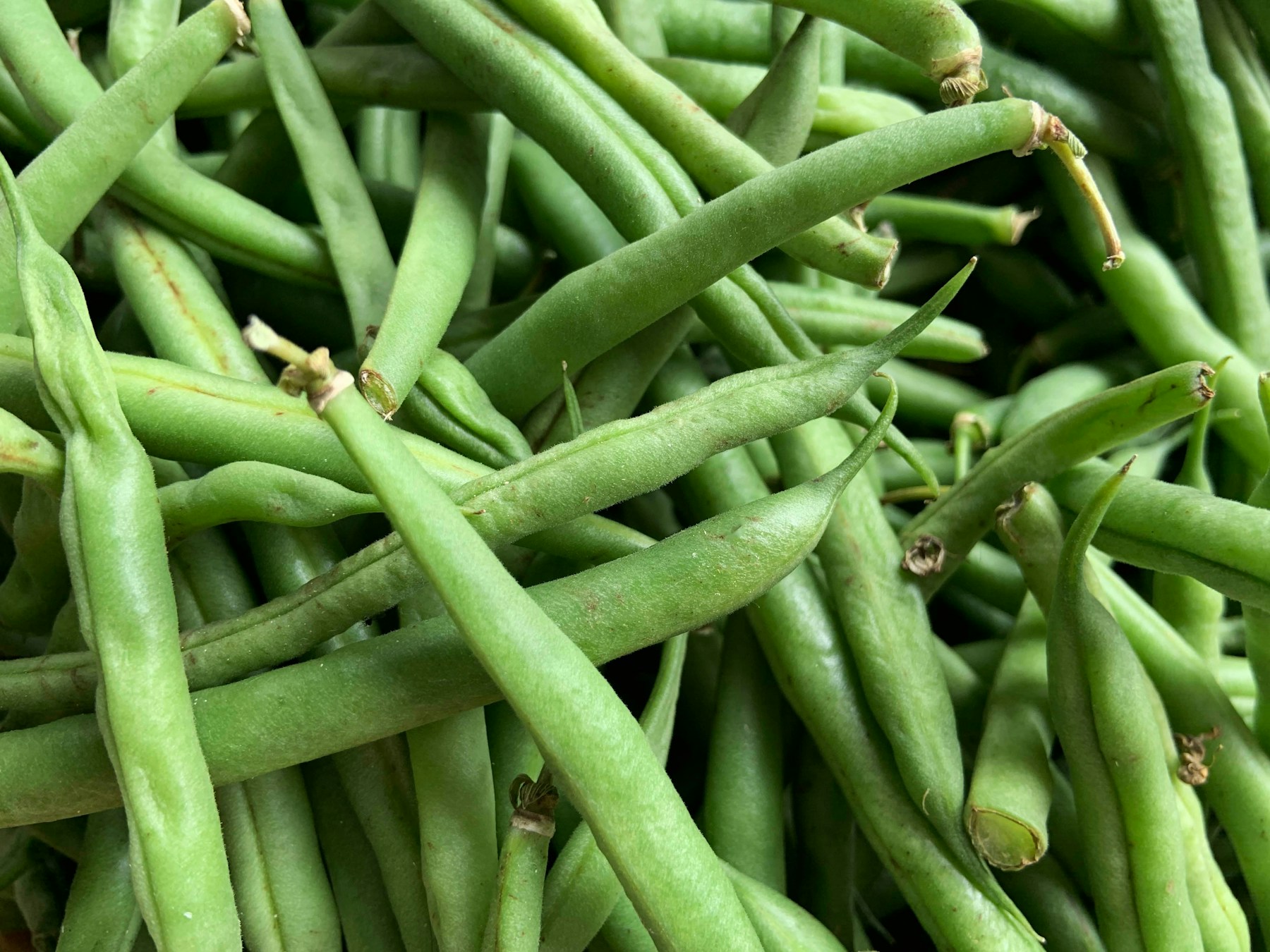
Fasolakia lathera means, more or less, "green beans in oil". It belongs to the family of Greek dishes called ladera: vegetables cooked slowly in olive oil and tomato until they are meltingly soft, then left to settle before anyone eats them. It is not a dish that belongs to Ikaria alone; it is cooked all over Greece. But it is a good example of the way of eating that researchers describe on the island: plenty of vegetables, with olive oil as the cooking fat.
Forget the bright, squeaky beans of a quick stir-fry. Here the beans go olive-green and silky, the potatoes soak up the tomato, and the oil turns the cooking liquid into a sauce you want bread for. Each serving holds close to 190 g of beans, nearly two cups by the USDA's measure, plus about 100 g of potato. Worked out from USDA FoodData Central, that comes to about 410 calories, 10 g of fibre and 7 g of protein a serving, with about 30 ml (2 tablespoons) of olive oil per person. A wedge of feta and a slice of bread turn it into a full meal.
It is how Ikaria's oldest residents eat. The Ikaria Study (Panagiotakos and colleagues, Cardiology Research and Practice, 2011) surveyed islanders in 2009 and looked closely at 187 people over 80 (89 men and 98 women). Their diets averaged 38 out of 55 on a Mediterranean diet score, which the authors put as 69% adherence to the traditional pattern. They describe "high fruit and vegetable consumption, often exceeding dietary recommendations", and explain it as "a typical feature of the Mediterranean food culture, since green vegetables eaten not only as a salad dish, but also as the main meal, are usually cooked in olive oil". That is a fair description of fasolakia. It is a survey, though, not a trial: it tells you what long-lived Ikarians eat, not that the food is why they lived long.
The olive oil has trial evidence behind it. In PREDIMED (Estruch and colleagues, New England Journal of Medicine, republished 2018), 7,447 Spanish adults aged 55 to 80 at high cardiovascular risk were randomly assigned to a Mediterranean diet with extra-virgin olive oil, the same diet with mixed nuts, or advice to cut fat. Over a median of 4.8 years, major cardiovascular events (heart attack, stroke or cardiovascular death) occurred in 3.8% of the olive-oil group versus 4.4% of the control group over the whole trial. After adjusting for differences between the groups at the start, the hazard ratio was 0.69 (95% CI 0.53–0.91). The authors withdrew their original 2013 report after finding protocol deviations, including household members enrolled without being randomised, and published these revised estimates; results were similar after leaving out the 1,588 participants with known or suspected protocol departures. The trial tested a whole diet, not oil on its own, in people already at high risk.
Oil helps you absorb what is in the tomato. In a small study by Fielding and colleagues (Asia Pacific Journal of Clinical Nutrition, 2005), 23 healthy adults ate one meal a day of 470 g of tomatoes for five days, cooked either with 25 ml of extra-virgin olive oil or without it. The 11 people in the olive-oil group had an 82% rise in plasma trans-lycopene and a 40% rise in cis-lycopene. In the 12 without oil there was no significant change in trans-lycopene and a 15% rise in cis-lycopene. The authors concluded that adding olive oil to tomatoes during cooking "greatly increases the absorption of lycopene". It was small and short, and blood lycopene is a marker rather than a health outcome, but the cooking method here is the same idea: tomato simmered in olive oil.
The frying step is worth doing properly. A lab study by Ramírez-Anaya and colleagues (Food Chemistry, 2015) cooked potato, tomato, aubergine and pumpkin four ways: deep-fried and sautéed in extra-virgin olive oil, and boiled in water or in a water-and-oil mix. "Deep frying and sautéing led to increased fat contents and TPC" (total phenols), "whereas both types of boiling (in water and W/O)", meaning in water and in a water-and-oil mix, "reduced the same". Every method kept or increased the vegetables' measured antioxidant capacity. Green beans were not tested, and this measured the food, not the people eating it. Still, it is a reason not to skip the first stage of this recipe, where the onion and beans are fried in the oil before any water goes in.
The beans bring fibre and vitamin K. By USDA values for raw green beans, each serving's 190 g carries about 5 g of fibre and 81 µg of vitamin K. The parsley adds roughly as much again and the olive oil a little more, for about 185 µg in all. The NIH adequate intake is 120 µg a day for adult men and 90 µg for women, so one plate covers it. If you take warfarin, that matters: the NIH advises people on it to "maintain a consistent intake of vitamin K from food and supplements". Talk to your doctor before making this a regular dish.
The Ingredients
- 750g (1⅔ lb)green beans, flat or round, weighed after trimming
- 120ml (½ cup)extra-virgin olive oil, divided
- 1 largeonion (about 150g), chopped
- 3garlic cloves, sliced
- 1 tbsptomato paste, no-salt-added if you can find it
- 400g (14 oz)waxy potatoes (about 2 medium), peeled and cut into 4cm chunks
- 1 × 400g tinchopped tomatoes (14 oz), no-salt-added if you can find it, or 400g ripe tomatoes, grated, skins discarded
- 250ml (1 cup)hot water
- 1 tspsalt, plus black pepper
- 20g (⅓ cup)flat-leaf parsley, chopped; a little dill or mint too, if you like
- To serve: crusty bread for the sauce, and feta if you eat it
How to Make It
Snap or cut off the stem ends of the beans and pull away any strings. Leave round beans whole, or halve them if they are very long. Cut wide flat beans into 6–7cm lengths. Rinse and drain. Peel the potatoes and cut them into large chunks so they hold together through the long cook. Chop the onion and slice the garlic.
Warm 60ml (¼ cup) of the olive oil in a wide, heavy pot over a medium heat. Add the onion with a pinch of the salt and cook for about 8 minutes, stirring now and then, until soft and translucent. Add the garlic and tomato paste and stir for a minute, until the paste darkens slightly.
Add the beans and turn them in the oil for 4–5 minutes, until they turn bright green and glossy and start to slump. This frying stage gives the dish its depth, so don't rush it.
Tuck the potatoes in among the beans, then add the tomatoes, the rest of the salt, a good grind of pepper and the hot water. The liquid should come about halfway up the vegetables; the beans release more as they cook. Bring to a boil, then cover, turn the heat right down and simmer gently for 50–60 minutes. Shake the pot every so often instead of stirring, so the beans and potatoes stay whole. They are done when the beans are completely soft and olive-green and a knife slides straight through the potato.
Uncover, pour in the remaining 60ml of olive oil and scatter over most of the parsley. Simmer uncovered for 5–10 minutes, until the liquid has cooked down to a thick, oily tomato sauce. Taste for salt. Take it off the heat and let it rest for at least 30 minutes. Fasolakia is at its best warm or at room temperature, with the last of the parsley on top, bread alongside and feta if you like.
Questions People Ask
It is a Greek dish, cooked all over the country, not one that belongs to Ikaria. We call it a Blue Zone recipe because it fits what researchers describe there: the Ikaria Study found high vegetable intake among the island's over-80s, and its authors note that in Mediterranean cooking green vegetables are eaten as a main meal as well as a salad and are usually cooked in olive oil. It is typical of that way of eating, not a secret to long life.
It is about 30ml (2 tablespoons) per person. By USDA values that adds roughly 240 calories and 27g of fat per serving, about three-quarters of it monounsaturated. That much oil is what makes ladera soft and rich rather than watery. If you need to cut back, use 80ml for the pot, but the sauce will be thinner. Serve it as the main course, not as a side to a meat dish, and the numbers make more sense.
Yes. Add them straight from frozen at step 3, fry them a little longer to drive off some of the ice, and start with half the water, adding more only if the pot looks dry. They usually need less time to soften, so check after 35–40 minutes.
Green beans and parsley both contain vitamin K, and with the olive oil the dish has about 185µg per serving by USDA values. That is not a reason to avoid the dish, but the NIH advises people on warfarin to keep their vitamin K intake consistent, because sudden changes can alter how the drug works. Talk to your doctor or anticoagulation clinic before you start eating it regularly.
Make it ahead, yes; it is better the next day. It keeps 4 days in the fridge. Let it come back to room temperature or warm it gently before serving. It doesn't freeze well, because the potatoes go grainy.
Sources
- Panagiotakos DB, et al. Sociodemographic and lifestyle statistics of oldest old people (>80 years) living in Ikaria island: the Ikaria Study. Cardiol Res Pract. 2011;2011:679187. Full text
- Estruch R, et al. Primary prevention of cardiovascular disease with a Mediterranean diet supplemented with extra-virgin olive oil or nuts. N Engl J Med. 2018;378(25):e34. Article · University of Barcelona record and abstract
- Fielding JM, et al. Increases in plasma lycopene concentration after consumption of tomatoes cooked with olive oil. Asia Pac J Clin Nutr. 2005;14(2):131–136. Full text (PDF)
- Ramírez-Anaya JP, et al. Phenols and the antioxidant capacity of Mediterranean vegetables prepared with extra virgin olive oil using different domestic cooking techniques. Food Chem. 2015;188:430–438. University of Granada record and abstract
- NIH Office of Dietary Supplements. Vitamin K: Fact Sheet for Health Professionals. ods.od.nih.gov
- Blue Zones. Ikaria, Greece. bluezones.com
- USDA FoodData Central, SR Legacy: Beans, snap, green, raw (FDC 169961); Oil, olive, salad or cooking (FDC 171413); Onions, raw (FDC 170000); Garlic, raw (FDC 169230); Potatoes, flesh and skin, raw (FDC 170026); Tomatoes, red, ripe, canned, packed in tomato juice, no salt added (FDC 170138); Tomato products, canned, paste, without salt added (FDC 170459); Parsley, fresh (FDC 170416); Salt, table (FDC 173468). fdc.nal.usda.gov


