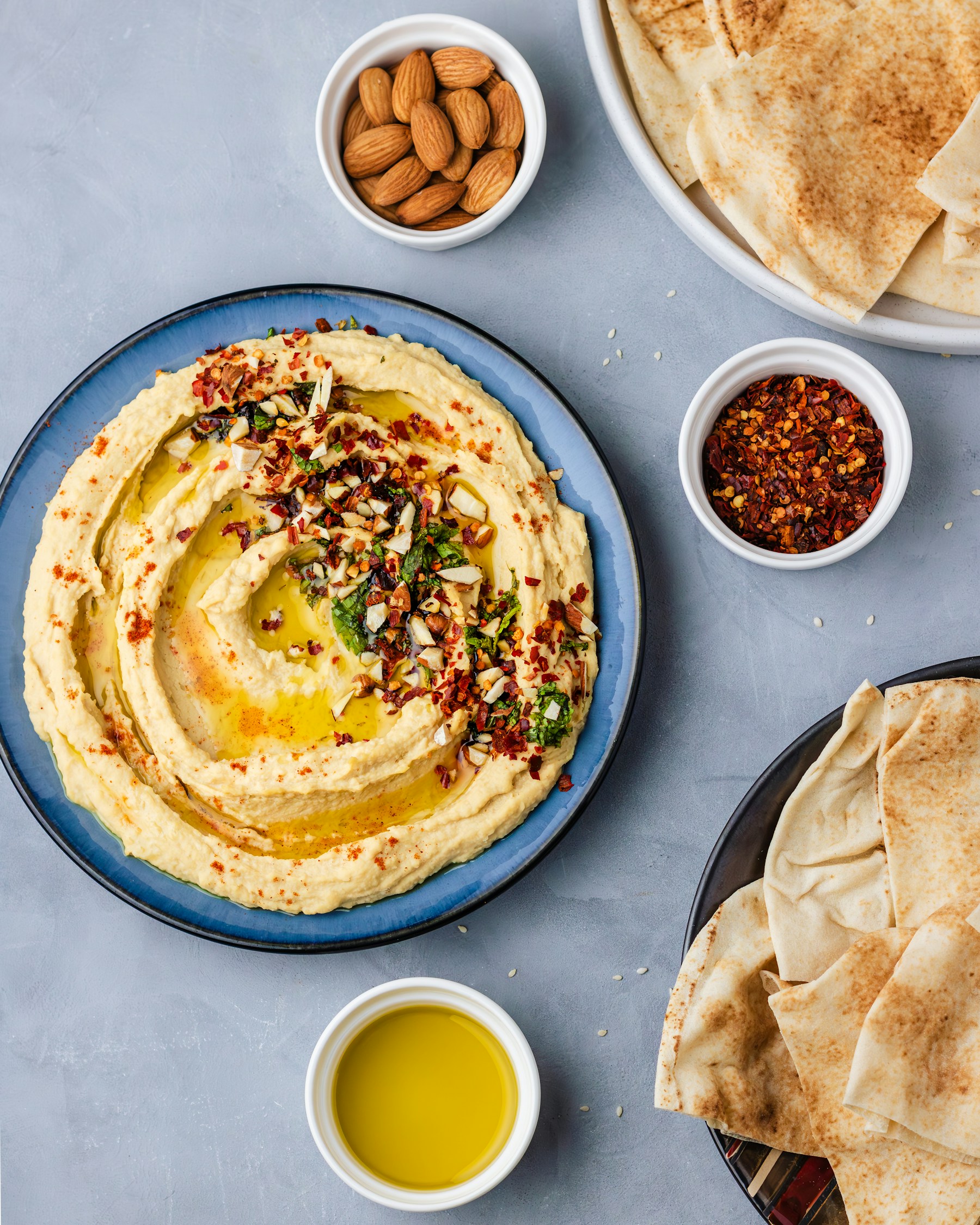
First, the name. In Greece fava has nothing to do with fava beans. It is a purée of yellow split peas, cooked until they fall apart and beaten smooth with olive oil and lemon. Santorini is famous for it and makes it from a local pulse with its own protected name, but across most of the Aegean, Ikaria included, it is made from the ordinary dried split peas you can buy anywhere. It comes to the table warm, in a shallow bowl, with a well of oil in the middle and sharp things on top: raw onion, capers, sometimes tomato.
There is almost nothing to the method. Peas, water, an onion, a long gentle simmer, then oil and lemon at the end. A serving starts from roughly 60 g of dried split peas, which is a proper portion of legumes by any standard. This is the kind of dish that explains how islanders eat pulses so often without thinking of it as a health decision.
Legumes and living longer. The best-known result here is old but still striking. Darmadi-Blackberry and colleagues (2004) followed 785 people aged 70 and over in Japan, Sweden, Greece and Australia for up to seven years, and of the food groups they examined, legumes were the only one that consistently predicted survival across the cohorts: a 7–8% lower mortality hazard for every extra 20 g a day (RR 0.92, 95% CI 0.85–0.99). A much larger 2023 meta-analysis in Advances in Nutrition pooled 32 cohorts and 1,141,793 people and found higher legume intake tied to 6% lower all-cause mortality (HR 0.94, 95% CI 0.91–0.98), with a similar 6% per extra 50 g a day. In that analysis the link with cardiovascular deaths specifically was not statistically significant, so the honest summary is: fewer deaths overall, mechanism still argued about, certainty rated low to moderate.
Pulses and cholesterol. This part is trial evidence, not just observation. Ha and colleagues (CMAJ, 2014) pooled 26 randomised trials (1,037 people) and found that about 130 g of cooked pulses a day, roughly one serving, lowered LDL cholesterol by 0.17 mmol/L (95% CI −0.25 to −0.09). Small, but it comes from food rather than a pill. A serving of this fava starts from about 60 g of dried peas, which is roughly 190 g once cooked, so it clears that dose.
Fibre and blood sugar. Each serving carries about 14 g of fibre, most of it from the peas. In a 2009 meta-analysis in Diabetologia, the 11 trials that fed pulses on their own found a significant fall in fasting blood glucose (standardised mean difference −0.82, 95% CI −1.36 to −0.27), and the authors concluded pulses "may modestly improve medium to longer term glycaemic control". The confidence interval is wide and the effect on longer-term markers like HbA1c was not significant, so treat that as a reasonable expectation rather than a promise.
The olive oil is not decoration. There is about 20 g of extra-virgin olive oil in each serving. In the 2022 JACC analysis of 60,582 women and 31,801 men followed from 1990 to 2018, people eating more than 7 g of olive oil a day (half a tablespoon) had 19% lower cardiovascular mortality (HR 0.81, 95% CI 0.75–0.87) and 19% lower total mortality (HR 0.81, 95% CI 0.78–0.84) than those who rarely or never ate it. Observational again, in health professionals, but large and consistent.
Where it sits in Ikaria. The Ikaria Study looked at 187 islanders over 80 and scored their diet at 38 out of 55 on the Mediterranean diet scale, about 69% adherence, with greens routinely cooked in olive oil. Blue Zones reports that on Ikaria one in three people reaches their 90s, eating a diet built on fruit, vegetables, whole grains, beans, potatoes and olive oil. None of this proves that fava makes anyone live longer. It does show that a plate like this one is what a long-lived population actually eats, and that the two main things in it, pulses and olive oil, each carry their own evidence.
The Ingredients
- 250g (1¼ cups)yellow split peas
- 1onion, peeled and halved
- 2garlic cloves, peeled
- About 750mlwater
- 60ml (¼ cup)extra-virgin olive oil, for the cook
- 2 tbspextra-virgin olive oil, to finish
- 1lemon, juiced
- Salt
- To top: thinly sliced red onion, capers, chopped parsley or dill, and chopped tomato if you like
How to Make It
Put the split peas in a sieve and rinse under cold running water until the water runs clear. No soaking is needed.
Put the peas in a pot with the onion halves, the garlic cloves and about 750ml of cold water. Bring to the boil over high heat. A grey foam will rise in the first few minutes; skim it off with a spoon and discard it.
Lower the heat to the gentlest simmer, half-cover and cook for 45–60 minutes, stirring now and then so the bottom does not catch. The peas are done when they have broken down into a thick, rough porridge and a spoon dragged through leaves a trail. Add a splash of hot water if it looks dry before then.
Take the pot off the heat. Lift out the onion and garlic if you want a plainer purée, or leave them in for more flavour. Add the 60ml of olive oil and the lemon juice, then blend with a stick blender, or in a food processor, until completely smooth. Add hot water a spoonful at a time if it is stiffer than a thick hummus.
Season with salt and taste: it should be rich, lemony and clearly salted. Spoon into a shallow bowl, make a well with the back of a spoon and pour in the 2 tbsp of finishing oil. Top with red onion, capers, herbs and tomato if using. Serve warm with bread.
Questions People Ask
No. In Greece, fava is a purée of yellow split peas. On Santorini the local version is made from the seeds of a related plant, Lathyrus clymenum, which has EU protected designation of origin status. Almost everywhere else, including Ikaria, it is ordinary yellow split peas; a few other places, such as Feneos in the Peloponnese, grow their own grass-pea varieties. Broad (fava) beans are a different dish called koukia.
No. Split peas have had their skins removed, so they cook in 45–60 minutes from dry. Rinse them well and skim the foam that rises in the first minutes of the boil.
It sets as it cools, like polenta. That is normal. Loosen it with hot water and a little olive oil when you reheat it, and it will be smooth again.
Yes. It keeps 4 days in the fridge and freezes for 3 months. Reheat gently with a splash of water, then add fresh lemon and the raw olive oil just before serving.
Sources
- Darmadi-Blackberry I, et al. Legumes: the most important dietary predictor of survival in elderlies of different ethnicities. Asia Pac J Clin Nutr. 2004;13(2):217–220. Full text (PDF)
- Zargarzadeh N, et al. Legume consumption and risk of all-cause and cause-specific mortality: a systematic review and dose-response meta-analysis of prospective studies. Adv Nutr. 2023;14(1):64–76. Record and abstract
- Ha V, et al. Effect of dietary pulse intake on established therapeutic lipid targets for cardiovascular risk reduction: a systematic review and meta-analysis of randomized controlled trials. CMAJ. 2014;186(8):E252–E262. Full text
- Sievenpiper JL, et al. Effect of non-oil-seed pulses on glycaemic control: a systematic review and meta-analysis of randomised controlled experimental trials in people with and without diabetes. Diabetologia. 2009;52:1479–1495. Full text
- Guasch-Ferré M, et al. Consumption of olive oil and risk of total and cause-specific mortality among U.S. adults. J Am Coll Cardiol. 2022;79(2):101–112. Record and abstract · ACC summary
- Panagiotakos DB, et al. Sociodemographic and lifestyle statistics of oldest old people (>80 years) living in Ikaria island: the Ikaria Study. Cardiol Res Pract. 2011;679187. Full text
- Blue Zones. Ikaria, Greece. bluezones.com
- USDA FoodData Central, SR Legacy: Peas, green, split, mature seeds, raw (FDC 172428); Oil, olive, salad or cooking (FDC 171413); Onions, raw (FDC 170000); Garlic, raw (FDC 169230); Lemon juice, raw (FDC 167747). fdc.nal.usda.gov


