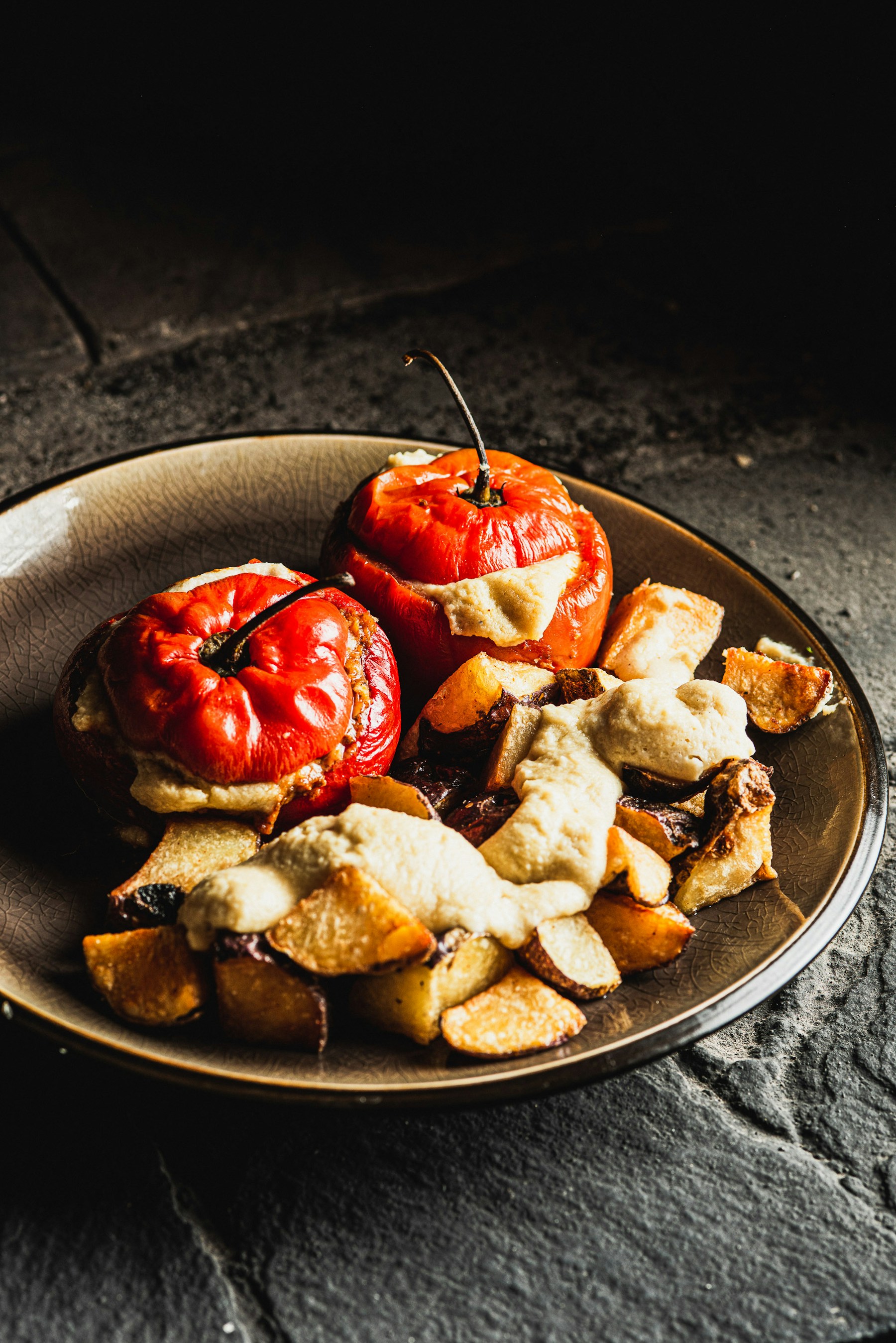
Gemista simply means "stuffed", and in a Greek kitchen it usually means this: tomatoes and peppers with their insides scooped out, filled with rice and herbs, and baked in a tin with potatoes until the tops blister and the oil goes red with tomato juice. The meatless version is one of the ladera, the family of vegetable dishes cooked in olive oil. It is eaten all over Greece, on the islands as well as the mainland. It is not an Ikarian speciality and there is nothing secret about it. We include it because it is a very good example of the everyday pattern researchers describe on Ikaria: a plate built from vegetables, potatoes and olive oil.
Nothing is wasted. The tomato pulp you scoop out becomes the cooking liquid for the rice, so the filling tastes of tomato all the way through, and the potatoes sit in the juices that run out of the vegetables while they bake. Each serving is one tomato, one pepper and a share of the potatoes. Worked out from USDA FoodData Central values for the raw ingredients, that comes to about 580 calories, 10 g of fibre and 11 g of protein a serving, with about 25 ml (just under 2 tablespoons) of olive oil per person. It is a main course, not a side. Serve it warm or at room temperature, with bread and a piece of feta if you eat it.
It fits the island pattern. The Blue Zones organisation describes Ikarians as eating "a variation of the Mediterranean diet, with lots of fruits and vegetables, whole grains, beans, potatoes," and olive oil. Gemista ticks the vegetables, the potatoes and the olive oil. Be clear about what that does and doesn't mean: this is a dish typical of that way of cooking, found across Greece, not a food anyone has shown to lengthen life. And the rice here is white, not whole grain.
The Mediterranean pattern is linked to lower mortality. In a cohort study from the Women's Health Study (Ahmad and colleagues, JAMA Network Open, 2024), 25,315 initially healthy US women, mean age 54.6 and about 95% of them White, were followed for an average of 24.7 years, during which 3,879 died. Diets were scored 0 to 9 on a Mediterranean diet scale that gives points for vegetables (not counting potatoes), fruit, nuts, whole grains, legumes, fish, a higher ratio of monounsaturated to saturated fat, less red and processed meat, and moderate alcohol. Women scoring 6 to 9 had a 23% lower risk of death than those scoring 0 to 3 (hazard ratio 0.77, 95% CI 0.70–0.84) after adjusting for age, energy intake and trial treatment assignment. Adjusting further for smoking, physical activity, menopausal status and hormone use shrank that to 0.89 (0.82–0.98), still statistically significant. Blood measures of small-molecule metabolites and of inflammation explained the largest shares of the association (14.8% and 13.0%). It is observational, so it shows a link, not cause and effect. A dish like this earns points on the vegetable and olive-oil items, not the rest.
One plate is about five servings of vegetables. Wang and colleagues (Circulation, 2021) followed 66,719 women and 42,016 men in two large US cohorts, with 33,898 deaths, and combined the results with 24 other cohorts for a meta-analysis of 1,892,885 people. In the two US cohorts, compared with 2 servings a day, eating 5 servings of fruit and vegetables a day was linked to 13% lower total mortality (hazard ratio 0.87, 95% CI 0.85–0.90). The meta-analysis found the same summary risk ratio for 5 servings a day (0.87, 95% CI 0.85–0.88), and the lower risk levelled off at about 5 servings. Two servings of fruit and three of vegetables was the combination linked to the lowest mortality. Potatoes and fruit juice were not linked to lower mortality, and nor were starchy vegetables such as peas and corn. The meta-analysis used 80 g as a standard serving. Leave the potatoes out and each serving of gemista still holds about 440 g of raw tomato, pepper and onion, roughly five of those servings, though some of that weight is water that bakes off.
The peppers bring a lot of vitamin C. By USDA values, raw green bell pepper has 80.4 mg of vitamin C per 100 g and red bell pepper 128 mg. The pepper in each serving weighs about 150 g once trimmed, which works out at roughly 120 mg if it is green or 190 mg if it is red, before cooking. The NIH recommended daily amount is 90 mg for adult men and 75 mg for adult women, and people who smoke need 35 mg more. The NIH also notes that "cooking can reduce the vitamin C content of food", and an hour or more in the oven will cost some of it. Treat those raw figures as a ceiling, not a guarantee.
Next-day rice: a small, early finding. Gemista is often better the day after, and there is a little evidence that chilling rice changes its starch. In a randomised crossover study (Sonia and colleagues, Asia Pacific Journal of Clinical Nutrition, 2015), 15 healthy adults ate 125 g of plain white rice, served with a small omelette, that was either freshly cooked or cooked, chilled at 4°C for 24 hours and then reheated. The chilled-and-reheated rice had more resistant starch (1.65 g vs 0.64 g per 100 g), and the rise in blood sugar after eating it was smaller (incremental area under the curve 125 vs 152 mmol·min/L, p=0.047). The study tested plain rice eaten with an omelette, not rice baked inside a tomato with oil, measured blood sugar after one meal rather than any longer-term health outcome, and analysed 14 people. It is a curiosity, not a reason to eat gemista cold.
The Ingredients
- 4 largeripe tomatoes, about 1kg (2¼ lb) in all
- 4 largegreen bell peppers, about 650g (1½ lb) in all; red or yellow work too
- 100ml (scant ½ cup)extra-virgin olive oil, divided
- 1 largeonion (about 150g), grated or very finely chopped
- 2garlic cloves, finely chopped
- 1 tbsptomato paste, no-salt-added if you can find it
- 200g (1 heaped cup)white rice, medium- or long-grain, uncooked
- 20g (⅓ cup)flat-leaf parsley, chopped
- 10g (about ½ cup loosely packed leaves)fresh mint leaves, chopped
- 10g (about 1 cup loosely packed sprigs)fresh dill, chopped
- 500g (1 lb)potatoes (2–3 medium), peeled and cut into wedges
- 1 tspsalt, divided, plus black pepper
- 250ml (1 cup)hot water
- To serve: crusty bread, and feta if you eat it
How to Make It
Heat the oven to 200°C (180°C fan) / 400°F. Slice a lid off the stem end of each tomato and set the lids aside. With a teaspoon, scoop out the seeds and flesh into a bowl, leaving a wall about 1cm thick so the tomato holds its shape. Chop the pulp finely or blitz it briefly, keeping all the juice. Cut the tops off the peppers the same way, keep them as lids, and pull out the seeds and white ribs. Sprinkle the insides of the tomatoes with a pinch of the salt.
Warm 60ml (¼ cup) of the olive oil in a frying pan over a medium heat. Cook the onion for 6–8 minutes, until soft and sweet, then add the garlic and tomato paste and stir for a minute. Add the rice and stir for 2 minutes so every grain is coated in oil. Pour in about half the tomato pulp and simmer for 5 minutes, stirring, until the rice has soaked up some of the liquid but is still hard in the middle. It finishes cooking in the oven.
Take the pan off the heat and stir in the parsley, mint, dill, ¼ teaspoon of the salt and plenty of black pepper. Stand the tomatoes and peppers upright in a large roasting tin. Spoon in the filling until each is about three-quarters full, no more, because the rice swells as it cooks. Spoon a little of the remaining pulp over the rice in each one and put the lids back on.
Toss the potato wedges with the rest of the salt and some pepper, and wedge them into the gaps between the vegetables. They help keep everything standing up. Pour the rest of the tomato pulp and the hot water into the bottom of the tin, then drizzle the remaining 40ml of olive oil over the vegetables and potatoes.
Cover the tin loosely with foil and bake for 40 minutes. Uncover, spoon some of the juices over the potatoes, and bake for another 35–45 minutes, until the potatoes are golden, the tops of the vegetables are blistered and the rice is tender. Check by spooning a little out of one pepper. If the tin looks dry before the rice is done, add a splash of water. Let it rest for at least 20 minutes before serving (the rest is not included in the total time). Gemista is at its best warm or at room temperature, with the pan juices spooned over.
Questions People Ask
No. It is cooked all over Greece, including the islands, and doesn't belong to Ikaria. We call it a Blue Zone recipe because it is typical of the way of eating described there: the Blue Zones organisation says Ikarians eat a variation of the Mediterranean diet with lots of fruits and vegetables, whole grains, beans, potatoes and olive oil. This dish is vegetables, potatoes and olive oil. It is an example of that pattern, not a secret to long life.
Because it finishes cooking inside the vegetables, soaking up the tomato juice as it goes. That is where the flavour comes from. A short simmer in the pan first gives it a head start, so it is tender by the time the vegetables are soft. Fill each one only about three-quarters full: the rice swells, and overfilled tomatoes split.
Almost all the sodium comes from the teaspoon of salt. By USDA values that teaspoon adds about 580 mg per serving, for roughly 620 mg in all. That assumes fresh tomatoes, no-salt-added tomato paste and water rather than stock. Without any added salt, the vegetables, rice and herbs bring only about 40 mg a serving. Halving the salt brings a serving down to about 330 mg, and the mint, dill and tomato carry plenty of flavour. If you use salted tomato paste or stock, check the label.
Yes. Green peppers taste a little sharper; red and yellow are sweeter and work just as well. By USDA values, raw red bell pepper has about 128 mg of vitamin C per 100 g against 80 mg for green, so swapping green for red raises the vitamin C. The calories barely change.
Yes, and many people think it is better the next day. Cool it, cover it and get it into the fridge promptly, as with any cooked rice. It keeps up to 3 days. Bring it back to room temperature or warm it, covered, in a low oven. It doesn't freeze well; the tomatoes collapse and the potatoes go grainy.
Sources
- Blue Zones. Ikaria, Greece. bluezones.com
- Ahmad S, Moorthy MV, Lee IM, et al. Mediterranean diet adherence and risk of all-cause mortality in women. JAMA Netw Open. 2024;7(5):e2414322. Full text
- Wang DD, Li Y, Bhupathiraju SN, et al. Fruit and vegetable intake and mortality: results from 2 prospective cohort studies of US men and women and a meta-analysis of 26 cohort studies. Circulation. 2021;143(17):1642–1654. Full text (PMC)
- NIH Office of Dietary Supplements. Vitamin C: Fact Sheet for Health Professionals. ods.od.nih.gov
- Sonia S, Witjaksono F, Ridwan R. Effect of cooling of cooked white rice on resistant starch content and glycemic response. Asia Pac J Clin Nutr. 2015;24(4):620–625. Full text (PDF)
- USDA FoodData Central, SR Legacy: Tomatoes, red, ripe, raw, year round average (FDC 170457); Peppers, sweet, green, raw (FDC 170427); Peppers, sweet, red, raw (FDC 170108); Rice, white, long-grain, regular, raw, unenriched (FDC 169756); Potatoes, flesh and skin, raw (FDC 170026); Oil, olive, salad or cooking (FDC 171413); Onions, raw (FDC 170000); Garlic, raw (FDC 169230); Tomato products, canned, paste, without salt added (FDC 170459); Parsley, fresh (FDC 170416); Spearmint, fresh (FDC 173475); Dill weed, fresh (FDC 172233); Salt, table (FDC 173468). fdc.nal.usda.gov


