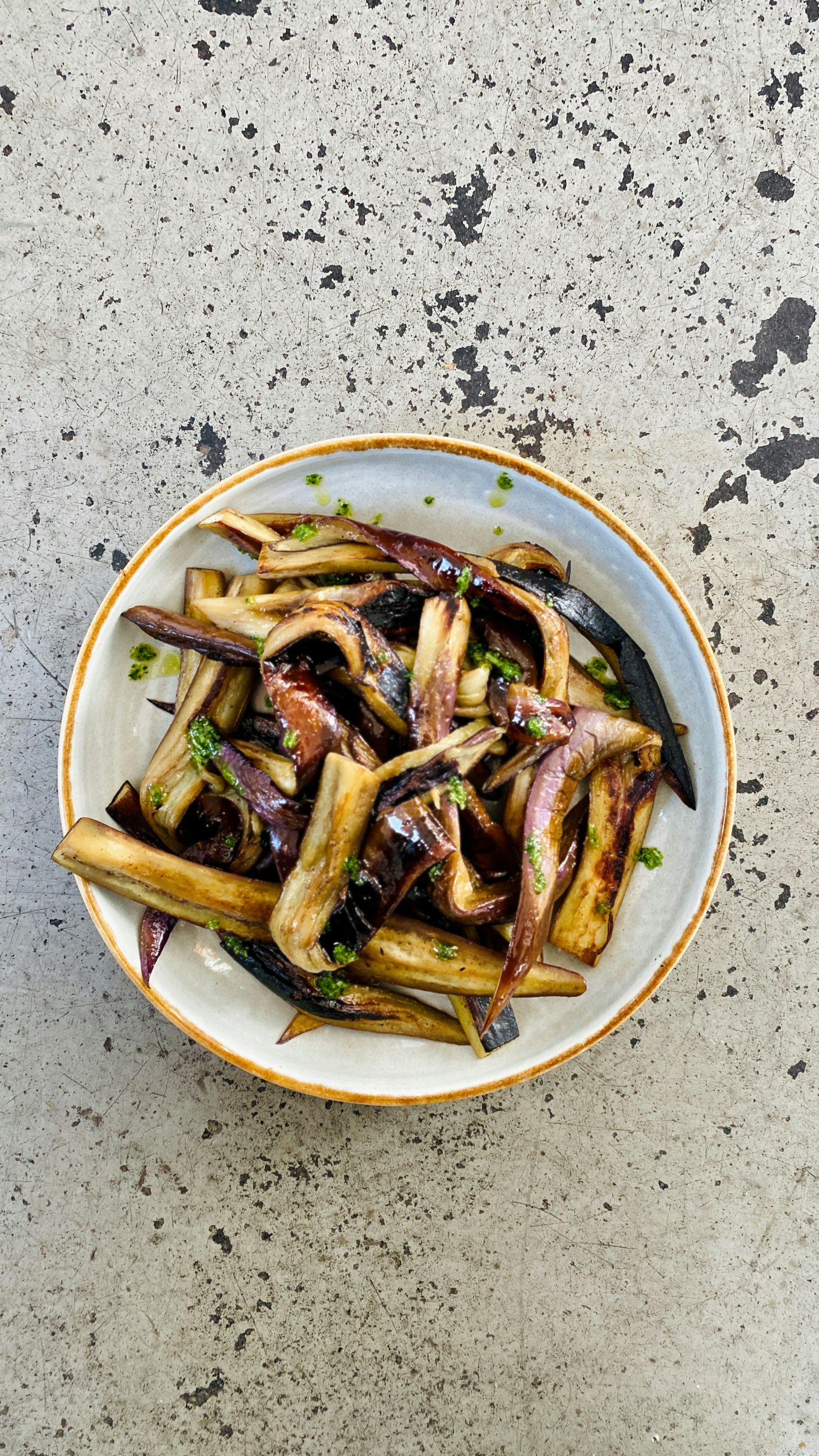
Okinawan home cooking has a word for this kind of dish: nbushi (ンブシー), a dish of tofu, vegetables and usually pork simmered in miso. Japan's agriculture ministry describes it as sitting somewhere between a simmered dish and a soup. The classic versions use naabeeraa, the young sponge gourd that Okinawans eat as a summer vegetable, or shibui (winter melon); goya is used too. This recipe takes the same approach to eggplant, which is far easier to find outside Japan. It is not a named heritage dish, and we are not claiming it as one. It is an everyday Okinawan way of cooking, applied to a vegetable you can buy anywhere.
Traditional nbushi usually includes a little pork. This version leaves the pork out and leans on tofu instead, which keeps it vegan. That is not as big a departure as it sounds: the Blue Zones organisation notes that pork was traditionally reserved for infrequent ceremonial occasions, and that the Okinawan diet is rich in soy foods like tofu and miso. If you want the pork back in, the FAQ below explains how.
The difference between good miso eggplant and a greasy, grey one is all in the method, so the steps below are more detailed than usual. In short: cut the eggplant thick, coat it in a measured amount of oil instead of pouring oil into the pan, sear it hard in a single layer, then put the lid on with a splash of water so the steam turns the inside soft and creamy. Brown the tofu separately until it is properly golden, and add the sauce only at the end. Worked out from USDA FoodData Central values, a serving comes to roughly 280 calories, 13 g of protein and 7 g of fibre before rice, with about 490–670 mg of sodium, almost all of it from the miso, depending on which one you use. More on that below.
It is built from the traditional Okinawan pattern. A widely cited review of the traditional Okinawan diet (Willcox and colleagues, Journal of the American College of Nutrition, 2009) describes it as low in calories yet nutritionally dense. The authors write that in the traditional diet soy was the main source of protein, and they report, from their own unpublished data, that the older Okinawans they studied ate an average of about three ounces (85 g) of soy products a day, mostly as tofu and miso. One serving of this dish has about 100 g of tofu and 13 g of miso, about a third more than that daily average. Two caveats. The review is a description of a dietary pattern, not a trial of any one dish. And the authors themselves note that dietary change in Okinawa since the Second World War has been largely harmful, so the traditional diet describes how older generations ate, not how the islands eat today.
Soy foods are linked to lower cardiovascular and cancer deaths. A 2019 meta-analysis (Nachvak and colleagues, Journal of the Academy of Nutrition and Dietetics) pooled 23 prospective studies with 330,826 participants. Eating more soy and soy products was associated with a 15% lower risk of death from cardiovascular disease (pooled effect size 0.85, 95% CI 0.72–0.99) and a 12% lower risk of death from cancer (relative risk 0.88, 95% CI 0.79–0.99). People in the highest category of soy isoflavone intake had a 10% lower risk of death from any cause than those in the lowest. The link between soy foods and all-cause mortality held only in some subgroups of studies, particularly the higher-quality ones, and soy protein on its own was not significantly linked with all-cause or cardiovascular deaths. These are observational studies, so they show associations, not cause and effect.
Fermented soy, like miso, may matter more than tofu. In the Japan Public Health Center-based Prospective Study (Katagiri and colleagues, BMJ, 2020), 92,915 men and women aged 45 to 74 were followed for an average of 14.8 years, during which 13,303 died. Total soy intake was not significantly linked with mortality once other factors were accounted for, and neither was non-fermented soy such as tofu. But people in the top fifth for fermented soy, natto and miso, had about a 10% lower risk of death from any cause than those in the bottom fifth (hazard ratio 0.90, 95% CI 0.83–0.97, in men; 0.89, 0.80–0.98, in women). Looked at on its own, miso was linked with lower mortality only in women. The authors cautioned that residual confounding might explain some of this. They also pointed out that miso is higher in sodium than natto, which is one reason the sodium note below matters.
The eggplant brings fibre for very few calories. By USDA values, raw eggplant has 25 calories and 3 g of fibre per 100 g, so the 175 g in each serving brings about 5 g of fibre for under 45 calories. With the tofu, miso, ginger and spring onions, a serving has about 7 g in all. In a series of reviews by Reynolds and colleagues (The Lancet, 2019), drawing on 135 million person-years of data from prospective studies and 58 clinical trials, observational data suggested a 15–30% decrease in all-cause and cardiovascular mortality when comparing people who ate the most fibre with those who ate the least. The risk reduction was greatest at 25–29 g of fibre a day. One serving of this dish gets you about a quarter of the way there.
Calcium-set tofu helps with calcium. By USDA values for firm tofu made with calcium sulfate and magnesium chloride (nigari), the 100 g of tofu in each serving has about 200 mg of calcium, and the whole serving about 250 mg. The NIH recommended amount for most adults is 1,000 mg a day, rising to 1,200 mg for women from 51 and men from 71. So a serving covers roughly a quarter of a day's needs. The NIH notes that tofu's calcium figures apply to tofu processed with a calcium salt, so check the label for calcium sulfate.
The Ingredients
- 400g (14 oz)firm or extra-firm tofu, one block, ideally calcium-set (check the label for calcium sulfate)
- 700g (1½ lb)eggplant (aubergine): 2 small globe eggplants or 5–6 slim Japanese eggplants
- 3 tbsp (45ml)neutral oil, such as canola, divided
- 3 tbsp (about 50g)miso, red or mixed (awase); use 2 tbsp for a lower-sodium version
- 1 tbsp (about 13g)sugar, or 2 tbsp mirin
- 120ml (½ cup)water, or 2 tbsp sake topped up to ½ cup with water
- 4cm (1½ in) pieceginger, about 15g, finely grated
- 1garlic clove, finely grated (optional)
- 60ml (¼ cup)water, for steaming the eggplant
- 1 tsptoasted sesame oil
- 2 (about 30g)spring onions (scallions), thinly sliced
- 1 tbsp (9g)toasted sesame seeds
- To serve: cooked short-grain rice, about 150g (¾ cup) a person.
How to Make It
Wrap the block of tofu in a clean tea towel or several layers of kitchen paper, set it on a plate and put a heavy pan or a couple of tins on top. Leave it for 15–20 minutes while you get everything else ready. Then cut it into 2.5cm (1 in) cubes and pat them dry. A dry surface is what lets tofu brown instead of steaming.
In a small bowl, whisk the miso, sugar (or mirin), the 120ml (½ cup) of water (or sake and water), the ginger and the garlic, if using, until smooth, with no lumps of miso left. Taste it: it should be salty-sweet and gingery, a little stronger than you want the finished dish, because the eggplant and tofu will soak it up.
Leave the skin on; it helps the pieces hold together. Cut globe eggplants into batons about 2.5cm (1 in) thick and 6–7cm (2½ in) long. Cut slim Japanese eggplants into 5cm (2 in) lengths, then halve or quarter them lengthways. Pieces this size are thick enough to stay whole and thin enough to cook through. Do not salt them: most modern eggplants are not bitter, and you do not need to salt eggplant to brown it, so salting just adds sodium. Instead, just before cooking, toss the pieces in a bowl with 2 tbsp of the oil until every cut face is glossy. That way the oil is shared out evenly, instead of the first pieces in the pan soaking up a pool of it while the rest get none.
Use a large frying pan, 28–30cm (11–12 in), with a lid; non-stick or well-seasoned cast iron is easiest. Heat the remaining 1 tbsp of oil over a medium-high heat until it shimmers. Add the tofu in a single layer and leave it alone for 3–4 minutes, until it releases easily and is deep golden underneath. If it sticks, it is not ready to turn. Turn the cubes and brown at least two more sides, 8–10 minutes in all, then lift them onto a plate.
Turn the heat up to high (medium-high if your pan is non-stick). Add the eggplant cut-side down in a single layer; if it will not all fit, do it in two batches. Do not stir. Let it sear for about 3 minutes, until the underside is deep golden-brown, then turn the pieces and give them 2 minutes more. A crowded pan steams the eggplant grey instead of browning it, so be patient. Put all the eggplant back in the pan.
Lower the heat to medium and pour in the 60ml (¼ cup) of water. It will hiss. Put the lid on straight away and cook for 4–6 minutes, until a knife slides into the thickest piece with no resistance and the flesh is soft and creamy all the way through. This is the step that makes the eggplant silky: the trapped steam cooks the centre without any more oil. If water is left in the pan, take the lid off for 30 seconds to let it bubble away.
Turn the heat to medium-low. Return the tofu, pour the miso sauce over, and turn everything gently with a spatula rather than stirring hard, because the eggplant is now tender. Simmer for 2–3 minutes, until the sauce thickens and clings to the pieces in a glossy coat. Sauces with miso and sugar can catch, so keep the heat moderate and add a splash of water if it gets too thick. Leave a little loose sauce in the pan to spoon over the rice.
Take the pan off the heat. Drizzle over the sesame oil and scatter on the spring onions and sesame seeds. Taste. If it needs more punch, add a little more grated ginger rather than more miso. Serve hot, with a bowl of rice each.
Questions People Ask
The method is, but this exact dish is our version. Nbushi (ンブシー) is the Okinawan word for a dish of tofu, vegetables and pork simmered in miso, which Japan’s agriculture ministry describes as somewhere between a simmered dish and a soup. The standard versions use naabeeraa (sponge gourd, or loofah) or shibui (winter melon), and goya versions are common too. We use eggplant because it is easy to find and takes to the same treatment, but we are not claiming eggplant nbushi as a named heritage dish. Traditional versions usually include pork; this one uses tofu only. The Blue Zones organisation says the Okinawan diet is rich in soy foods like tofu and miso, so a dish like this fits the traditional pattern. It is an example of how the islands eat, not a secret to long life.
Almost all the sodium comes from the miso, and miso varies a lot. By USDA’s value for generic miso (3,730 mg of sodium per 100 g), 3 tablespoons carry about 1,900 mg, or about 475 mg a serving, and the whole dish comes to about 490 mg a serving. Japan’s official food tables put red miso, which this recipe suggests, at about 5,100 mg per 100 g, and with a miso that salty a serving is nearer 670 mg. That is about 21–29% of the 2,300 mg Daily Value, and the FDA counts 20% or more in a serving as high. Use 2 tablespoons of miso and it falls to about 335–450 mg (about 15–20%), depending on the miso. Make up the flavour with more ginger and spring onion, or look for a reduced-salt miso and check the label. Serving it with miso soup as well adds more sodium. If you have been told to watch your sodium or blood pressure, talk to your doctor about how dishes like this fit in.
Oily eggplant usually means the oil went into the pan, not onto the eggplant. The first pieces soak it all up, and then more gets added. Tossing the pieces in a measured 2 tablespoons first spreads the oil out. Soggy, grey eggplant usually means the pan was crowded, or the heat was too low, so it stewed in its own water instead of browning. Sear in a single layer on high heat, in batches if you need to, and only add water once the outside is browned, with the lid on for a short, controlled steam.
Japan’s agriculture ministry recipe for the classic sponge-gourd nbushi uses red miso, and a red or mixed (awase) miso gives a deep, savoury sauce. White miso is milder and sweeter, so you can cut the sugar if you use it. For the tofu, use firm or extra-firm; silken tofu will not brown. If you want the calcium, check the label for calcium sulfate. The NIH notes that tofu’s calcium content depends on it being made with a calcium salt.
Yes to both. For a more traditional version, brown about 100g (3½ oz) of thinly sliced pork belly before the tofu, the amount the Japanese agriculture ministry’s recipe uses to serve four, and leave a spoonful of its fat in the pan for the eggplant. The nutrition figures here do not include it. The dish keeps for 3 days in the fridge. The eggplant softens further as it sits, and the tofu takes on more of the sauce. Reheat it gently with a splash of water. It does not freeze well, because the tofu turns spongy.
Sources
- Ministry of Agriculture, Forestry and Fisheries of Japan. Our Regional Cuisines: Naabeeraanbushi (Okinawa). maff.go.jp (English) · maff.go.jp (Japanese)
- JLect: Japonic Languages and Dialects Database. っんぶしー・ぅんぶしー (qnbushii, 'nbushii). jlect.com
- Teruya Tofu. 琉球料理伝承人が教える、島豆腐のおすすめレシピ (Island tofu recipes from a Ryukyu cuisine tradition-bearer). teruya-tofu.jp
- Orion Beer. ナーベーラーンブシー recipe. orionbeer.co.jp
- Blue Zones. Okinawa, Japan. bluezones.com
- Willcox DC, Willcox BJ, Todoriki H, Suzuki M. The Okinawan diet: health implications of a low-calorie, nutrient-dense, antioxidant-rich dietary pattern low in glycemic load. J Am Coll Nutr. 2009;28(sup4):500S–516S. Article
- Nachvak SM, et al. Soy, soy isoflavones, and protein intake in relation to mortality from all causes, cancers, and cardiovascular diseases: a systematic review and dose-response meta-analysis of prospective cohort studies. J Acad Nutr Diet. 2019;119(9):1483–1500.e17. Article
- Katagiri R, Sawada N, Goto A, et al. Association of soy and fermented soy product intake with total and cause specific mortality: prospective cohort study. BMJ. 2020;368:m34. Full text
- Reynolds A, et al. Carbohydrate quality and human health: a series of systematic reviews and meta-analyses. Lancet. 2019;393(10170):434–445. Article · Accepted manuscript (PDF)
- NIH Office of Dietary Supplements. Calcium: Fact Sheet for Health Professionals. ods.od.nih.gov
- US Food and Drug Administration. Sodium in Your Diet. fda.gov
- Ministry of Education, Culture, Sports, Science and Technology (MEXT), Japan. Standard Tables of Food Composition in Japan (8th revised edition): Rice miso, red, salty (米みそ・赤色辛みそ). fooddb.mext.go.jp
- Milk Street. Listener Question: Should I Salt My Eggplant? (2021). 177milkstreet.com
- USDA FoodData Central, SR Legacy: Eggplant, raw (FDC 169228); Tofu, firm, prepared with calcium sulfate and magnesium chloride (nigari) (FDC 172448); Miso (FDC 172442); Oil, canola (FDC 172336); Sugars, granulated (FDC 169655); Ginger root, raw (FDC 169231); Garlic, raw (FDC 169230); Onions, spring or scallions (includes tops and bulb), raw (FDC 170005); Oil, sesame, salad or cooking (FDC 171016); Seeds, sesame seeds, whole, dried (FDC 170150); Rice, white, short-grain, cooked, unenriched (FDC 168932). fdc.nal.usda.gov


