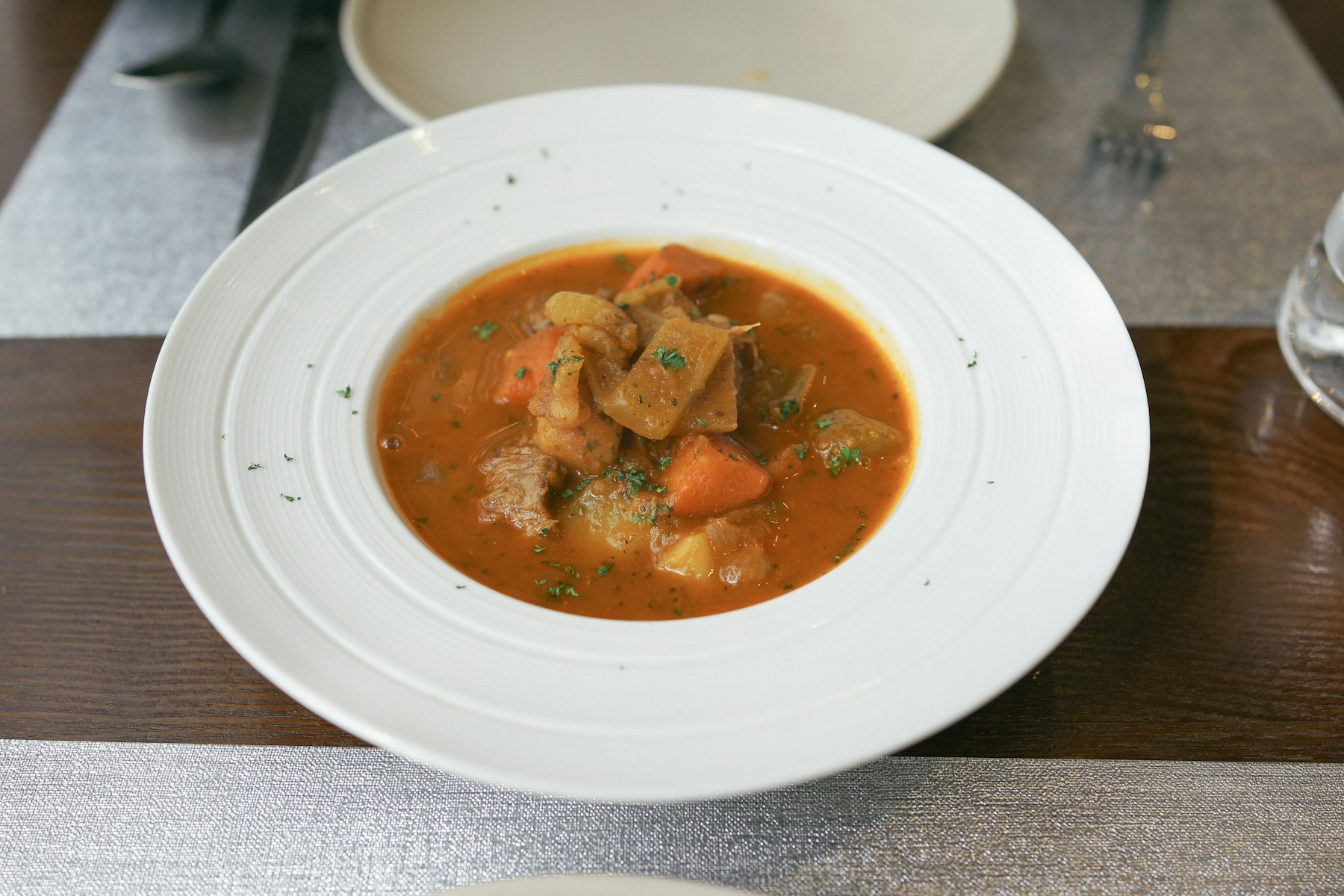
Olla de carne means, quite literally, "pot of meat", which undersells it. It is Costa Rica's big beef and vegetable soup: a modest piece of stewing beef simmered slowly into broth, then a market's worth of vegetables added in two waves, the hard roots first and the soft squashes last. It is cooked across Costa Rica, including the Nicoya Peninsula, where we have placed it among our Blue Zone recipes. This is not a recipe from any one family. It is the general shape of the dish, written down with weights so you can repeat it and so we could work out what is in a bowl.
We have kept the beef deliberately modest: 700 g for a pot that feeds six, or about 117 g raw per bowl. Against that sit roughly 425 g of vegetables per bowl, from eleven different plants. Worked out from USDA FoodData Central, a bowl without rice comes to about 470 calories, 31 g of protein, 7 g of fat and 8.5 g of fibre, with about 720 mg of sodium if you use all the salt. It takes about two and a half hours, but nearly all of that is the pot simmering on its own.
The longevity finding is mostly about men. The key demographic paper on Nicoya is by Luis Rosero-Bixby, William Dow and David Rehkopf, published in the Vienna Yearbook of Population Research in 2013. A survival follow-up of 16,300 older Costa Ricans found that, between 1990 and 2011, men aged 60 and over living in Nicoya had a death rate about 20% lower than the national figure (death rate ratio 0.80, 95% CI 0.69–0.93). The authors estimate that a 60-year-old Nicoyan man had a median of 24.3 more years to live, almost two years more than Okinawan men (22.6) and about three more than other Costa Rican men (21.2); his life expectancy at 60 was about 23.6 years. There was no such advantage for women. The men's advantage was independent of socio-economic conditions, disappeared in people who had moved away, and came from lower cardiovascular deaths. This is demographic, observational evidence about a place, not a test of any food.
Longer telomeres, unexplained. Much of this work draws on CRELES, which the 2013 paper describes as a longitudinal study based on a national sample of Costa Ricans aged 60 and older in 2005. Using it, Rehkopf and colleagues (Experimental Gerontology, 2013) found that white blood cell telomeres, which the Vienna paper treats as a marker of ageing and stress, were on average 81 base pairs longer in Nicoya than in the rest of the country after adjusting for age, sex, rurality and season. The gap stayed at 79 base pairs after adjusting for nineteen possible biological, dietary and social explanations, and it narrowed at older ages. In the authors' words, it "does not appear to be explainable by traditional behavioral and biological risk factors." Dietary factors were among those nineteen, and they did not account for the gap.
What older Nicoyans actually ate. CRELES estimated diet from how often, and in what portions, people ate 27 "tracer" foods. The Vienna paper reports that Nicoyan diets included significantly more plain everyday foods such as rice, beans, beef, fish and chicken, and that Nicoyans took in more calories, carbohydrates, fibre and protein, mostly of animal origin. The differences were small: about 3 g a day more protein than the 70 g national average, and about 1 g a day more fibre than the national 23 g. The authors also caution against over-interpreting such quirks of diet or biomarkers as proof that they cause the survival advantage. So beef was part of the traditional pattern, eaten alongside beans, corn and rice; it was not a plant-only diet, and nobody has shown that any single dish explains anything.
Why we keep the beef modest. The World Cancer Research Fund advises that if you eat red meat, you limit it to no more than about three portions a week, about 350–500 g cooked weight, and notes that 500 g cooked is equivalent to 700–750 g raw. The World Health Organization's cancer agency, IARC, classes red meat, beef included, as Group 2A, probably carcinogenic to humans, based on limited evidence from observational studies and strong mechanistic evidence. It adds that meat can be part of a healthy diet and provides important nutrients. At about 117 g raw, roughly 80 g cooked by WCRF's ratio, one bowl of this soup uses about a sixth to a quarter of that weekly ceiling. The whole pot, 700 g raw, is close to the top of the range for one person for a week, which is why it serves six.
The vegetables carry the bowl. The WHO healthy diet fact sheet says everyone older than 10 should aim for at least 400 g of fruit and vegetables a day. The 2018 version spelled out that this excludes "potatoes, sweet potatoes, cassava and other starchy roots". Take out the yuca and potato, and, to be conservative, the plantain too, and each bowl still has about 265 g of chayote, squash, carrot, corn, onion, sweet pepper, garlic and coriander: about two-thirds of the daily 400 g in one meal. Counting everything, it is about 425 g.
The Ingredients
- 700g (1½ lb)boneless beef chuck (stewing beef), trimmed of hard fat and cut into 4cm (1½ in) chunks
- 2.5 litres (10½ cups)cold water
- 1 largeonion (about 200g / 7oz; use a second small one if yours is lighter)
- 5garlic cloves
- 1red sweet pepper (about 150g / 5oz)
- 1 bunch (30g)culantro or coriander (cilantro), stalks and leaves separated
- 1bay leaf (optional)
- 400g (14oz)yuca (cassava), weighed after peeling, cut into 5cm (2 in) chunks; frozen peeled yuca is fine
- 2 mediumcorn cobs, each cut into 4 rounds (about 200g / 7oz of kernels in total)
- 1 largegreen plantain (about 250g / 9oz peeled), cut into 4cm (1½ in) rounds
- 2–3 large (200g / 7oz)carrots, cut into thick chunks
- 300g (10½oz)potatoes (about 1½ medium), cut into large chunks; or sweet potato
- 400g (14oz)ayote or butternut squash, weighed after peeling, cut into 5cm (2 in) chunks
- 2 (about 400g / 14oz)chayote, peeled, seeded and quartered
- 1½ tsp (9g)salt, added in stages
- Cooked white or brown rice, to serve
How to Make It
Put the beef in a large pot, 6 litres or more, with the 2.5 litres of cold water, half the onion in one piece, 2 whole garlic cloves, half the sweet pepper, the coriander stalks and the bay leaf if you are using it. Bring it slowly to the boil over a medium heat, which takes about 10 minutes, and skim off the grey foam as it rises. Starting cold and skimming is what keeps the broth clear.
Lower the heat until the broth barely bubbles, half-cover and simmer for about 1 hour 30 minutes, until a chunk of beef breaks apart when you press it with a spoon. While it cooks, peel and cut the vegetables. Yuca has a thick waxy bark: cut it into lengths, slit the skin and peel it off with the pink layer underneath. For the plantain, cut off the ends, score the skin along its ridges and push it off with your thumb. Keep the cut yuca, potato and plantain in a bowl of cold water so they do not discolour.
Lift out and throw away the onion, pepper, garlic, stalks and bay leaf; they have given the broth what they had. Add the yuca, corn rounds, plantain and carrots with 1 teaspoon of the salt. If the vegetables are not covered, top up with a little hot water. Simmer for 15 minutes.
Finely chop the rest of the onion and pepper and the remaining 3 garlic cloves and add them with the potatoes, squash and chayote. Simmer for another 15 to 20 minutes, until a knife slides easily into the yuca and the potato. Yuca must be cooked right through; if a piece is still firm and chalky in the middle, give it longer. Pull out any woody strands from its centre.
Taste the broth and add the last ½ teaspoon of salt only if it needs it. Stir in the chopped coriander leaves and let the pot sit off the heat for 5 minutes. Serve in deep bowls with a piece of beef and some of every vegetable in each, and rice on the side for people to spoon into the broth.
Questions People Ask
No. It is a traditional Costa Rican dish and fits how people in the region have long eaten, but no study has tested it, and the research on Nicoya cannot say which part of daily life explains its long-lived older men. Diet data from the Costa Rican CRELES study show Nicoyans ate more rice, beans and animal protein, including beef, than other Costa Ricans, and the authors warn against treating such differences as proof of cause.
About 117 g of raw beef per bowl, which shrinks to roughly 80 g once cooked. The World Cancer Research Fund advises that people who eat red meat keep it to no more than about three portions a week, about 350 to 500 g cooked weight. One bowl uses roughly a sixth to a quarter of that weekly amount, so plan the rest of your week around it.
With 1½ teaspoons of salt in the pot, a bowl has about 720 mg of sodium by USDA values: about 580 mg from the salt and the rest from the beef and vegetables. WHO advises adults to keep sodium under 2 g a day. Add the salt in stages, taste before the last of it, and skip stock cubes, which would add much more. If you have high blood pressure or kidney disease, ask your doctor what sodium target suits you.
Frozen peeled yuca from Latin grocers works well; add it straight from frozen. Courgette (zucchini) can stand in for chayote, added 10 minutes before the end. If there is no green plantain, use extra potato or sweet potato. The nutrition figures here are for the recipe as written.
Yes. It keeps 3 to 4 days in the fridge, and the broth tastes better on day two. Chill it and lift off the fat that sets on top if you want it leaner. It freezes for up to 3 months, though the potato goes a little grainy, so you may want to leave it out of a batch meant for the freezer.
Sources
- Rosero-Bixby L, Dow WH, Rehkopf DH. The Nicoya region of Costa Rica: a high longevity island for elderly males. Vienna Yearbook of Population Research. 2013;11:109–136. Author manuscript (PDF)
- Rehkopf DH, Dow WH, Rosero-Bixby L, Lin J, Epel ES, Blackburn EH. Longer leukocyte telomere length in Costa Rica's Nicoya Peninsula: a population-based study. Exp Gerontol. 2013;48(11):1266–1273. eScholarship
- World Cancer Research Fund. Limit red and processed meat. wcrf.org
- World Health Organization. Cancer: carcinogenicity of the consumption of red meat and processed meat (Q&A). who.int
- World Health Organization. Healthy diet: fact sheet (January 2026). who.int
- World Health Organization. Healthy diet: fact sheet N°394 (updated August 2018). PDF
- USDA FoodData Central, SR Legacy: Beef, chuck for stew, separable lean and fat, choice, raw (FDC 170810); Cassava, raw (FDC 169985); Chayote, fruit, raw (FDC 170402); Squash, winter, butternut, raw (FDC 169295); Potatoes, flesh and skin, raw (FDC 170026); Plantains, green, raw (FDC 168215); Carrots, raw (FDC 170393); Onions, raw (FDC 170000); Corn, sweet, yellow, raw (FDC 169998); Peppers, sweet, red, raw (FDC 170108); Coriander (cilantro) leaves, raw (FDC 169997); Garlic, raw (FDC 169230); Salt, table (FDC 173468); Rice, white, long-grain, regular, enriched, cooked (FDC 168878). fdc.nal.usda.gov


