- The hunch is reasonable. Across 13 countries and 74 million deaths, cold weather was linked to about 17 times more deaths than hot weather — 7.29% of all deaths against 0.42%. A place without harsh winters should have an edge
- But the Blue Zones' weather is less alike than the map suggests. Sardinia's longest-lived villages sit up to 1,000 m high with frosty winters; Loma Linda's summer highs average about 36°C; Nicoya has no winter at all
- Mild climate alone doesn't protect. Portugal had the worst excess winter deaths in the EU and Finland among the lowest — a gap researchers link mainly to housing and heating, not weather. Snowy Nagano now outlives Okinawa in Japan, and Switzerland, Sweden and Norway rank near the top worldwide
- Where climate really helps is indirect: it makes it easy to live outdoors. People move more in good weather, brighter days go with lower mortality, and in Sardinia it was the steepness of the villages — not the temperature — that tracked male longevity
- The verdict: climate is a helper, not the cause. What you can copy doesn't need a plane ticket — daily outdoor time, hills, a home kept at 18°C or warmer in winter, and a heat plan as you age
Look at the five Blue Zones on a map and a pattern jumps out. Sardinia and Ikaria sit in the Mediterranean. Okinawa is subtropical. Nicoya is on Costa Rica's Pacific coast. Loma Linda is in sunny Southern California. There's no Blue Zone in Siberia, Scotland or Minnesota. It's natural to wonder whether some of the magic is simply the weather — that people who never face a brutal winter, who can sit outside most evenings of the year, live longer partly because their climate is kinder to the body.
It's a good question, and one the Blue Zones books mostly skip. So we tested it. We looked at what the research says about temperature and death, at what the weather in each Blue Zone is actually like, and at the places that break the pattern in both directions. The answer is more interesting than yes or no: climate matters, but not in the way the map suggests.
Cold Is the Quiet Killer
Evidence: Strong — very large multi-country studiesStart with the part of the hunch that holds up. The biggest study of temperature and death, led by Antonio Gasparrini at the London School of Hygiene & Tropical Medicine, analysed 74.2 million deaths in 384 locations across 13 countries between 1985 and 2012 (The Lancet, 2015). It found that 7.71% of all deaths could be attributed to temperatures away from the local optimum — and almost all of that was cold: 7.29% of deaths, against 0.42% for heat. Just as surprising, the killer wasn't the dramatic cold snaps. Extreme temperatures, hot and cold combined, accounted for only 0.86% of deaths; ordinary, moderately cold days accounted for 6.66%. A long, grey, chilly winter does more damage than a headline-making freeze.
A global follow-up put the toll at about 5.1 million deaths a year — 9.43% of all deaths worldwide — with cold again responsible for the large majority: 8.52% versus 0.91% for heat (Zhao, Lancet Planetary Health 2021).
Share of all deaths linked to non-optimal temperature
Gasparrini et al., The Lancet 2015, Table 2. Each country's own "optimal" temperature is used, so this measures deaths above what the best local weather would give. Sweden's estimate is very uncertain. Note that Italy, home to a Blue Zone, carries one of the highest burdens.
The mechanism isn't mysterious. Cold narrows blood vessels and pushes up blood pressure. The World Health Organization's housing guidelines cite evidence that every 1°C drop in indoor temperature is associated with higher blood pressure, and recommend keeping homes at a minimum of 18°C in cold seasons — warmer for older people (WHO, 2018). In a large Japanese study, morning systolic blood pressure rose by 8.2 mmHg for every 10°C drop in indoor temperature, and older people were more sensitive (Umishio, Hypertension 2019). Winter also brings respiratory infections, and less daylight and outdoor movement.
There's even some direct support for the hunch. Studies of Chinese census data found the places with the most people living into their late 80s and beyond were mostly warm, humid and coastal, with little swing in temperature through the year; most of those "longevity cities" averaged above 15°C (Huang, IJERPH 2017). A related analysis concluded that a moderate climate is more conducive to long life than an extreme one (Huang, International Journal of Biometeorology 2018). These are ecological studies — they compare regions, not people, and diet and selenium in the soil were in the mix too — but they point the same way.
So the case for climate is real: winters kill, mild ones kill fewer. Now look at the Blue Zones themselves.
Five Blue Zones, Five Different Climates
Evidence: Strong — official climate recordsAverage temperature of the coldest and warmest months, °C
Monthly means from national weather-service normals: Fonni (Italian Air Force, 1961–90), Naha (Japan Meteorological Agency, 1991–2020), Liberia (Costa Rica IMN, 1977–2013), San Bernardino (NOAA, 1981–2010), Nagano (JMA, 1991–2020). Ikaria's figures are modelled estimates.
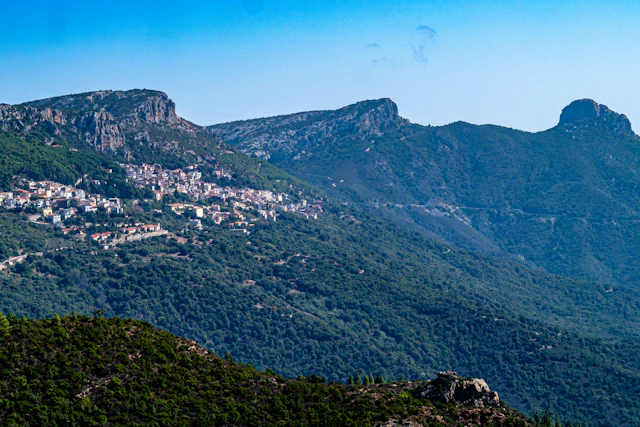
Put the five side by side and "mild and pleasant" starts to wobble. Sardinia's Blue Zone isn't the sunny coast of the postcards; it's a cluster of villages in the mountainous interior, between roughly 400 and 1,000 metres up. In Fonni, at 1,000 m, January averages about 4°C with nightly lows near freezing, and the summers are warm rather than hot. It's the same island that has beaches, but the longest-lived Sardinians live where it frosts. Ikaria is closer to the Mediterranean ideal — mild, wet winters and hot, dry summers — though its peaks do occasionally see snow.
Okinawa is warm year-round but humid and wet, with more than two metres of rain a year. Nicoya has essentially no winter: every month averages 26–29°C, with a hard dry season from November to April. And Loma Linda, the most "Southern California" of the five, is inland, where July highs average around 36°C and neighbouring San Bernardino's record is above 115°F (46°C). That's not mild; it's hot.
What the Blue Zones share, in other words, isn't a temperature. The demographers who validated four of them — Sardinia, Ikaria, Okinawa and Nicoya — note that "the climate varies greatly across the four sites with a prevalence of relatively warm temperatures." Warm-ish, then, but far from uniform — and it isn't what Michel Poulain, Gianni Pes and colleagues single out. They point instead to something else on the map: islands and mountain regions, relatively isolated, where traditional ways of living lasted longer (Poulain, Vienna Yearbook of Population Research 2013). The climates range from Mediterranean mountain to a hot tropical peninsula to a hot inland valley.
Mild Winters, More Winter Deaths — and Other Surprises
Evidence: Strong — national statistics and cross-country studiesIf a mild climate were protective in itself, the mildest places would do best. They don't — and the reasons are the most useful part of this story.
The winter paradox
In a comparison of 14 EU countries, the highest excess winter mortality — the extra deaths in winter compared with the rest of the year — wasn't in Finland or Germany. It was in Portugal, at 28%, followed by Spain and Ireland at 21%. Finland, with an average winter temperature of −3.5°C against Portugal's 13.5°C, had the lowest, at 10% (Healy, Journal of Epidemiology & Community Health 2003). The author's explanation was blunt: "Those countries with the poorest housing (Portugal, Greece, Ireland, the UK) demonstrate the highest excess winter mortality." The paper notes how few homes in Portugal and Greece had wall, roof or floor insulation or double glazing: houses built for summer, so when winter comes, people are cold indoors. A larger study of 31 countries a decade later found the same thing: the warmer a country's winters, the higher its excess winter deaths (Fowler, European Journal of Public Health 2015).
Extra deaths in winter, by country
Coefficient of seasonal variation in mortality, 1988–97 (Healy 2003). Gold = Mediterranean countries. Researchers link the pattern mainly to housing, heating and income rather than the weather itself: the coldest countries are best at keeping people warm indoors.
Heat tells a similar story from the other side. In the European summer of 2022, an estimated 61,672 people died from heat. The highest death rates were in Italy (295 per million), Greece (280) and Spain (237) — Italy and Greece being home to Europe's two Blue Zones — against a European average of 114 (Ballester, Nature Medicine 2023). Warm climates carry their own risk, and it's growing: the WHO estimates that heat-related deaths among over-65s rose by about 85% between the early 2000s and 2017–21 (WHO). Older bodies sweat less and struggle more to shed heat, which is exactly why a hot Blue Zone summer is a hazard to manage, not a perk.
Japan's cold-weather upset
The most striking test comes from Japan, which publishes life expectancy for every prefecture. Okinawa, warm and subtropical, was once the country's longevity capital — its men ranked first in 1980 and 1985. By 2000 they had fallen to 26th, a drop so shocking in Japan it got its own name, the "26 shock" (Okamoto, 2022). Meanwhile Nagano — a landlocked mountain prefecture where, in Nagano city, January averages below freezing and 163 cm of snow falls a year — climbed to the top, ranking first for both sexes in 2010.
Life expectancy at birth, Japanese prefectural rankings, 2020
Nagano
Mountains · Nagano city: January −0.4°C · 163 cm of snow a year- Men
- 2nd of 47 · 82.68 yrs
- Women
- 4th · 88.23 yrs
- 2015
- Women 1st, men 2nd
Okinawa
Subtropical islands · January 17.3°C · the Blue Zone- Men
- 43rd of 47 · 80.73 yrs
- Women
- 16th · 87.88 yrs
- 1980–85
- Men ranked 1st
Ministry of Health, Labour and Welfare prefectural life tables, 2015 and 2020. National average 2020: men 81.49, women 87.60.
Why the reversal? Explanations differ. Many researchers point to lifestyle — the island's shift towards a more Westernised diet and a car-dependent way of life after the war. Okamoto, whose paper tracks the rankings, argues something different: that Okinawan men's lead in the 1980s was largely a legacy of the Battle of Okinawa, which killed so many that the survivors were an unusually robust group — a selection effect, "not the effect of diet or lifestyle." Nagano, meanwhile, became known for a long-running community campaign to cut salt and improve diets. Whichever explanation is right, Okinawa's climate didn't change.
The world's longest-lived countries aren't the warmest
Cold and warm countries side by side
World Bank, life expectancy at birth, 2023. Bars start at 76 years. Japan and the US span snowy and subtropical regions, so they're shown as both.
At the level of whole countries, climate barely lines up with longevity. Switzerland, Sweden and Norway — long, dark, cold winters — sit alongside Spain and Italy near the top. Greece and Costa Rica, both home to Blue Zones, rank below all three, and below Iceland too. The same holds within the US: in 2022, Hawaii had the highest state life expectancy (80.0 years), but frosty Minnesota matched sunny California (79.3), and warm Florida (77.9) and Arizona (76.7) did worse than both (CDC, U.S. State Life Tables 2022). In Italy, the longest-lived region is Alpine Trentino-Alto Adige; the shortest-lived is sunny Campania, around Naples (Istat, Indicatori demografici 2024).
And then there's Loma Linda. Its residents' long lives were never about the valley. When Gary Fraser and David Shavlik compared Seventh-day Adventists across the whole of California with other white Californians, Adventist men could expect to live 7.3 years longer from age 30, and women 4.4 years longer — and they attributed the gap to diet, exercise, not smoking and body weight (Archives of Internal Medicine, 2001). Same state, same sun, same heat; different lives.
Not the Temperature — the Life It Allows
Evidence: Moderate — consistent observational studies, few trialsSo is the hunch wrong? Not entirely. It's pointing at the right thing through the wrong window. Weather doesn't seem to extend life directly — but it shapes how people live, and in the Blue Zones it has made one way of living especially easy: outdoors, on foot, all year.
People move more when the weather is good. A review of 37 studies found that 73% reported weather had a significant effect on physical activity (Tucker, Public Health 2007). A later review of 110 studies using activity trackers, covering 118,189 people in 30 countries, found activity was higher in summer than winter, rose with day length and temperature, and fell with rain, while sitting time went up in winter (Turrisi, IJBNPA 2021). Where there's no real winter, there's no winter slump. A shepherd in Sardinia or a farmer in Nicoya works outside in January as in July.
The ground matters more than the sky. The best direct evidence on what physical geography does in a Blue Zone comes from Sardinia. When Gianni Pes and colleagues compared all 377 Sardinian municipalities, the ones with the highest male longevity were steeper — an average slope of 15.2% versus 11.5% for the rest of the island — and their men travelled further to work each day, 12.4 km versus 8.2 km (Pes, Nutrition, Metabolism & Cardiovascular Diseases 2013). Terrain and the daily effort of getting around tracked longevity. Temperature wasn't even in the model. It's a useful correction to the map: the Sardinian Blue Zone is defined by hills, not by sunshine.
Daylight is its own signal. In 88,905 UK Biobank participants who wore light sensors for a week, people with the brightest days had a 17–34% lower risk of death over eight years than people whose days were average or dimmer, while bright light at night went with higher risk (Windred, PNAS 2024). A Swedish study of 29,518 women went further: over 20 years, those who avoided the sun had about twice the death rate of the most sun-exposed (Lindqvist, Journal of Internal Medicine 2014), and a later analysis put their life expectancy 0.6 to 2.1 years shorter (Lindqvist 2016). Both are observational, and healthier, fitter people go outside more — so these numbers overstate the effect of light itself. Tellingly, vitamin D pills don't reproduce it: in 50 trials with 74,655 people, supplements didn't reduce deaths from all causes (Zhang, BMJ 2019). Whatever sunlit, outdoor lives give people, it isn't only vitamin D. (Our morning sunlight guide covers what light does for sleep.)
Greenery helps too. Across nine cohort studies with more than 8 million people, living in greener surroundings was associated with lower mortality — 4% lower for each step up in a satellite greenness score (Rojas-Rueda, Lancet Planetary Health 2019). The Blue Zones are rural, green and close to where their food grows.
Climate Is a Helper, Not the Cause
Put it all together and the answer to the original question is a qualified one. A mild climate probably helps the Blue Zones a little — by making outdoor work, walking, gardening and socialising in the village square a year-round habit rather than a summer one. But it isn't what makes them special. Plenty of places share their weather without sharing their lifespans, some of the world's longest-lived people endure real winters, and the best-studied Blue Zone advantage — the Adventists' — travels with the person, not the postcode.
What you can borrow without moving
The encouraging part is that the pieces of the Blue Zone climate that seem to matter are portable:
- Get outside in daylight every day, especially in winter, when the weather-driven activity slump hits hardest. A daily walk is the simplest version.
- Find your hills. Sardinia's lesson is terrain: stairs, slopes and walking as transport build the kind of activity that doesn't feel like exercise.
- Keep your home at 18°C or warmer in winter — the WHO minimum, and higher for older or frail people. Cold homes, not cold climates, drive most winter deaths.
- Make a heat plan as you get older. Shade, fluids, a cool room and checking on older neighbours during heatwaves. The Mediterranean's hot summers are a risk the Blue Zone books rarely mention.
- Copy the lifestyle, not the latitude. Beans, plants, walking, family and purpose travel well — see the Blue Zones guide and our 7-day meal plan.
Frequently Asked Questions
It's not the weather. It's what the weather lets them do.
Cold kills more people than heat, and a gentle winter is a real advantage — but only if your home is warm, and the Blue Zones' climates turn out to be far more varied than the map suggests. Snowy Nagano outlives subtropical Okinawa; Portugal loses more people to winter than Finland; Adventists outlive their neighbours under the same California sun.
What the Blue Zones' landscapes really give their people is an easy, daily, outdoor life on foot, often up and down hills. That part you can have anywhere. Go outside every day, walk the steep way, keep your house warm in winter and cool in a heatwave, and borrow the rest of the lifestyle. You don't need a Mediterranean postcode for any of it.