- For most healthy people on most days, water is enough. The National Academies say the "vast majority" meet their hydration needs by letting thirst guide them, and most North Americans already eat more sodium than the 2,300 mg a day above which the National Academies advise cutting back
- Electrolytes earn their place in long or hot exercise with heavy sweating, and when you lose fluid through diarrhoea (or vomiting with it), where oral rehydration solution (ORS) is the standard treatment
- Sweat sodium varies a lot. Whole-body sweat carries about 230 to 1,610 mg of sodium per litre, and athletes typically sweat about 0.5 to 2 litres an hour, so hourly losses differ many times over between people
- In a hydration test of 13 drinks, whole milk, skimmed milk and ORS were retained better than water over 4 hours. A sports drink was not significantly different from water
- Over-drinking is an overlooked endurance risk: 13% of 488 Boston Marathon runners finished with low blood sodium. Weight gain during the race was the warning sign, and drinking sports drinks rather than water wasn't linked to lower risk
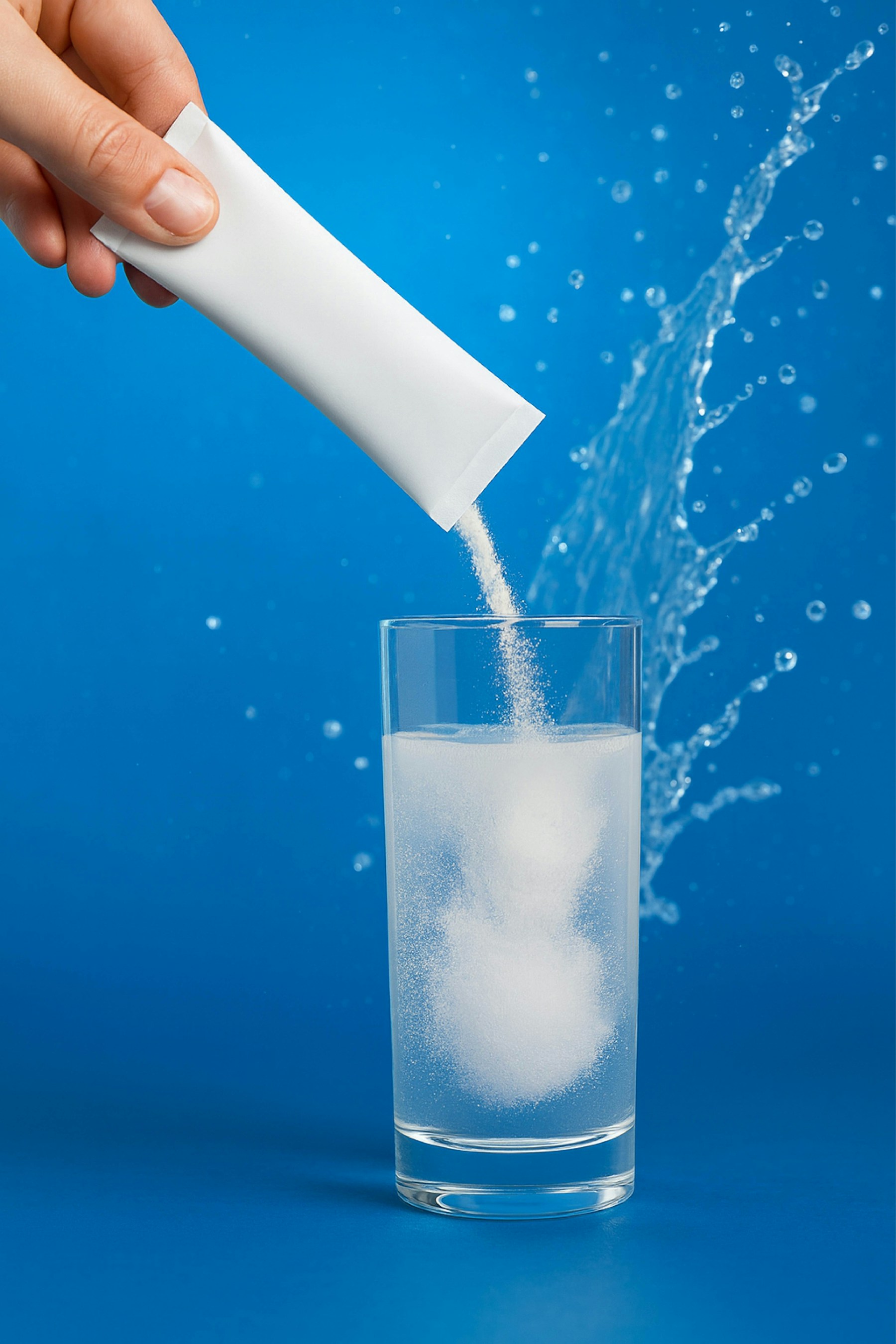
- LMNT has 1,000 mg of sodium per stick, about 43% of the 2,300 mg a day above which the National Academies advise cutting back. That suits heavy sweaters, not desk days. If you have high blood pressure, kidney or heart disease, ask your doctor first
Electrolyte powders have moved from the marathon start line to the office desk, sold on the idea that water alone doesn't really hydrate you.
The research is more nuanced. For most people on most days, water and ordinary food cover it. In a few situations sodium genuinely matters, and in one (drinking too much plain water during long endurance events) getting it wrong can be dangerous. This isn't medical advice: if you have a heart, kidney or blood pressure condition, talk to your doctor before changing your salt intake.
When Plain Water Is Enough
Evidence: Strong — official dietary guidanceWhen the National Academies set reference intakes for water in 2004, they concluded: "The vast majority of healthy people adequately meet their daily hydration needs by letting thirst be their guide." About 20% of our water comes from food rather than drinks (National Academies, 2004).
The exceptions: "Prolonged physical activity and heat exposure will increase water losses," and endurance athletes may need more sodium.
Nor is sodium usually short. The 2019 update set an adequate intake of 1,500 mg a day for everyone 14 and older, advised reducing intake if it's above 2,300 mg, and noted that most people in the US and Canada consume more than both (National Academies, 2019). For potassium, the adequate intake for adults is 3,400 mg a day for men and 2,600 mg for women (NIH).
How Much Sodium Sweat Really Costs
Evidence: Moderate — wide ranges, big individual differencesA widely cited summary of sweat losses is a 2017 Sports Medicine review by Lindsay Baker, who works for the Gatorade Sports Science Institute, part of PepsiCo (Baker, Sports Med 2017). Its main message is variability:
- How fast you sweat: whole-body sweat rates in athletes "typically" range from about 0.5 to 2.0 litres an hour. Over 3 litres an hour is rare.
- How salty it is: whole-body sweat sodium is about 10 to 70 mmol per litre. That's roughly 230 to 1,610 mg of sodium per litre of sweat.
- Even you vary: the same person's sweat rate differs by about 5% to 7% from day to day, and whole-body sweat sodium by about 11% to 17%.
Multiply the low and high ends and hourly sodium losses differ many times over, which is why no single number describes everyone.
Sodium lost per hour at the edges of the typical range
| Sweat rate | Less salty sweat 10 mmol/L = 230 mg/L | Very salty sweat 70 mmol/L = 1,610 mg/L |
|---|---|---|
| 0.5 L an hour lighter sweater | about 115 mg | about 805 mg |
| 2.0 L an hour heavy sweater | about 460 mg | about 3,220 mg |
Our calculation from the typical ranges in Baker, Sports Medicine 2017: whole-body sweat rate about 0.5–2.0 L/h and whole-body sweat sodium about 10–70 mmol/L (1 mmol of sodium = 23 mg). Real losses depend on intensity, heat, acclimatisation, body size and more.
The American College of Sports Medicine (ACSM) therefore recommends individual fluid plans, noting that "Individual sweat rates can be estimated by measuring body weight before and after exercise." It aims to keep dehydration during exercise under 2% of body weight, and says drinks with electrolytes and carbohydrates "can provide benefits over water alone" under certain circumstances (ACSM, 2007).
What the Hydration Index Found
Evidence: Moderate — one randomised trial, resting menWhich drinks actually stay in your body? In a 2016 randomised trial in the American Journal of Clinical Nutrition, Ronald Maughan and colleagues tested 13 common drinks in 72 healthy, active men (average age 24). Each drank 1 litre of water and 1 litre of three other drinks over 30 minutes on separate visits, fasted and already hydrated, and their urine was collected for 4 hours (Maughan, Am J Clin Nutr 2016). The beverage hydration index (BHI) compares urine after each drink with urine after water: less urine means more was retained.
Urine passed in 4 hours after drinking 1 litre, by drink
Mean urine over 4 hours after 1 L drunk in 30 minutes; 72 fasted, hydrated men aged 18–35; every man drank water, but each other drink was tested on about 17 of them. Milk and ORS were significantly lower than water; the other nine drinks, including the sports drink, coffee, tea, cola and lager, were not. Totals include all urine produced over the 4 hours.
After ORS, whole milk or skimmed milk, the men passed about 1,040 to 1,050 g of urine in 4 hours, against 1,337 g after water. At 2 hours their BHI was about 1.5 (urine after water was about one and a half times that after these drinks); by 4 hours they had passed roughly a fifth less urine than after water. The sports drink, with less than half the sodium of the study's ORS (21 versus 55 mmol per litre), was not significantly different from water.
Why? Drinks with energy empty from the stomach more slowly, and "the drinks with the highest electrolyte content tended to have the highest BHI." Milk has both, with about 18 to 19 mmol of sodium and 40 to 41 mmol of potassium per litre in the drinks tested.
What it doesn't tell you
- Resting, not exercising. The men started well hydrated and fasted, and the authors say the results relate only to "the acute effects of a large bolus of fluid over the subsequent four hours."
- Men only, aged 18 to 35.
- Industry funding. The study was funded by the European Hydration Institute, which, according to 2015 press reports, was set up with Coca-Cola money (City AM), and Maughan chairs its scientific advisory board. The sports drink tested, Powerade, is a Coca-Cola product.
The Danger of Too Much Water
Evidence: Strong — large observational studyIn endurance events, the risk that gets less attention is drinking too much. When people drink far more than they lose over many hours, blood sodium can fall, a condition called hyponatremia.
In a study published in the New England Journal of Medicine in 2005, researchers recruited runners before the 2002 Boston Marathon and took blood at the finish. Of 766 enrolled, 488 gave usable samples. Thirteen percent had hyponatremia (sodium at or below 135 mmol per litre) and 0.6% had critical hyponatremia (120 mmol per litre or below) (Almond, NEJM 2005).
- The main link was weight gain during the race: finishing heavier than you started means you drank more than you lost. Long racing times and very low or very high body-mass index were also linked.
- In simpler analyses, drinking more than 3 litres during the race, drinking at every mile, a finishing time over 4 hours, female sex and a low BMI were also associated, though female sex didn't hold up once other factors were accounted for.
- The type of drink mattered little. The composition of the fluids runners drank was not associated with hyponatremia; the authors say typical sports drinks are far less salty than blood, so the volume drunk matters much more than the type. A sports drink is no protection against drinking too much.
It's an observational study, so it shows associations rather than cause. Still, the lesson for a slower marathon, long hike or charity ride is clear: don't force fluids on a schedule. An international consensus statement on exercise-associated hyponatremia advises using thirst to guide drinking (Hew-Butler, Br J Sports Med 2015), and if you finish heavier than you started, you drank too much.
When Electrolytes Actually Help
Evidence: Strong for illness; moderate for exerciseLong or hot exercise and heavy sweating
When sweat losses run for hours, the sodium adds up (Figure 1), and this is where the ACSM says electrolyte-carbohydrate drinks can, in some circumstances, beat water. Afterwards, its goal is to "replace any fluid electrolyte deficit." Think of a long summer run or ride, a day of outdoor work in the heat, or a tournament.
Vomiting and diarrhoea
Here the evidence is strongest. The World Health Organization says diarrhoea should be treated with oral rehydration solution, a mix of clean water, salt and sugar that "is absorbed in the small intestine and replaces the water and electrolytes lost in the faeces" (WHO). Its reduced-osmolarity formula has, per litre, 2.6 g sodium chloride, 13.5 g glucose, 1.5 g potassium chloride and 2.9 g trisodium citrate dihydrate: 75 mmol of sodium and 20 of potassium (WHO Essential Medicines List).
For adults with diarrhoea, the US National Institute of Diabetes and Digestive and Kidney Diseases (NIDDK) advises water plus electrolyte drinks such as broths, sports drinks or ORS. Older adults and people with diabetes, kidney disease or other conditions should check with a doctor before using ORS, and anyone whose diarrhoea gets worse, or lasts more than 2 days despite over-the-counter medicine, should see one (NIDDK).
The first days of a fast or very-low-carb diet
Fasting makes the kidneys pass more sodium. In a small 1975 study of nine women with obesity, sodium excretion rose with fasting, and on refeeding with glucose "sodium excretion promptly decreased" (Sigler, J Clin Invest 1975). Some people feel light-headed or flat early in a fast or very-low-carb diet, but we found no good trials showing electrolyte supplements help, so a little extra salt (a cup of broth, say) is reasonable to try, not proven. If you take diabetes or blood pressure medicine, talk to your doctor before fasting or cutting carbs hard.
Water, Sports Drink, LMNT, ORS, Milk: Side by Side
Here's what a typical serving of each contains. Note the very different serving sizes: one LMNT stick packs more sodium than three 20 oz bottles of Gatorade.
Sodium, potassium and sugar in common options
| Drink serving | Sodium | Potassium | Sugar |
|---|---|---|---|
| Bottled water 500 mL | ~10 mg | 0 mg | 0 g |
| Gatorade Thirst Quencher 20 oz bottle | ~270 mg | ~90 mg | ~32 g |
| LMNT 1 stick | 1,000 mg | 200 mg + 60 mg magnesium | 0 g |
| WHO oral rehydration solution 500 mL, as made up | ~860 mg | ~390 mg | ~6.8 g glucose |
| Whole milk 1 cup (244 g) | ~105 mg | ~320 mg | ~12 g naturally occurring |
| Coconut water 1 cup (240 g) | ~250 mg | ~600 mg | ~6 g |
Water, milk, coconut water: USDA FoodData Central (SR Legacy 174158, 171265, 170174). Gatorade: sodium from Gatorade ("about 270 mg" per 20 oz); potassium and sugar from USDA's analysis (173660), so may differ slightly from today's label. LMNT: maker's page. ORS: WHO formula, halved. Packaged coconut waters vary by brand.
A standard sports drink is mostly sugar with modest sodium: the carbohydrate can help in long exercise, but it's no sodium top-up. ORS is far saltier and built for illness. Milk adds potassium and energy, which may explain why it was retained so well. Coconut water is rich in potassium with moderate sodium.
LMNT: Who It Suits, Who It Doesn't
LMNT is a zero-sugar electrolyte mix. The maker lists 1,000 mg of sodium, 200 mg of potassium and 60 mg of magnesium per stick. The unflavoured version is just salt, magnesium malate and potassium chloride; flavoured versions add natural flavours and stevia leaf extract, plus citric or malic acid (or cocoa powder in the chocolate flavours). A 30-stick box is $45 on LMNT's site at the time of writing, $1.50 a stick (LMNT).
To be plain: 1,000 mg is two-thirds of the 1,500 mg adequate intake and about 43% of the 2,300 mg level above which the National Academies advise cutting back. If you aren't sweating heavily, that's a lot of added salt for a day most people already exceed. LMNT says many people find one to two sticks a day "optimal" depending on activity. Its dosing advice rests on its view that 4 to 6 grams of sodium a day is optimal, far above the National Academies' 2,300 mg level.
- It suits: people who sweat heavily for long periods (long runs, rides, hikes, hot outdoor work), and people whose sweat is especially salty. It's also a sugar-free option if you don't want the 30-odd grams in a sports drink bottle.
- It doesn't suit: desk days, short workouts, or anyone told to limit salt. It's also no substitute for oral rehydration solution in diarrhoea or vomiting: the WHO formula contains glucose as well as salts, and LMNT has no sugar.
- Be careful if: you have high blood pressure, kidney disease or heart disease, or take medicines such as ACE inhibitors or potassium-sparing diuretics, which can raise blood potassium. The NIH notes that people at risk of high potassium should consult a physician or dietitian (NIH ODS). Ask your doctor before using high-sodium mixes.
A Simple Hydration Plan
- Everyday life: drink water when you're thirsty and eat normally. You don't need electrolyte drinks, and most people already get more sodium than recommended.
- Ordinary workouts in normal conditions: water is fine. There's no reason to add salts or sugar.
- Long or hot sessions: weigh yourself before and after a typical session to estimate how much you sweat, as the ACSM suggests. Aim not to lose more than 2% of your body weight, and don't finish heavier than you started. For sessions of several hours, a drink with sodium (and carbohydrate if you need fuel) makes sense.
- Endurance events: drink to thirst rather than at every aid station. Gaining weight during a race is the warning sign for hyponatremia, whatever you're drinking.
- Afterwards: the ACSM's goal is to replace any fluid and electrolyte deficit. After ordinary sessions, regular meals and drinks usually do that; milk may be a good choice given how well it was retained at rest.
- Diarrhoea or vomiting: use an oral rehydration solution from the pharmacy. If you're older or have diabetes, kidney disease or another health condition, check with a doctor first, and see a doctor if diarrhoea gets worse or lasts more than 2 days despite over-the-counter treatment.
- On blood pressure, kidney or heart medicines: check with your doctor before using any high-sodium or high-potassium product.
If heat is part of your routine, our sauna guide covers how to approach it safely, and our fasting timeline covers what happens in the first days without food.
Frequently Asked Questions
Water for most days, salt for sweaty ones.
For everyday life and ordinary workouts, water and normal food are enough, and most of us already eat more sodium than we should. Electrolytes matter when sweat losses run for hours, and oral rehydration solution is the right tool for vomiting and diarrhoea.
In endurance events, drinking too much is a real and often overlooked risk, alongside dehydration. If you use a high-sodium mix like LMNT, save it for heavy sweating, and talk to your doctor first if you have high blood pressure, kidney or heart disease.
Sources
- National Academies of Sciences, Engineering, and Medicine. Report sets dietary intake levels for water, salt, and potassium to maintain health and reduce chronic disease risk. News release, 11 February 2004.
- National Academies of Sciences, Engineering, and Medicine. Sodium and potassium dietary reference intake values updated in new report. News release, 5 March 2019.
- NIH Office of Dietary Supplements. Potassium: Fact Sheet for Health Professionals.
- Baker LB. Sweating rate and sweat sodium concentration in athletes: a review of methodology and intra/interindividual variability. Sports Medicine 2017;47(Suppl 1):S111–S128 (supplement supported by the Gatorade Sports Science Institute) (doi:10.1007/s40279-017-0691-5).
- Sawka MN, Burke LM, Eichner ER, Maughan RJ, Montain SJ, Stachenfeld NS. American College of Sports Medicine position stand: Exercise and fluid replacement. Medicine & Science in Sports & Exercise 2007;39(2):377–390 (doi:10.1249/mss.0b013e31802ca597).
- Maughan RJ, et al. A randomized trial to assess the potential of different beverages to affect hydration status: development of a beverage hydration index. American Journal of Clinical Nutrition 2016;103(3):717–723 (doi:10.3945/ajcn.115.114769). Accepted manuscript via Liverpool John Moores University.
- City AM. Coca-Cola pumps millions into scientific research disproving link between sugary drinks and obesity. 9 October 2015.
- Almond CSD, et al. Hyponatremia among runners in the Boston Marathon. New England Journal of Medicine 2005;352(15):1550–1556 (doi:10.1056/NEJMoa043901).
- Hew-Butler T, Rosner MH, Fowkes-Godek S, et al. Statement of the 3rd International Exercise-Associated Hyponatremia Consensus Development Conference, Carlsbad, California, 2015. British Journal of Sports Medicine 2015;49(22):1432–1446 (doi:10.1136/bjsports-2015-095004).
- World Health Organization. Diarrhoeal disease (fact sheet).
- World Health Organization. Oral rehydration salts. WHO Electronic Essential Medicines List. See also Oral rehydration salts: production of the new ORS (WHO/FCH/CAH/06.1, 2006).
- National Institute of Diabetes and Digestive and Kidney Diseases. Treatment of Diarrhea.
- Sigler MH. The mechanism of the natriuresis of fasting. Journal of Clinical Investigation 1975;55(2):377–387 (doi:10.1172/JCI107941).
- USDA FoodData Central, SR Legacy: Water, bottled, generic (174158); Beverages, PEPSICO QUAKER, Gatorade, G performance O 2, ready-to-drink (173660); Milk, whole, 3.25% milkfat, with added vitamin D (171265); Nuts, coconut water (170174).
- Gatorade. Gatorade Thirst Quencher Lemon-Lime (product page and FAQ).
- LMNT. LMNT Zero-Sugar Electrolytes (product page), FAQ, How much LMNT can I drink per day? and ingredients by flavour.