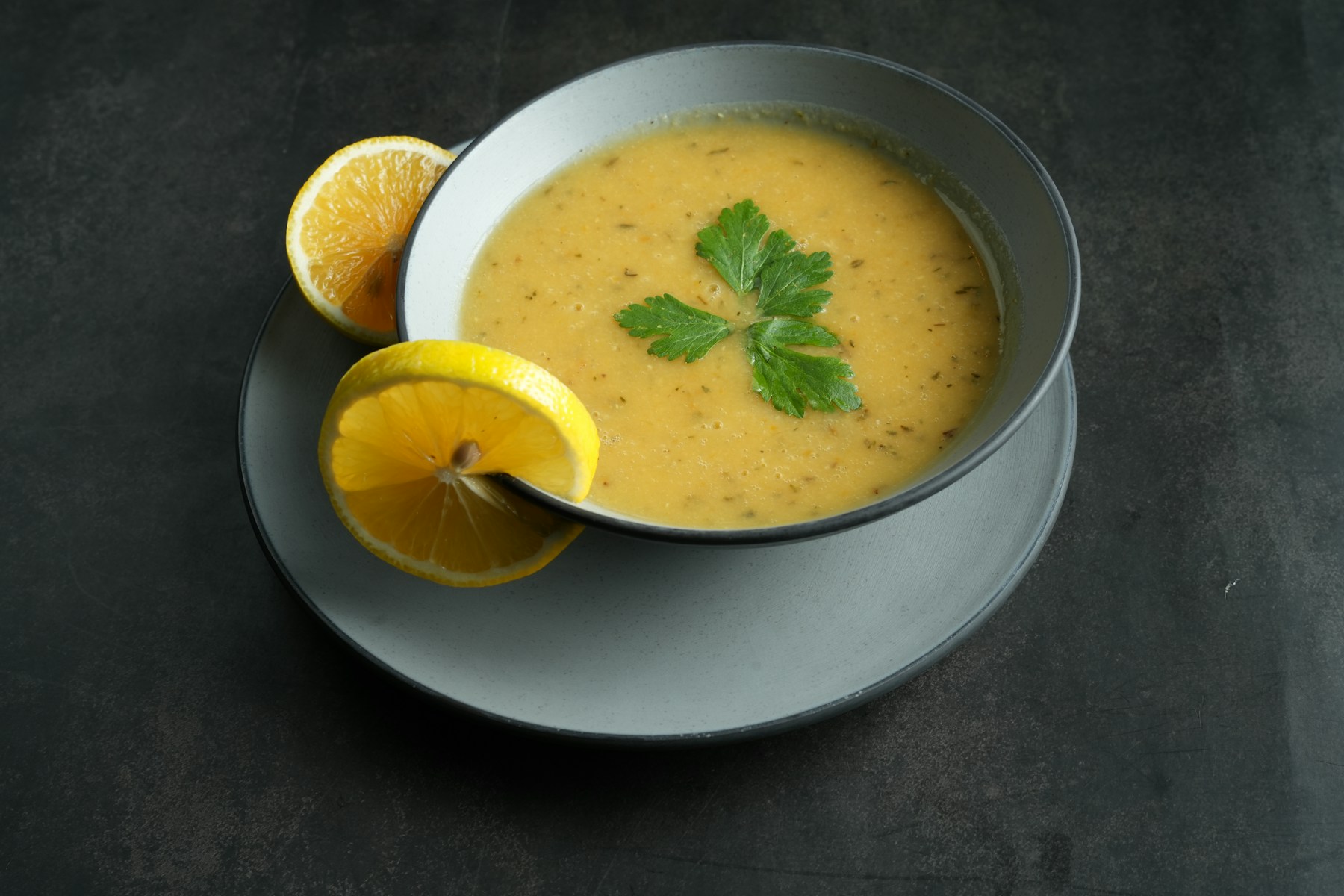
The name joins the Greek words for egg, avgo, and lemon. Eggs and lemon juice are whisked together, warmed with ladles of hot broth and stirred back into the pot, and a plain chicken and rice soup turns pale, silky and bright. Saveur notes that egg-and-lemon soups turn up all over the world, but this classic belongs to the Mediterranean. Diane Kochilas, revisiting her mother’s recipe, calls the soup light and easy on the stomach, and a good choice when you are feeling under the weather. That is the right way to think about it: a very good bowl of soup, not a medicine and not a longevity secret.
The only hard part is the eggs, and only if you rush. Pour beaten eggs into a boiling pot and they set into shreds before they can blend in: egg-drop soup when you wanted silk. The fix is tempering. You warm the eggs gradually by whisking hot broth into them a ladle at a time, pour them into the pot, and never let it boil again. Whisking the whites to a foam first, then the yolks and lemon, gives a light mixture and a soft, almost creamy soup. Whole eggs whisked until frothy work too.
A proper stock matters, because there is so little else in the pot. Simmering a whole chicken gives you a golden broth and the meat in one go; a good low-sodium shop-bought stock and a few thighs get you there in about an hour. Worked out from USDA FoodData Central values, a bowl with chicken, one of six, is roughly 330 calories and 26 g of protein, with about 550 mg of sodium before you add any salt. The rice is white, so there is almost no fibre; serve horta or a salad alongside.
A sometimes-dish in the Blue Zone pattern. The Blue Zones organisation describes the Ikarian way of eating as a variation of the Mediterranean diet, with lots of fruit and vegetables, whole grains, beans, potatoes and olive oil. Meat is not at the centre of it. In its food guidelines, the organisation says that, averaging out consumption across the Blue Zones, people ate about two ounces of meat or less about five times a month, and that people in all of the Blue Zones eat eggs about two to four times a week. Its own advice is stricter: it does not recommend meat or eggs as part of a Blue Zones diet, and says anyone who eats eggs should keep to three a week or fewer. A bowl of this soup has about 47 g (1⅔ oz) of chicken and half an egg. Avgolemono is a pan-Greek comfort soup, not an Ikarian speciality, and no study has tested it. At most it fits the observed pattern as an occasional dish.
Protein, which matters more as you age. With the chicken in, each bowl has about 26 g of protein by USDA values, roughly half of the Recommended Dietary Allowance of 56 g a day for men and 46 g for women. That RDA is a floor. An international expert group appointed by the European Union Geriatric Medicine Society, the PROT-AGE Study Group (Bauer and colleagues, Journal of the American Medical Directors Association, 2013), recommends that people over 65 average at least 1.0 to 1.2 g of protein per kilogram of body weight a day, more for those who exercise, and 1.2 to 1.5 g/kg for most older adults with an acute or chronic illness. For a 70 kg (154 lb) person, 1.0–1.2 g/kg is 70–84 g a day, so one bowl covers about a third. Soft and warm, it is an easy way to get protein in when appetite is low. The group made an exception for people with severe kidney disease who are not on dialysis, who may need to limit protein, so if that is you, ask your doctor what is right.
The lemon is for flavour, not vitamin C. By USDA values, the juice of about two lemons carries 35 mg of vitamin C, or about 6 mg a bowl, before any is lost to heat. The NIH Office of Dietary Supplements sets the RDA at 90 mg a day for men and 75 mg for women, so a bowl gives you well under a tenth. The same NIH fact sheet also reports a Cochrane review finding that taking vitamin C regularly did not significantly reduce the risk of catching a cold in the general population, though it modestly shortened colds, by 8% in adults; taking it after symptoms start did not appear to help. The lemon is there for taste.
Chicken soup and colds: a lab finding, not a cure. In a study published in Chest in 2000, Rennard and colleagues tested a traditional homemade chicken soup on neutrophils, white blood cells involved in inflammation, taken from healthy non-smoking volunteers. In the lab, the soup reduced the cells’ migration toward an inflammatory signal, and the more concentrated the soup, the bigger the effect. Thirteen shop-bought soups varied greatly. The authors suggested a mild anti-inflammatory effect could be one way soup might ease cold symptoms, but noted this was not a clinical trial. Nobody has shown that it happens in a person who eats a bowl, or that soup shortens a cold or the flu.
In Greece, the overall pattern mattered more than any one food. In a population study of 22,043 Greek adults (Trichopoulou and colleagues, New England Journal of Medicine, 2003), people were scored on a 10-point scale for how closely they followed a traditional Mediterranean diet and followed for a median of 44 months, during which 275 died. Each two-point step up the score was linked with a 25% lower risk of death (hazard ratio 0.75, 95% CI 0.64–0.87), with lower risks of death from coronary heart disease (0.67) and cancer (0.76). On their own, individual food groups were generally not significantly linked with mortality. This is observational, so it shows a link rather than cause and effect. It is the honest frame for avgolemono: one small part of a way of eating, not a medicine.
The Ingredients
- For the stock
- 1 (1.6kg / 3½ lb)whole chicken
- 3 litres (12¾ cups)cold water
- 1 largeonion, halved
- 2carrots, cut into chunks
- 2 stickscelery, cut into chunks
- 1bay leaf
- 8black peppercorns, plus a few parsley stalks if you have them
- For the soup
- 2 litres (8½ cups)of the strained stock (or a good low-sodium shop-bought stock; see the shortcut below)
- 150g (¾ cup)medium-grain white rice, such as Greek Carolina-type or arborio, or 150g (5 oz) orzo
- About 280g (2 cups)shredded cooked chicken from the stock, skin and bones removed
- 3 largeeggs
- 90ml (6 tbsp)fresh lemon juice, from about 2 lemons, plus more to taste and wedges to serve
- To tastesalt; taste first, as each ¼ tsp adds about 100mg sodium a bowl
- Black or white pepper, and chopped fresh dill or parsley to serve.
The shortcut. Skip steps 1 and 2. Bring 2 litres (8½ cups) of good low-sodium shop-bought chicken stock to a simmer, add 500g (1 lb) of boneless, skinless chicken thighs and poach them gently for 15–20 minutes, until they reach 165°F (74°C) in the middle. Lift them out, shred them, and carry on from step 3. Leftover roast chicken works too, but shop-bought rotisserie chickens can be seasoned with salt, so taste before you season.
How to Make It
Put the chicken in your largest pot, breast side up, and cover it with the 3 litres of cold water. Bring it slowly to a simmer over a medium heat. For the first 10–15 minutes, grey foam will rise; skim it off with a large spoon. Add the onion, carrots, celery, bay leaf, peppercorns and parsley stalks. Turn the heat down until only a few lazy bubbles break the surface, partly cover, and simmer for 1¼–1½ hours, until the leg meat pulls easily away from the bone. Keep it gentle; a hard boil makes a cloudy, greasy stock. Don’t salt it yet. The chicken must reach at least 165°F (74°C) in the thickest part of the thigh; after this long it will be well past that, but check if you have a thermometer.
Lift the chicken onto a board. Pour the stock through a fine sieve into a clean pot or a large bowl and throw away the vegetables. Spoon off as much of the yellow fat from the surface as you can (or cool the stock quickly, divided into shallow containers and in the fridge within 2 hours, then lift off the set fat the next day). Measure out 2 litres. If you are short, top it up with water; if you have extra, freeze it for another day. When the chicken is cool enough to handle, pull the meat off the bones, discard the skin and bones, and shred about 280g (2 cups) into bite-sized pieces for the soup. Keep the rest, which is roughly another 250–300g, to serve on the side.
Bring the 2 litres of stock to the boil in a large pot. Stir in the rice, lower the heat and simmer, partly covered, for 15–18 minutes, stirring now and then so it doesn’t stick, until the rice is tender. Orzo needs less time, usually 8–10 minutes; check the packet. Stir in the shredded chicken for the last 2 minutes to warm it through, then turn the heat right down so the pot is barely simmering.
While the rice cooks, separate the eggs, putting the whites in a large bowl that will hold at least 2 litres. Whisk the whites until they turn into a thick, white foam that just holds soft peaks: 2–3 minutes by hand, about a minute with an electric whisk. Whisk in the yolks one at a time, then pour in the lemon juice in a thin stream, whisking all the time. If you would rather not separate them, whisk the whole eggs hard for 1–2 minutes until pale and frothy, then whisk in the lemon. Both work; the foam gives a little more margin for error.
This is the step that matters. Take the pot off the heat and wait about a minute, until it stops bubbling. Using a ladle, scoop up hot broth, trying not to catch the rice, and pour it into the egg mixture in a thin, steady stream while you whisk without stopping. Do the same with another ladle, then another, until you have added 4–5 ladles, about 500–600ml (2–2½ cups). The bowl should now feel hot and hold about twice the volume you started with. Pour the tempered mixture back into the soup in a slow stream, stirring the pot gently as you go.
Put the pot back on a low heat. Stir slowly and constantly, scraping the bottom, for 2–4 minutes, until the soup turns opaque and silky and thickens a little, enough to coat the back of a spoon. If you have an instant-read thermometer, take it to 160°F (71°C) in the middle of the pot, the temperature FoodSafety.gov gives for egg dishes. With the broth this hot, it is usually there or above as soon as the eggs go back in; the gentle stirring is to make sure, not to cook it hard. Do not let it bubble. Boiling is what splits avgolemono into flecks of cooked egg, so if you see a bubble break the surface, lift the pot off the heat straight away. Taste, then add salt, pepper and more lemon as you like.
Ladle into warm bowls and scatter with dill or parsley and a grind of pepper, with lemon wedges on the side. Serve the rest of the chicken on a plate alongside, with a squeeze of lemon and a little olive oil, or add it to the bowls of anyone who wants a heartier meal. Cool leftovers and refrigerate them within 2 hours, and eat them within 3–4 days. Reheat gently over a low heat, stirring and adding a splash of water or stock to loosen it, until it reaches 165°F (74°C) on a thermometer, the FDA’s figure for reheated egg dishes. USDA’s general advice for soups is to bring them to a rolling boil; that would split this one, so check the temperature instead. It doesn’t freeze well, because the egg-thickened broth can turn grainy, so freeze spare stock instead.
If It Goes Wrong
- A few flecks of egg. Take the pot off the heat at once and pour the soup into a cool bowl or pot to stop the cooking. A hard whisk will often smooth small flecks away.
- It has split. Give it 10–20 seconds with a stick blender. It comes back smooth and creamy. The rice will be partly blended, so the texture is thicker, but the flavour is the same.
- It is thinner than you hoped. Avgolemono should be like a thin custard, not a gravy, and it thickens as it stands. Next time, add an extra yolk.
- It has set thick overnight. The rice soaks up the broth. Loosen it with hot water or stock as you reheat it gently, and add a squeeze of lemon.
Questions People Ask
No. Nobody has shown that it does. The study usually quoted, by Rennard and colleagues in Chest in 2000, was a lab study: chicken soup reduced the migration of inflammatory white blood cells in a lab test. It was not a clinical trial. The lemon will not do it either; a bowl has about 6 mg of vitamin C, and the NIH notes that regular vitamin C did not significantly reduce the risk of catching a cold in the general population. Soup is warm, easy to eat and a good way to get fluid and protein when you feel rough. If you have the flu, especially if you are older, pregnant or have a long-term condition, talk to your doctor.
Not in any special sense. It is a comfort soup made all over Greece, not an Ikarian speciality. The Blue Zones organisation says that, averaged across the Blue Zones, people ate about two ounces of meat or less about five times a month, and eggs two to four times a week, though its own guidelines go further and do not recommend meat or eggs, suggesting three eggs a week or fewer for those who eat them. A bowl here has about 47 g (1⅔ oz) of chicken and half an egg, so at most it fits the observed pattern as an occasional dish, not an everyday one. It is a good soup, not a longevity secret.
The stock brings almost all of it. Our figure of about 550 mg a bowl uses USDA’s value for home-prepared chicken stock, with no salt added to the soup; the eggs and chicken add about 70 mg of that. An unsalted stock like this one may well come in lower. Each ¼ teaspoon of salt adds about 100 mg a bowl. By USDA values, an ordinary shop-bought broth would make it about 1,300 mg, a reduced-sodium broth about 840 mg, and a low-sodium broth about 170 mg, the easiest cut. The FDA counts 460 mg (20% of the Daily Value) or more a serving as high. Brands vary, so check the label, and taste before salting. If you have been told to watch your sodium or blood pressure, talk to your doctor about how dishes like this fit in.
Usually, yes. Take it off the heat the moment you see flecks and pour it into a cool bowl to stop the cooking. A hard whisk smooths a few flecks; if it has split, 10–20 seconds with a stick blender brings it back, thicker and creamier but just as good. The usual causes are broth still boiling when the eggs went in, broth added too fast, or a boil afterwards.
Yes, if you heat it properly. FoodSafety.gov gives 160°F (71°C) for egg dishes and 165°F (74°C) for chicken and leftovers, and the FDA says reheated egg dishes should reach 165°F. Stirring gently over a low heat gets you there without boiling. USDA’s general advice for reheating soups is a rolling boil; that would split this one, so check with a thermometer instead. The FDA also advises refrigerating egg dishes within 2 hours and eating leftovers within 3–4 days. To get ahead, make the stock and pick the chicken a day or two before, cool both quickly in shallow containers and refrigerate within 2 hours, and do the rice and egg-lemon on the day, which takes about 35–40 minutes. The finished soup doesn’t freeze well; the stock does.
Sources
- Blue Zones. Ikaria, Greece. bluezones.com
- Blue Zones. Food Guidelines. bluezones.com
- Rennard BO, Ertl RF, Gossman GL, Robbins RA, Rennard SI. Chicken soup inhibits neutrophil chemotaxis in vitro. Chest. 2000;118(4):1150–1157. Article (PDF)
- Bauer J, et al. Evidence-based recommendations for optimal dietary protein intake in older people: a position paper from the PROT-AGE Study Group. J Am Med Dir Assoc. 2013;14(8):542–559. Article · Abstract
- Food and Nutrition Board, National Academies. Dietary Reference Intakes: Recommended Dietary Allowances and Adequate Intakes, Total Water and Macronutrients. ncbi.nlm.nih.gov
- NIH Office of Dietary Supplements. Vitamin C: Fact Sheet for Health Professionals. ods.od.nih.gov
- Trichopoulou A, Costacou T, Bamia C, Trichopoulos D. Adherence to a Mediterranean diet and survival in a Greek population. N Engl J Med. 2003;348(26):2599–2608. Article
- FoodSafety.gov. Cook to a Safe Minimum Internal Temperature. Last reviewed November 2024. foodsafety.gov
- US Food and Drug Administration. What You Need to Know About Egg Safety. fda.gov
- US Food and Drug Administration. Sodium in Your Diet. 2021. fda.gov (PDF)
- Kochilas D. Easy avgolemono soup (Greek lemony chicken soup). dianekochilas.com
- Saveur. Avgolemono. saveur.com
- USDA FoodData Central, SR Legacy: Soup, stock, chicken, home-prepared (FDC 172884); Soup, chicken broth, ready-to-serve (FDC 174536); Soup, chicken broth, less/reduced sodium, ready to serve (FDC 172888); Soup, chicken broth, low sodium, canned (FDC 171609); Chicken, broilers or fryers, meat only, cooked, stewed (FDC 171451); Egg, whole, raw, fresh (FDC 171287); Rice, white, medium-grain, raw, enriched (FDC 168879); Pasta, dry, enriched (FDC 169736); Lemon juice, raw (FDC 167747); Salt, table (FDC 173468). fdc.nal.usda.gov


