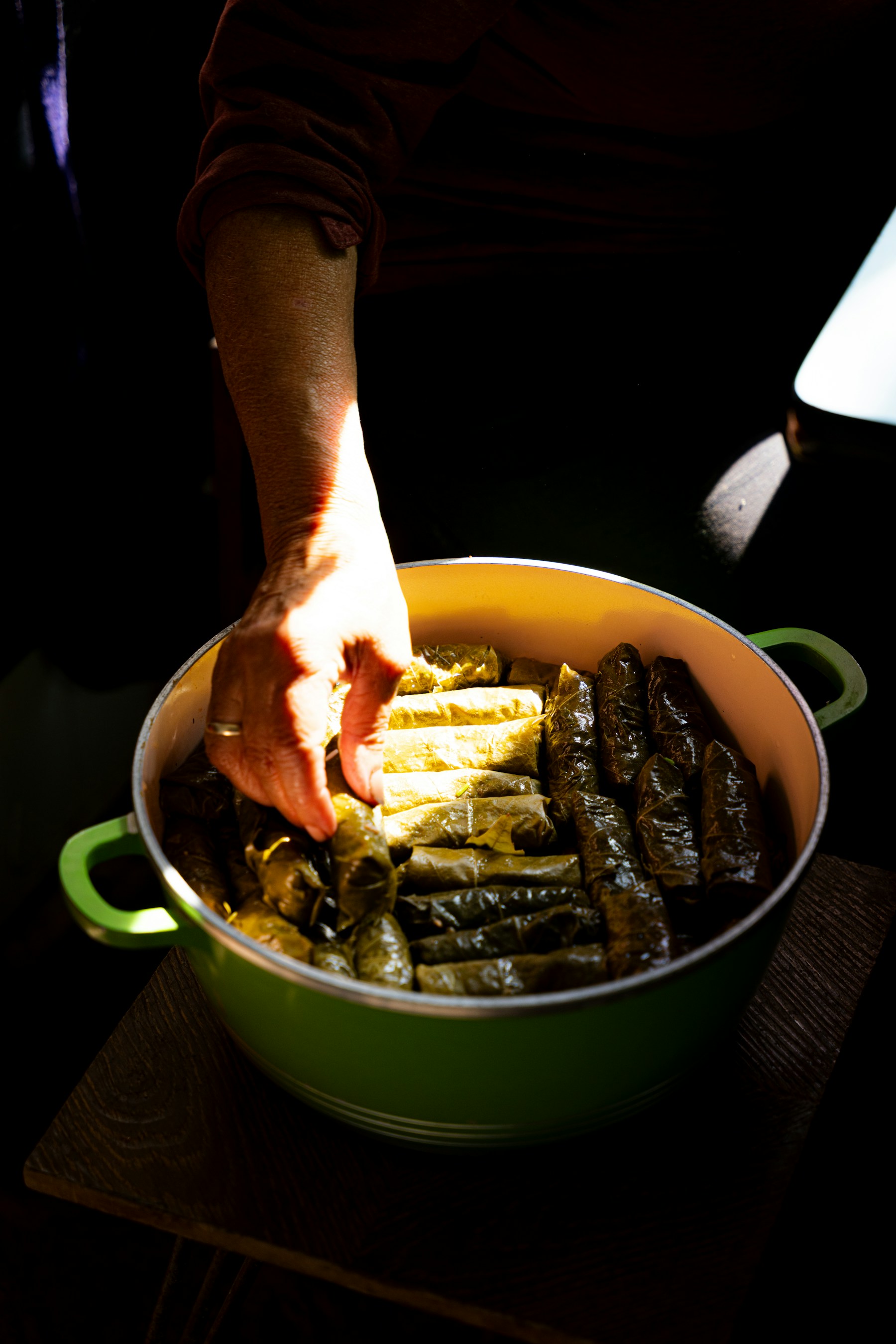
Dolmades are stuffed vine leaves, and dolmadakia are the little ones, rolled no thicker than a finger. This is the meatless kind, which Greeks call gialantzi. Thessaloniki's City of Gastronomy explains that the dish came from Asia Minor and that the name means "fake", in other words, without meat. Rice-stuffed dolmades are one of the traditional dishes of the Greek Orthodox fasting table, which rules out meat and dairy during Lent and on other fasting days, and Dan Buettner counts dolmades among Greece's most celebrated dishes. They are not an Ikarian speciality. The island had its own version, and we come to that below.
The cooking is easy. The rolling is the part that takes time, and the first ten are slow. By the last ten you will be doing one in well under a minute. Everything that makes the difference between dolmadakia that hold their shape and a pot of loose rice and torn leaves is in the method below: soften the leaves properly, don't overfill, roll snug but not tight, pack the pot closely, put a plate on top, keep the heat low and then leave them alone to rest. Those are the things a Greek grandmother would tell you if she were standing at your elbow, and none of them is hard.
Worked out from USDA FoodData Central values, a serving of six or seven dolmadakia comes to roughly 320 calories, 19 g of fat, nearly all of it olive oil, 4 g of protein and 4 g of fibre. That is light on protein, so treat them as a meze or a side and put beans or yoghurt on the table too. The thing to watch is salt. By USDA's figure, canned vine leaves carry 2,850 mg of sodium per 100 g, and they are the main reason this dish can be salty. The salt section below shows what to do about it.
Ikaria made dolmades, just not these ones. On his recipe page for dolmades, Dan Buettner, author of The Blue Zones Kitchen, writes that rice was considered a luxury in Greece until around the 1960s and was especially scarce on Ikaria. Ikarians traditionally stuffed their dolmades, whether made with grape leaves, cabbage or collard leaves, with corn instead. Diane Kochilas tells the same story from her elderly aunt, a keeper of old Ikarian recipes, who remembered that when she was a girl only well-to-do families could afford rice, so Ikarians used dried corn instead. So the rice version here is the pan-Greek one. It fits the island's pattern, which the Blue Zones organisation describes as a variation of the Mediterranean diet with lots of fruit and vegetables, whole grains, beans, potatoes and olive oil, set within a religious calendar that called for fasting for almost half the year. Dolmadakia gialantzi are plant food, herbs and olive oil, made for fasting days (strict observers keep oil itself for weekends during Lent). No study has tested this dish on its own, and the rice is white rice, not a whole grain.
The olive oil is linked to lower mortality. In a study of two large US cohorts (Guasch-Ferré and colleagues, Journal of the American College of Cardiology, 2022), 60,582 women and 31,801 men were followed for 28 years, during which 36,856 died. People who used more than half a tablespoon (about 7 g) of olive oil a day had a 19% lower risk of death from any cause than those who never or rarely used it (hazard ratio 0.81, 95% CI 0.78–0.84). In modelling, replacing 10 g a day of margarine, butter, mayonnaise or dairy fat with the same amount of olive oil was linked with an 8–34% lower risk of death, overall and from specific causes. Swapping olive oil for other vegetable oils combined showed no clear difference. This is observational: people who use more olive oil may differ in other ways that affect how long they live. A serving of these dolmadakia has about 18 g of olive oil, more than twice the top group's threshold.
In Greece, the pattern mattered more than any one food. A large population study in Greece (Trichopoulou and colleagues, New England Journal of Medicine, 2003) scored 22,043 Greek adults on how closely they ate a traditional Mediterranean diet, on a 10-point scale, and followed them for a median of 44 months, during which 275 died. Each two-point step up the score was linked with a 25% lower risk of death (adjusted hazard ratio 0.75, 95% CI 0.64–0.87), with lower risks of death from coronary heart disease (0.67) and cancer (0.76). On their own, the individual food groups were mostly not significantly linked with mortality. That is the honest way to see a dish like this: a small, tasty part of a way of eating, not a medicine. It is an observational study, so it shows a link rather than cause and effect.
A trial backs olive oil within the pattern. The PREDIMED trial (Estruch and colleagues, New England Journal of Medicine, 2018) assigned 7,447 people in Spain, aged 55 to 80 and at high cardiovascular risk but without cardiovascular disease, to a Mediterranean diet supplemented with extra-virgin olive oil, the same diet with nuts, or advice to cut down on fat. Over a median of 4.8 years, 288 had a heart attack, a stroke or died of cardiovascular causes. Compared with the low-fat advice group, the olive oil group had a 31% lower rate of these events (hazard ratio 0.69, 95% CI 0.53–0.91), and the nut group 28% lower (0.72). Two caveats: it measured heart attacks, strokes and cardiovascular deaths, not overall lifespan, and the authors withdrew their original 2013 report after finding that some participants had not been randomly assigned as the protocol required, and in 2018 published revised analyses that do not rely solely on the assumption of randomisation; leaving out the 1,588 affected participants gave similar results.
The leaves themselves: useful, not magic. By USDA values, canned vine leaves have 9.9 g of fibre and 289 mg of calcium per 100 g. A serving here uses only about 27 g of leaves, which gives you roughly 2.6 g of fibre, more than half the dish's total, and about 77 mg of calcium. Fresh leaves look better on paper for vitamin A, with 1,380 µg RAE per 100 g raw against 263 µg for canned, and they have almost no sodium. Some of what is in fresh leaves will be lost in blanching and simmering, so treat these as rough figures. The leaves are a modest part of the story. The olive oil, and the mostly plant-based way of eating this dish belongs to, matter more.
The Ingredients
- 1 jar, about 450g (16 oz)vine leaves in brine, or about 50 fresh young vine leaves. You need about 40 good leaves to roll and 10 or so torn or odd-sized ones to line the pot
- 120ml (½ cup)extra-virgin olive oil, divided, plus a little to serve
- 1 largeonion, about 150g (5 oz), grated or very finely chopped
- 1 bunchspring onions (6–8), about 100g (3½ oz), finely sliced, green tops included
- 200g (1 cup)medium-grain white rice, such as Greek Carolina (karolina) or arborio, rinsed and drained
- 30g (1 oz)fresh dill, a generous bunch, finely chopped
- 15g (½ oz)fresh mint, ideally spearmint, finely chopped (or 2 tsp dried)
- 30g (1 oz)flat-leaf parsley, finely chopped
- ¼ tspsalt with jarred leaves, or ½ tsp with fresh leaves
- 2lemons, juiced (about 6 tbsp / 90ml), plus 1 more cut into wedges to serve
- About 500ml (2 cups)hot water, plus a splash more if needed
- Black pepper. To serve, if you like: thick Greek yoghurt, about 50g (3 tbsp) a person.
How to Make It
Jarred leaves come rolled tightly in brine. Ease the bundles out of the jar without tugging, put them in a large bowl of hot water and gently unfurl and separate them. Leave them to soak for 10–15 minutes, change the water once, then drop them into a pan of boiling water for 2–3 minutes. This softens leaves that can be tough and draws out some of the salt. Fresh leaves need the boiling water too: blanch them in batches for 1–2 minutes, just until they turn from bright green to olive green and go limp. Either way, lift them into a bowl of cold water, then drain them in a colander. Snip off any stems with scissors. Sort as you go: the medium-sized, unbroken leaves, about the size of your palm, are for rolling. Torn, huge or tiny ones go in a separate pile for lining the pot and patching holes.
Warm 60ml (4 tbsp) of the olive oil in a frying pan over a medium-low heat. Add the onion and spring onions with a pinch of the salt and cook for 6–8 minutes, stirring, until soft and sweet but not browned. Add the rinsed rice and stir for 1–2 minutes, until every grain is glossy with oil. Take the pan off the heat and stir in the dill, mint, parsley, the rest of the salt, plenty of black pepper and 2 tablespoons of the lemon juice. Do not add water. The rice goes into the leaves raw and cooks in the pot, which is what makes the filling tender and the rolls firm. Spread it out on a plate to cool until you can handle it.
Choose a wide, heavy-based pot, about 24cm (9½ in) across, so the dolmadakia sit in two layers at most. Cover the base with a layer of the torn and spare leaves. They stop the rolls sticking and catching on the bottom, and they soak up the lemony oil. If you have a few left over, keep them for the top.
Lay a leaf on the board, shiny side down and veins up, with the stem end towards you. Put a scant tablespoon of filling, a little less for a small leaf, in a short line just above where the stem was. Fold the bottom of the leaf up over the filling, fold in both sides, then roll it away from you into a neat little cigar about 6cm (2½ in) long. Roll it snug, but not tight. The rice swells a lot as it cooks. Squeeze it in too hard and the leaf splits. Roll it too loose and it unravels and goes soggy. The same goes for the filling: overfill and they burst. If a leaf has a hole, patch it with a scrap from the spare pile before you roll.
Set each roll seam side down in the pot, starting at the edge and working in circles, packed tightly against its neighbours so they hold each other closed. Start a second layer if you need to. Pour over the remaining 60ml (4 tbsp) of olive oil and the rest of the lemon juice, then add hot water until it just reaches the top of the rolls. Cover with any spare leaves, then lay a heatproof plate upside down on top, a little smaller than the pot, so it sits directly on the rolls. The plate is not optional. It stops them floating, shifting and unrolling as the rice swells.
Put the lid on and bring the pot slowly to a gentle simmer over a medium heat, then turn it to its lowest setting and cook for 45–50 minutes. You want small, lazy bubbles at the edge, never a rolling boil, which bursts the leaves. After 35 minutes, tilt the pot and look: if the liquid has almost gone and the rice is not yet soft, add a splash of hot water down the side. They are done when you taste one and the rice is tender all the way through, the leaf is soft enough to bite through easily and most of the liquid has been absorbed, leaving a little lemony oil at the bottom.
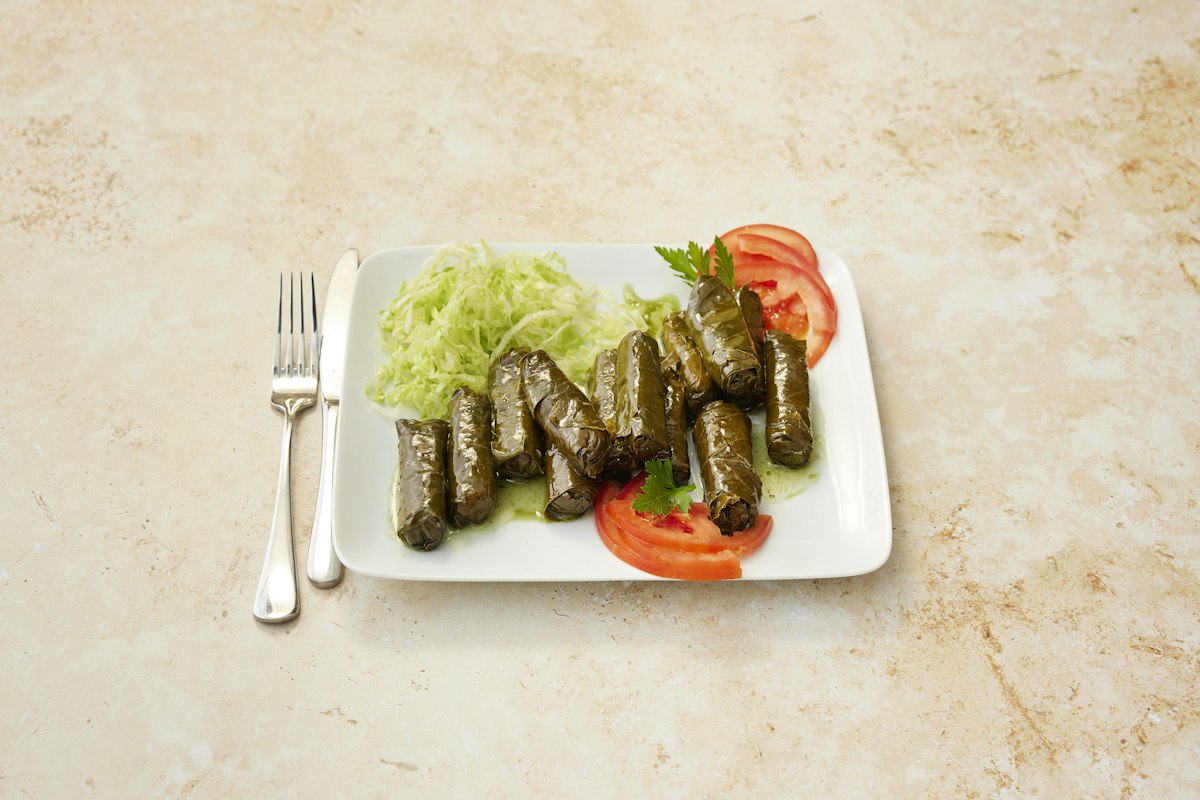
Take the pot off the heat and leave it alone, lid and plate still on, for at least 30 minutes. Better still, let them cool completely in the pot. As they rest they firm up, take in the last of the liquid and the flavours settle. Lift them out too soon and they tear. Arrange them on a platter, spoon over the juices from the pot and a little fresh olive oil, and serve at room temperature with lemon wedges and a bowl of thick yoghurt. They are even better the next day.
Questions People Ask
Not this version. Rice-stuffed dolmadakia are made all over Greece. Ikarians did make dolmades, from grape, cabbage or collard leaves, but Dan Buettner and Diane Kochilas both write that rice was scarce and expensive on the island, so the traditional filling there was corn. We call this a Blue Zone recipe because it fits how Ikarians are described as eating: lots of vegetables and olive oil, within a religious calendar that called for fasting for almost half the year. It is an example of that pattern, not a secret to long life.
Our figure of about 870 mg of sodium a serving assumes jarred leaves straight from the brine and ¼ teaspoon of salt. By USDA values, the leaves account for about 760 mg of that and the salt about 100 mg. That is a ceiling for the leaves, because soaking and blanching draw out some of the brine, but we have found no reliable figure for how much, so we haven't subtracted anything. The FDA, which advises rinsing salty canned foods, counts 20% of the Daily Value (460 mg) or more in a serving as high. So soak the leaves in two changes of hot water, blanch them, taste the filling before you add any salt, and skip the salt altogether if the leaves still taste briny. With fresh leaves, which have almost no sodium, and ½ teaspoon of salt, a serving is about 210 mg. If you have been told to watch your sodium or blood pressure, talk to your doctor about how dishes like this fit in.
Both work. Jarred leaves are easy to find and ready to use after soaking, but they are salty and vary in size and toughness from brand to brand. Fresh leaves are better if you have a vine: pick young, tender, palm-sized leaves in late spring or early summer, from plants you know haven't been sprayed. Both kinds need blanching. Either way, get extra. A few always tear, and spare leaves are useful for lining the pot.
Bursting usually means too much filling, rolls squeezed too tight or a pot that boiled hard. Remember the rice swells a lot, so use no more than a scant tablespoon and keep the heat at a bare simmer. Unrolling usually means the rolls were loose, were not packed closely, were not placed seam side down or had no plate on top to hold them still. If the rice is still hard when the liquid has gone, the pot was too hot or too uncovered. Add a splash of hot water and give it another 10 minutes on the lowest heat.
It is vegan as written and naturally gluten-free, but check the label on your jar of leaves if you need to be strict. Served with yoghurt it becomes vegetarian. Dolmadakia are a good make-ahead dish because they are eaten at room temperature anyway. Cool them quickly, then keep them covered in the fridge in a little of their cooking oil and juices for 3–4 days, as you would any cooked rice. Take them out about 30 minutes before you eat so the oil softens, and add a fresh squeeze of lemon.
Sources
- Thessaloniki City of Gastronomy. Dolmadakia gialantzi with dill & spearmint (stuffed vine leaves). cityofgastronomy.thessaloniki.gr
- Palaiologos G. How fasting has shaped Greek cuisine. Greek Farms portal, 2025. portal.greekfarms.gov.gr; and Kochilas D. The Greek Lenten table. dianekochilas.com
- Buettner D. Stuffed grape leaves (dolmades). danbuettner.com
- Kochilas D. Ikaria corn-stuffed collard dolmades. dianekochilas.com; and Dolmades: grape leaves stuffed with rice, onions and herbs. dianekochilas.com
- Blue Zones. Ikaria, Greece. bluezones.com
- Guasch-Ferré M, et al. Consumption of olive oil and risk of total and cause-specific mortality among U.S. adults. J Am Coll Cardiol. 2022;79(2):101–112. Full text (PMC)
- Trichopoulou A, Costacou T, Bamia C, Trichopoulos D. Adherence to a Mediterranean diet and survival in a Greek population. N Engl J Med. 2003;348(26):2599–2608. Full text (NEJM, via DOI)
- Estruch R, et al. Primary prevention of cardiovascular disease with a Mediterranean diet supplemented with extra-virgin olive oil or nuts. N Engl J Med. 2018;378(25):e34. Record and abstract · NEJM (DOI)
- US Food and Drug Administration. Sodium in Your Diet. 2021. fda.gov (PDF)
- Barbarigou A. Dolmadakia yalantzi (stuffed grape leaves with rice & herbs). To Vima, 2026. tovima.com
- USDA FoodData Central, SR Legacy: Grape leaves, canned (FDC 169393); Grape leaves, raw (FDC 168575); Rice, white, medium-grain, raw, enriched (FDC 168879); Oil, olive, salad or cooking (FDC 171413); Onions, raw (FDC 170000); Onions, spring or scallions (includes tops and bulb), raw (FDC 170005); Dill weed, fresh (FDC 172233); Spearmint, fresh (FDC 173475); Parsley, fresh (FDC 170416); Lemon juice, raw (FDC 167747); Salt, table (FDC 173468); Yogurt, Greek, plain, whole milk (FDC 171304). fdc.nal.usda.gov


