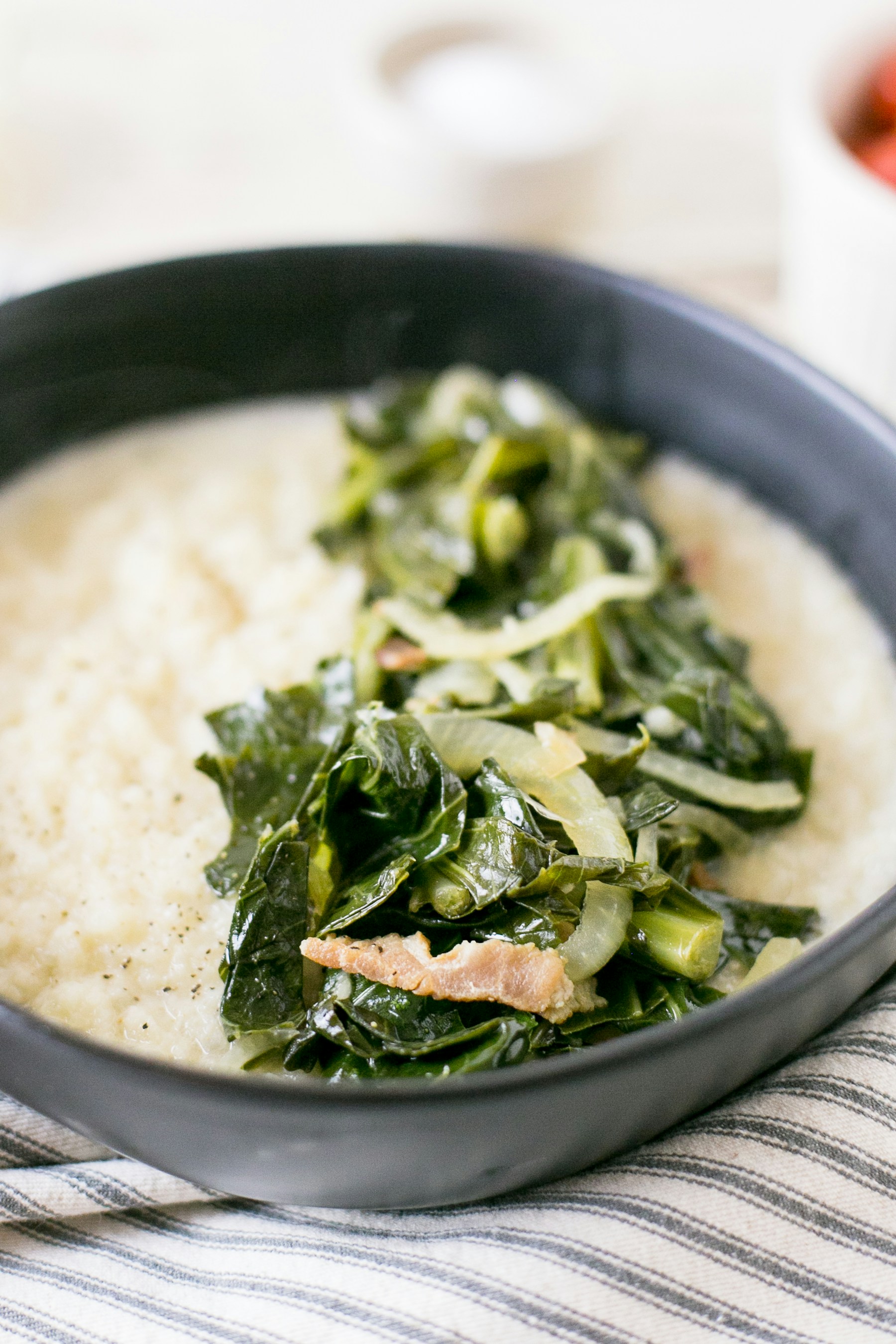
Spanaki is spinach and rizi is rice, and spanakorizo is exactly that: spinach and rice, cooked slowly in olive oil until the rice is soft and the spinach has melted into it. It belongs to the family of Greek lathera, the one-pot vegetable dishes that rely on olive oil, and it is one of the dishes Greek households make during the long Orthodox fasts, when meat and dairy are off the table. It is eaten all over Greece. It is not an Ikarian secret, but it is exactly the kind of cooking the island is known for.
The method is simple and forgiving. Soften an onion and a bunch of spring onions in olive oil, stir in the rice, pile in the spinach a handful at a time, add hot water and simmer until the rice is tender. Then, off the heat, add a fistful of dill, a little mint if you like and the juice of a lemon. Every family has a version. Some add a spoonful of tomato paste, some add leeks, and in some regions of Greece it is made with tomato rather than lemon. This is the plain lemon version.
Each plate carries about 200 g of raw spinach, nearly seven cups by the USDA's measure, and just over a tablespoon of olive oil. Worked out from USDA FoodData Central values, a serving comes to roughly 400 calories, 10 g of protein and 7 g of fibre. It is vegan and gluten-free as written. Serve it with a piece of feta on the side, a common way to eat it, and it becomes vegetarian, with more protein and a lot more salt. The numbers are below.
It fits the island pattern, nothing more. The Blue Zones organisation describes Ikarian eating as a variation of the Mediterranean diet, with plenty of fruit and vegetables, whole grains, beans, potatoes and olive oil. It also notes that Ikarians have traditionally been devout Greek Orthodox Christians whose religious calendar called for fasting for almost half the year. Spanakorizo is a fasting dish made of greens and olive oil, so it belongs to that pattern. A version appears in Diane Kochilas's cookbook Ikaria, but it is cooked across Greece, and no study has tested this dish on its own. The rice is white rice, not a whole grain.
The spinach: leafy greens and a slower-ageing brain. In the Memory and Aging Project (Morris and colleagues, Neurology, 2018), 960 people aged 58 to 99 filled in a food questionnaire and had their thinking tested at least twice over an average of 4.7 years. Those in the top fifth for green leafy vegetables, a median of 1.3 servings a day, had a slower rate of cognitive decline than those in the bottom fifth, a difference the authors put at roughly the equivalent of being 11 years younger. Higher intakes of most of the nutrients the team looked at in leafy greens, including vitamin K (phylloquinone), lutein and folate, were also linked with slower decline. The authors suggested that about one serving a day of leafy greens and foods rich in these nutrients may help slow cognitive decline with ageing. It is an observational study, so it shows a link rather than proof, and it needs confirming in other groups.
The olive oil is linked to lower mortality. In a study of two large US cohorts (Guasch-Ferré and colleagues, Journal of the American College of Cardiology, 2022), 60,582 women and 31,801 men were followed for 28 years, during which 36,856 died. People who used more than half a tablespoon (about 7 g) of olive oil a day had a 19% lower risk of death from any cause than those who never or rarely used it (hazard ratio 0.81, 95% CI 0.78–0.84). They also had lower risks of dying from cardiovascular disease, cancer, neurodegenerative disease and respiratory disease. In modelling, replacing 10 g a day of margarine, butter, mayonnaise or dairy fat with olive oil was linked to 8–34% lower risk. Swapping olive oil for other vegetable oils combined showed no clear difference. This is observational: people who use more olive oil may differ in other ways that also affect how long they live. Each plate of spanakorizo has about 17 g, more than twice the top group's threshold.
The oil also helps you absorb the greens. Vitamin K is fat-soluble, and the NIH Office of Dietary Supplements notes that the vitamin K in plant foods is less well absorbed than that in oils or supplements, although eating vegetables together with fat can improve absorption. Cooking spinach in olive oil does exactly that. By USDA values for raw spinach, each plate here holds roughly 1,000 µg of vitamin K, against an adequate intake of 120 µg a day for men and 90 µg for women, and about 24 mg of lutein and zeaxanthin. Some will be lost in the pot, so treat these as rough figures.
Three honest caveats. First, that much vitamin K matters if you take warfarin. The NIH says people on warfarin and similar anticoagulants need to keep their vitamin K intake consistent, because sudden changes can alter how the drug works. Talk to your doctor or anticoagulation clinic before making this a regular dish. Second, spinach is high in oxalate. The NIDDK lists spinach among the foods people who have had calcium oxalate kidney stones may want to avoid. If that is you, ask your doctor or a dietitian how much oxalate is right for you. Third, spinach has plenty of iron on paper, about 5 mg a plate by USDA values, but the NIH notes that it has low iron bioavailability, because it contains substances that reduce iron absorption. Vitamin C helps the body absorb this kind of iron, which is one more reason for the lemon, though one lemon shared four ways adds only a little; the spinach carries some vitamin C of its own, though much of it is lost in cooking.
The Ingredients
- 75ml (5 tbsp)extra-virgin olive oil, divided
- 1 largeonion, about 150g (5 oz), finely chopped
- 1 bunchspring onions (6–8), about 100g (3½ oz), sliced, green tops included
- 200g (1 cup)medium-grain white rice, such as Carolina or arborio
- 800g (1¾ lb)spinach, weighed after trimming the tough stems (about 1kg / 2¼ lb as bought), well washed and roughly chopped
- 500ml (2 cups)hot water, plus a splash more if needed
- ¾ tspsalt, or less; taste first
- 20g (¾ oz)fresh dill, a small bunch, chopped
- 1 tspdried mint, or a small handful of fresh mint, chopped (optional)
- 1lemon, juiced (about 3 tbsp), plus wedges to serve
- Black pepper. To serve, if you like: feta, about 50g (1¾ oz) a person, and crusty bread.
How to Make It
Spinach holds a lot of grit. Fill a sink or a large bowl with cold water, plunge in the leaves, swish them around and lift them out, leaving the grit behind. Repeat with fresh water until none settles at the bottom. Cut off the tough stems and roughly chop the leaves. Chop the onion, slice the spring onions and chop the dill.
Warm 60ml (4 tbsp) of the olive oil in a large, wide pot over a medium heat. Add the onion with a pinch of the salt and cook for 6–8 minutes, stirring now and then, until soft and translucent but not browned. Add the spring onions and cook for 2 minutes more, until they wilt.
Stir in the rice and keep stirring for a minute or two, until every grain is glossy with oil. Add the spinach a few handfuls at a time, turning it over with a wooden spoon and letting each batch collapse before you add the next. It looks like far too much at first. Within about 5 minutes it will all have shrunk into the pot.
Pour in the hot water, add the rest of the salt and a good grind of pepper, and bring to the boil. Turn the heat down low, cover and simmer for 18–20 minutes, stirring gently once or twice so nothing catches, until the rice is soft. Spinach gives off a lot of its own liquid, so you may not need more water, but if the pot looks dry before the rice is done, add a splash. You want it moist and loose, like a soft risotto, not dry and fluffy.
Take the pot off the heat. Stir in the dill, the mint if you are using it, most of the lemon juice and the last tablespoon of olive oil. Cover and let it rest for 5 minutes. Taste, then add more lemon, salt or pepper as you like. Serve it warm or at room temperature, with lemon wedges, bread and a piece of feta on the side if you eat it.
Questions People Ask
Not specifically. It is a classic of the whole Greek table, and you will find it on mainland and island kitchens alike. Diane Kochilas includes a version in her cookbook about Ikaria, and it is the kind of dish the island is known for: the Blue Zones organisation says Ikarians eat a variation of the Mediterranean diet with lots of vegetables and olive oil, and that their religious calendar called for fasting for almost half the year. Spanakorizo is greens, olive oil and no meat or dairy, so it fits that pattern. It is an example of how the island eats, not a secret to long life.
Our figure of about 600 mg of sodium a serving assumes ¾ teaspoon of salt for the pot. By USDA values, the salt is about 440 mg of that and the spinach itself about 160 mg. Use ½ teaspoon and it falls to about 460 mg; leave the salt out and it is about 170 mg. The FDA counts 20% of the Daily Value (460 mg) or more in a serving as high, so the version as written is on the high side. Feta is the bigger issue: a 50 g piece adds about 570 mg, taking a plate to about 1,170 mg. If you serve feta, go easy on the salt in the pot, since the cheese will season each mouthful. If you have been told to watch your sodium or blood pressure, talk to your doctor about how dishes like this fit in.
Spinach is rich in vitamin K. By USDA values each plate has roughly 1,000 µg, about eight to eleven times the daily adequate intake. That is not necessarily a reason to avoid it, but the NIH advises people on warfarin and similar anticoagulants to keep their vitamin K intake consistent, because sudden changes can make the drug work more or less strongly. Talk to your doctor or anticoagulation clinic before you add a big plate of spinach to your week.
Use a medium-grain white rice. Greek cooks often use Carolina rice, and arborio works well; both give off starch and make the dish soft and creamy. Long-grain rice works but gives a drier result. Brown rice is possible too, but it needs more water and a much longer simmer. Frozen leaf spinach is fine: thaw it, squeeze out some of the water, add it at step 3 and start with half the water, adding more only as the rice needs it.
It is vegan and gluten-free as written, and becomes vegetarian if you serve it with feta or Greek yoghurt. It keeps for 3 days in the fridge. The rice keeps absorbing liquid as it sits, so loosen it with a splash of water when you reheat it gently, then add fresh lemon and a little raw olive oil. Cool leftovers quickly and keep them chilled, as you would any cooked rice. It does not freeze well, because the rice goes soft and grainy.
Sources
- Blue Zones. Ikaria, Greece. bluezones.com
- Morris MC, Wang Y, Barnes LL, Bennett DA, Dawson-Hughes B, Booth SL. Nutrients and bioactives in green leafy vegetables and cognitive decline: prospective study. Neurology. 2018;90(3):e214–e222. Article
- Guasch-Ferré M, et al. Consumption of olive oil and risk of total and cause-specific mortality among U.S. adults. J Am Coll Cardiol. 2022;79(2):101–112. Full text (PMC)
- NIH Office of Dietary Supplements. Vitamin K: Fact Sheet for Health Professionals. ods.od.nih.gov
- NIH Office of Dietary Supplements. Iron: Fact Sheet for Health Professionals. ods.od.nih.gov
- National Institute of Diabetes and Digestive and Kidney Diseases. Eating, Diet, & Nutrition for Kidney Stones. niddk.nih.gov
- US Food and Drug Administration. Sodium in Your Diet. 2021. fda.gov (PDF)
- Kochilas D. The Greek Lenten Table. dianekochilas.com; and Spanakorizo, Greek spinach rice (adapted from Ikaria, Rodale, 2014). dianekochilas.com
- Paravantes E. Greek spinach and rice (spanakorizo). olivetomato.com
- Greek City Times. Spanakorizo (spinach and rice) recipe. 2020. greekcitytimes.com
- Oliveology. Greek spinach rice (spanakorizo). oliveology.co.uk
- USDA FoodData Central, SR Legacy: Spinach, raw (FDC 168462); Rice, white, medium-grain, raw, enriched (FDC 168879); Oil, olive, salad or cooking (FDC 171413); Onions, raw (FDC 170000); Onions, spring or scallions (includes tops and bulb), raw (FDC 170005); Dill weed, fresh (FDC 172233); Lemon juice, raw (FDC 167747); Salt, table (FDC 173468); Cheese, feta (FDC 173420). fdc.nal.usda.gov


