Loma Linda, in Southern California, is the one American region on the Blue Zones map, and it is defined less by a place than by a church. The Blue Zones organisation describes a community of about 9,000 Seventh-day Adventists in the Loma Linda area, and says many of them follow a vegetarian diet. Chili is not an Adventist invention, and this is not a family heirloom from Loma Linda. It is here because it is exactly the kind of dish that way of eating runs on: three tins of beans, an orange vegetable, a pot of tomatoes, and no meat needed to make it taste like a proper bowl of chili.
The difference between a good vegetarian chili and a sad one is all technique, because there is no browned meat to do the work. So this one borrows the steps that give a meat chili its depth. The ground spices are bloomed in hot oil for a minute, which brings out much more flavour than stirring them into liquid. The tomato paste is fried until it turns from bright red to brick, which takes away its raw edge and adds a savoury sweetness. A tablespoon of unsweetened cocoa and a little cinnamon will not make it taste of chocolate; they round out the smoked paprika and chipotle and make it taste darker and more finished. Then the beans simmer before the sweet potato goes in, so the sauce has time to thicken without the sweet potato turning to mush. A squeeze of lime at the end wakes the whole pot up.
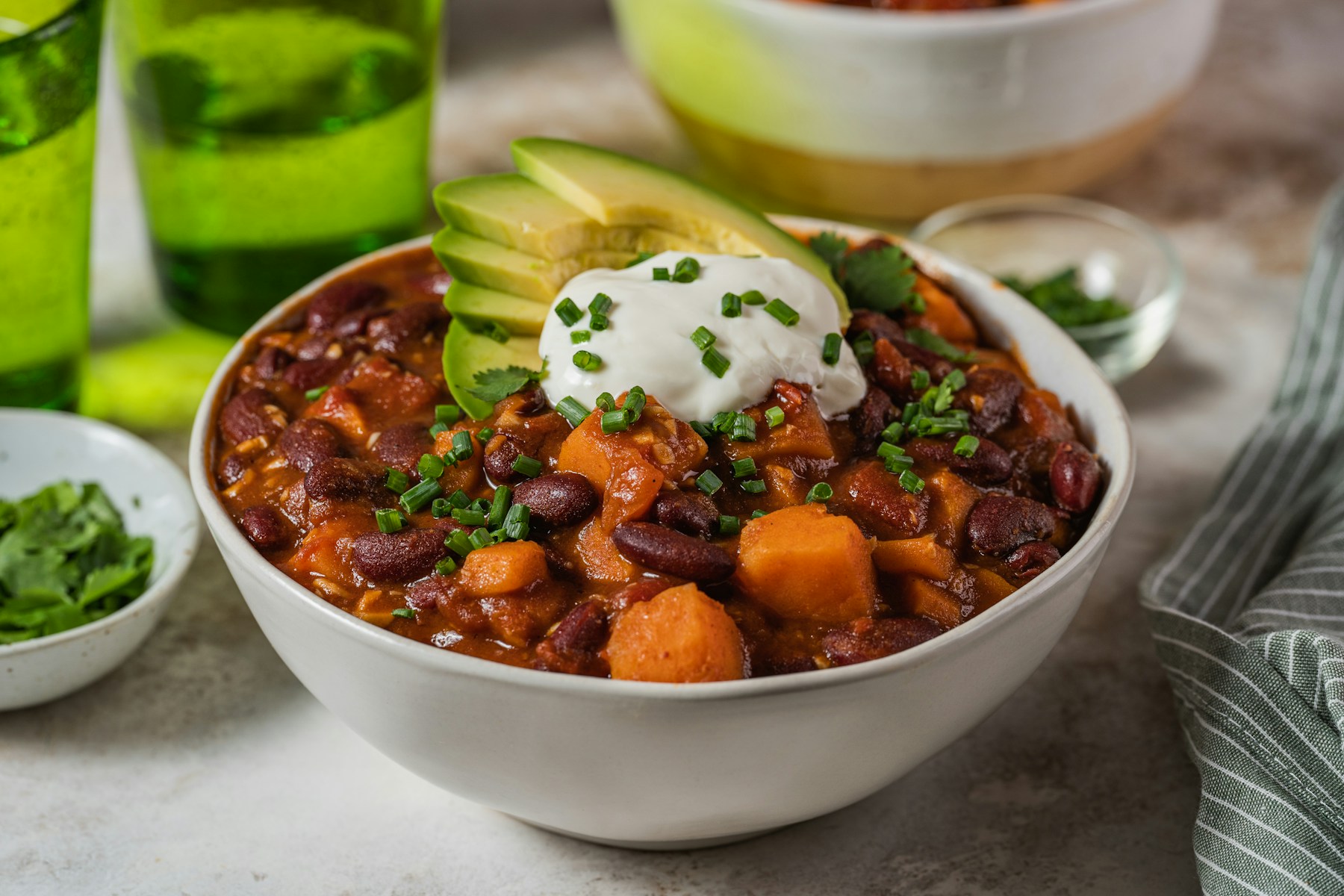
Each bowl carries about 120 g of beans and 100 g of sweet potato. Worked out from USDA FoodData Central values, that comes to roughly 360 calories, 14 g of protein and 16 g of fibre before toppings, with 3 tablespoons of olive oil in the whole pot. The chili itself is vegan and gluten-free. The sour cream on top, as in the photo, makes it vegetarian; use a plant-based yoghurt and it stays vegan.
The Adventist pattern, not this dish. The Adventist Health Study-2 (Orlich and colleagues, JAMA Internal Medicine, 2013) followed 73,308 Seventh-day Adventist men and women for an average of 5.79 years, during which 2,570 died. After adjusting for other factors, vegetarians as a group had 12% lower all-cause mortality than non-vegetarians (hazard ratio 0.88, 95% CI 0.80–0.97), and the associations were larger and more often significant in men than in women. This is an observational study of whole diets, so it cannot separate diet from everything else about how these people live, and it says nothing about any single recipe. It tells you that, within this population, the plant-based pattern a dish like this belongs to was linked with lower mortality.
The beans. The Food Habits in Later Life study (Darmadi-Blackberry and colleagues, Asia Pacific Journal of Clinical Nutrition, 2004) followed 785 people aged 70 and over in five groups: Japanese in Japan, Swedes in Sweden, Anglo-Celtic and Greek Australians, and Greeks in Greece. Over up to seven years, 169 died. The authors called legumes the most important dietary predictor of survival: each extra 20 g a day was linked with a 7–8% lower risk of death (risk ratio 0.92, 95% CI 0.85–0.99, after also controlling for ethnicity), after adjusting for age, sex and smoking. It was a small observational study and did not include Adventists, but the link showed up in the pooled data from five very different food cultures, whether or not ethnicity was taken into account. A bowl of this chili has about 120 g of beans, six times that 20 g step, though the study cannot tell you the benefit keeps adding up at that rate.
The fibre. At about 16 g a bowl, this chili gets you more than halfway to the range that stood out in the review of fibre and carbohydrate quality by Reynolds and colleagues (The Lancet, 2019). Drawing on 135 million person-years of data from prospective studies and 58 clinical trials, they found that people who ate the most fibre had a 15–30% lower risk of dying from any cause and from cardiovascular disease than those who ate the least. The benefit was greatest at 25–29 g of fibre a day, and the dose-response curves suggested higher intakes may bring even greater protection against heart disease, type 2 diabetes and colorectal and breast cancer. The mortality findings come from observational studies, which can show a link but not prove cause.
The sweet potato. This one is about getting enough, not living longer. Using USDA values for raw sweet potato, the 100 g in each bowl carries about 710 µg RAE of vitamin A, mostly as beta-carotene. The recommended dietary allowance (RDA), as listed by the NIH Office of Dietary Supplements, is 900 µg RAE for adult men and 700 µg for adult women, so one bowl covers roughly four-fifths of a man's daily need and about all of a woman's. Some is lost in cooking, so treat that as approximate.
The Ingredients
- 3 tbsp (45ml)olive oil
- 1 very largeonion (or 2 medium), about 200g (7 oz), diced
- 1 largered pepper (bell pepper), about 160g (5½ oz), diced
- 5garlic cloves, finely chopped
- 1 tbspground cumin
- 1 tbspsmoked paprika
- 2 tspground coriander
- 1 tspchipotle chilli powder, or more to taste
- 1 tspdried oregano, Mexican if you can find it
- ¼ tspground cinnamon
- 1 tbspunsweetened cocoa powder
- 3 tbsp (about 50g)tomato paste, no-salt-added if possible
- 2 × 400g tinschopped tomatoes, no-salt-added (US: 2 × 14.5 oz cans)
- 2 × 400g tinsred kidney beans, drained and rinsed, about 480g (3 cups) drained (US: 2 × 15 oz cans)
- 1 × 400g tinblack beans, drained and rinsed, about 240g (1½ cups) drained (US: 1 × 15 oz can)
- 600ml (2½ cups)water
- ½ tspsalt, plus more to taste
- About 600g (1⅓ lb)sweet potatoes (2–4, depending on size), weighed after peeling, cut into 2cm (¾ inch) cubes
- 1lime, juiced, plus wedges to serve
- Toppings bar: sour cream or thick yoghurt (a plant-based yoghurt keeps it vegan), sliced avocado, chopped chives, fresh coriander (cilantro), sliced jalapeño and lime wedges.
How to Make It
Dice the onion and red pepper, chop the garlic, and peel and cube the sweet potatoes. Tip the beans into a sieve and rinse them well under cold running water. Measure all the spices and the cocoa into one small bowl, because they go in together and fast.
Warm the olive oil in a large heavy pot over a medium heat. Add the onion and red pepper with a pinch of the salt and cook for 8–10 minutes, stirring now and then, until soft and starting to colour at the edges. Add the garlic and stir for 1 minute.
Push the vegetables to the sides so a little oil pools in the middle of the pot. Tip in the bowl of spices and cocoa and stir them in the oil for 45–60 seconds, until they smell toasty and darken slightly, then stir everything together. Keep the heat at medium and keep stirring; ground spices scorch quickly and turn bitter.
Add the tomato paste and cook it for 2–3 minutes, stirring and pressing it against the base of the pot, until it turns from bright red to a deeper brick colour and begins to stick. This is where much of the depth of the chili comes from.
Pour in the tomatoes and scrape up everything stuck to the base. Add the kidney beans, black beans, water and the rest of the ½ tsp salt. Bring to the boil, then lower to a gentle simmer, half-cover and cook for 20 minutes, stirring now and then.
Stir in the sweet potato. Simmer uncovered for 25–35 minutes, stirring more often towards the end so nothing catches, until the sweet potato is tender and the chili is thick. Crush a few cubes of sweet potato and a spoonful of beans against the side of the pot to give it body. If it gets too thick, add a splash of water.
Take the pot off the heat and stir in the lime juice. Taste, then add more salt, chipotle or lime as you like. If you have time, let it rest for 10 minutes while you set out the toppings, then serve in deep bowls and let everyone add their own.
Questions People Ask
No. Chili is not an Adventist invention, and this is not a Loma Linda heirloom. "Loma Linda-style" here means it follows the pattern the region is known for: plant-based and built on legumes and vegetables. According to the Blue Zones organisation, many Adventists follow a vegetarian diet, and a big pot of bean chili is an easy way to eat that way on a weeknight.
Most of the sodium comes from the tins and the salt you add. By USDA values our version has about 530 mg a bowl: roughly 250 mg from the rinsed beans, 190 mg from the ½ tsp of salt and the rest from the vegetables. Leave the salt out and it falls to about 330 mg. Use ordinary salted tinned tomatoes instead of no-salt-added and you add about 140 mg a bowl. Draining and rinsing tinned beans helps: in a study of five bean varieties, draining cut sodium by 36% and draining plus rinsing by 41%. The FDA counts 20% of the Daily Value (460 mg) or more in a serving as high, so as written a bowl just counts as high; skip the salt in the pot and salt bowls to taste, or use no-salt-added beans, to bring it well under. If you have been told to watch your sodium or blood pressure, talk to your doctor.
Yes, and they bring the sodium down further: by USDA values, kidney beans boiled without salt have about 2 mg of sodium per 100 g, against about 208 mg for rinsed tinned ones. You need about 720 g of cooked beans in total. Our guide to cooking dried beans has the method, with two changes for this chili: leave the salt out of the cooking water if you want the lower-sodium version, and give red kidney beans a hard boil first. Raw and undercooked kidney beans contain a natural toxin, phytohaemagglutinin. The Centre for Food Safety in Hong Kong advises soaking beans for at least 12 hours, then boiling them vigorously for at least 10 minutes, and not cooking them from raw at a low temperature, such as in a slow cooker. After that boil, turn them down and simmer until fully tender before they go in the chili.
The chili itself is vegan and gluten-free. It becomes vegetarian only if you top it with sour cream or dairy yoghurt; use a plant-based yoghurt to keep it vegan. Check that your spices and stock, if you use any, are gluten-free. With 1 tsp of chipotle powder it is warm rather than fiery. Add more chipotle, a chopped chipotle in adobo or fresh jalapeño if you like heat.
Yes, and it improves overnight. It keeps 4 days in the fridge and freezes for 3 months. It thickens as it sits, so loosen it with a splash of water when you reheat it, and add a fresh squeeze of lime. Keep the toppings separate and add them just before serving.
Sources
- Blue Zones. Loma Linda, California. bluezones.com
- Orlich MJ, Singh PN, Sabaté J, et al. Vegetarian dietary patterns and mortality in Adventist Health Study 2. JAMA Intern Med. 2013;173(13):1230–1238. Full text
- Darmadi-Blackberry I, Wahlqvist ML, Kouris-Blazos A, Steen B, Lukito W, Horie Y, Horie K. Legumes: the most important dietary predictor of survival in older people of different ethnicities. Asia Pac J Clin Nutr. 2004;13(2):217–220. Full text (PDF)
- Reynolds A, et al. Carbohydrate quality and human health: a series of systematic reviews and meta-analyses. Lancet. 2019;393(10170):434–445. Article · Accepted manuscript (PDF)
- NIH Office of Dietary Supplements. Vitamin A and Carotenoids: Fact Sheet for Health Professionals. ods.od.nih.gov
- Duyff RL, Mount JR, Jones JB. Sodium reduction in canned beans after draining, rinsing. J Culinary Sci Technol. 2011;9(2):106–112. Journal record · Full text (PDF, hosted by a bean manufacturer)
- US Food and Drug Administration. Sodium in Your Diet. 2021. fda.gov (PDF)
- Centre for Food Safety, Hong Kong. Phytohaemagglutinin Poisoning. Food Safety Focus, issue 208, November 2023. cfs.gov.hk
- USDA FoodData Central. SR Legacy: Beans, kidney, red, mature seeds, canned, drained solids, rinsed in tap water (FDC 175243); Beans, kidney, red, mature seeds, cooked, boiled, without salt (FDC 175194); Sweet potato, raw, unprepared (FDC 168482); Tomatoes, red, ripe, canned, packed in tomato juice, no salt added (FDC 170138); Tomatoes, red, ripe, canned, packed in tomato juice (FDC 170051); Tomato products, canned, paste, without salt added (FDC 170459); Oil, olive, salad or cooking (FDC 171413); Onions, raw (FDC 170000); Peppers, sweet, red, raw (FDC 170108); Garlic, raw (FDC 169230); Spices, cumin seed (FDC 170923); Spices, paprika (FDC 171329); Spices, coriander seed (FDC 170922); Spices, pepper, red or cayenne (FDC 170932); Spices, oregano, dried (FDC 171328); Spices, cinnamon, ground (FDC 171320); Cocoa, dry powder, unsweetened (FDC 169593); Lime juice, raw (FDC 168156); Salt, table (FDC 173468); Avocados, raw, all commercial varieties (FDC 171705); Cream, sour, cultured (FDC 171257); Chives, raw (FDC 169994). Foundation: Beans, black, canned, sodium added, drained and rinsed (FDC 2644285). fdc.nal.usda.gov