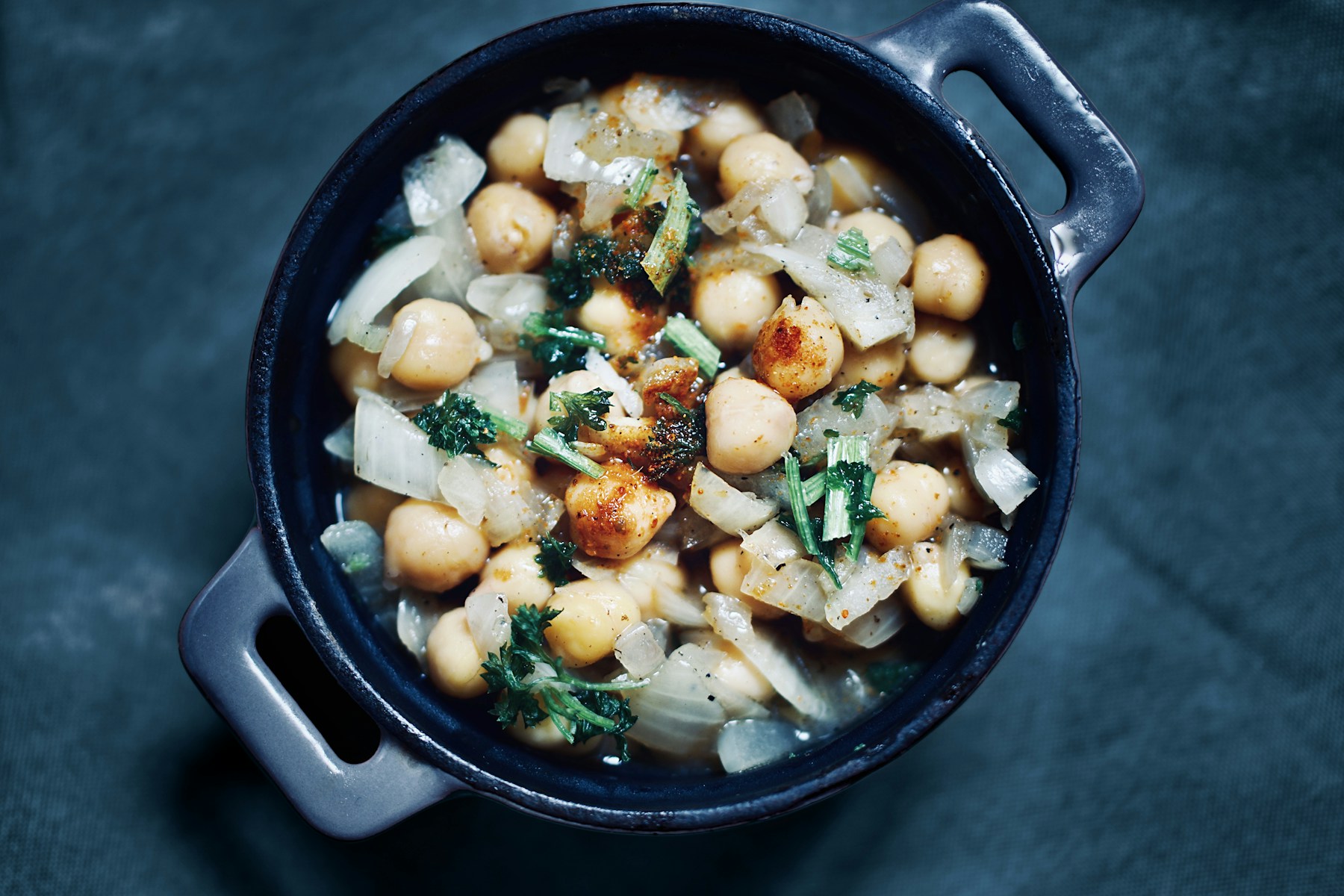
On Sifnos, a small island in Greece’s western Cyclades, Sunday lunch starts on Saturday. National Geographic describes how revithada is readied for the oven on Saturday afternoon: soaked chickpeas go into a skepastaria, “a squat, treacle-brown ceramic dish used only for revithada”, with sliced onions, salt, bay leaves, olive oil and water. Villagers carry their pots to a shared oven fed with olive wood (traditionally the local baker’s, writes the Greek cookery author Diane Kochilas), the door is sealed, and everything bakes overnight, ready for lunch the next day. As one islander tells the magazine, “People in Sifnos say: ‘It’s Sunday tomorrow. Chickpeas!’”
You don’t need a wood-fired oven or a clay pot to make it at home. A heavy lidded casserole or Dutch oven at 160°C (320°F) for 3 to 4 hours does the same job: the chickpeas soften slowly in their own liquid, some of them break down, and what was water turns into something thick and creamy, carrying the flavour of the onions and oil. The one step worth taking seriously is the onions. The island version simply slices them raw into the pot; here they are cooked gently first, for 20 minutes or so, until soft and sweet, which gives a home oven a head start on what a whole night in the bread oven would do.
The version National Geographic watched being made is just chickpeas, onions, oil, bay, salt and water. Kochilas, in her own Sifnos-style recipe, suggests oregano, thyme or rosemary as optional additions, and we’ve added a squeeze of lemon at the end, which is not traditional to every pot but lifts the whole dish. Worked out from USDA FoodData Central values, a bowl, one of six, comes to about 476 calories, 18 g of protein and 12 g of fibre. We’ve been straight about the oil below, because it is a real part of those calories.
A Cycladic dish, an Ikarian pattern. Let’s be clear about the Blue Zone link. Revithada comes from Sifnos, not Ikaria, and nobody has studied the dish itself. It fits the island way of eating that the Blue Zones organisation describes on Ikaria, “a variation of the Mediterranean diet”, with lots of fruit and vegetables, whole grains, beans, potatoes and olive oil. In the Ikaria Study (Panagiotakos and colleagues, Cardiology Research and Practice, 2011), 187 islanders over 80 answered a food frequency questionnaire. On average, the men reported eating legumes 2.0 times a week and the women 1.3 times; for olive oil, the figures were 6.8 and 5.3 times a week. Their average Mediterranean diet score was 38 out of 55, higher than the 33 the authors cite for older people in the MEDIS study. It is a one-off snapshot of what very old people said they ate. It cannot show that their diet is why they reached their 80s and 90s, and it is worth noticing that legumes came up a couple of times a week, not every day.
Legumes and survival in older people. The Food Habits in Later Life study (Darmadi-Blackberry and colleagues, Asia Pacific Journal of Clinical Nutrition, 2004) followed 785 people aged 70 and over in five cohorts in Japan, Sweden, Greece and Australia for up to seven years, during which 169 died. Legumes were the only food group consistently linked with survival: every extra 20 g a day was associated with a 7–8% lower risk of death (risk ratio 0.92, 95% CI 0.85–0.99, after accounting for ethnicity), which is why the paper’s title calls legumes “the most important dietary predictor of survival”. The two Greek cohorts were among the biggest legume eaters, at 63–86 g a day, alongside the Japanese cohort at 85 g. It is a small, observational study, adjusted for age, sex and smoking (and, in one model, ethnicity), so treat it as a strong hint rather than proof. A bowl of revithada has far more than one 20 g step, but the study can’t tell you that the benefit keeps rising at that rate.
Olive oil: what PREDIMED did and didn’t show. In the PREDIMED trial, 7,447 Spanish adults aged 55 to 80 at high cardiovascular risk were assigned to a Mediterranean diet with extra-virgin olive oil, a Mediterranean diet with mixed nuts, or advice to cut down on fat. The first report, in 2013, was retracted in June 2018 after the investigators found that some participants had not been randomised properly, including household members enrolled without randomisation, and some participants at one of the 11 sites who were assigned to a group without it. They republished in the New England Journal of Medicine with a reanalysis. Over a median of 4.8 years, a major cardiovascular event (heart attack, stroke or cardiovascular death) occurred in 3.8% of the olive oil group and 4.4% of the control group, a hazard ratio of 0.69 (95% CI 0.53–0.91). Results were similar when the 1,588 participants whose assignment had departed from the protocol were left out. That is real evidence for extra-virgin olive oil as part of a Mediterranean diet, compared with a low-fat diet, in people at high risk. It did not test oil on its own, and it did not show that more is always better.
What’s actually in a bowl. By USDA FoodData Central values, each serving (one of six) starts as about 83 g of dried chickpeas, roughly 190 g once cooked, and carries about 18 g of protein and 12 g of fibre. Against the FDA’s Daily Values of 50 g of protein and 28 g of fibre, that is about 36% and 42% of a day’s worth. Chickpeas are also naturally very low in sodium, at 24 mg per 100 g dry, so nearly all the salt in this dish is the salt you add.
The Ingredients
- 500g (1 lb 2 oz, about 2½ cups)dried chickpeas
- 1 tspbicarbonate of soda (baking soda), for the soak, optional
- 600g (1 lb 5 oz)onions, about 5 medium, halved and thinly sliced
- 90ml (6 tbsp)extra-virgin olive oil, divided
- 2bay leaves
- 2 sprigsfresh rosemary, or 1 tsp dried Greek oregano
- 1 tspsalt, plus more to taste
- About 1.2 litres (5 cups)hot water, plus more if needed
- 45ml (3 tbsp)fresh lemon juice, from 1–2 lemons, plus wedges to serve
- Black pepper, and crusty bread to serve
The pot. Use a heavy casserole or Dutch oven of 4–5 litres (4–5 quarts) with a lid, cast iron or enamelled cast iron for preference, or a lidded clay pot if you have one. Heavy pots hold an even, gentle heat, which is the whole point. A thin pot will catch on the bottom.
The Honest Bit About the Oil
Olive oil is what makes revithada taste like revithada rather than boiled chickpeas, and traditional recipes are generous with it. Diane Kochilas’s Sifnos-style version uses a full cup (240 ml) of extra-virgin olive oil for 450 g of chickpeas. By USDA values that is about 216 g of oil and roughly 1,900 calories in the pot, close to 480 a serving across the four it serves, before you count the chickpeas.
We use 6 tablespoons (90 ml) for 500 g of chickpeas. At 13.5 g and about 119 calories a tablespoon, that is 81 g of oil and about 716 calories in total, or roughly 120 calories a serving for six and 180 for four. It is about a quarter of the calories in each bowl. That is enough to soften the onions properly, carry the flavour and give the liquid its body, without the dish sitting in a slick of oil. Four of those tablespoons go into cooking the onions, one into the pot, and one goes over the top raw at the end, where you taste it most.
If you’re watching your weight, you can drop to 4 tablespoons and it will still be good, a little leaner and less silky. If you’re cooking for people who want it the island way, go up. Either way, it is extra-virgin olive oil doing the work, not butter. If you have been told to watch your calories or your fat intake for a medical reason, talk to your doctor or a dietitian about how dishes like this fit in.
How to Make It
Put the chickpeas in a large bowl, cover them with about 2 litres (8½ cups) of cold water and stir in the bicarbonate of soda if you are using it. They will roughly double in size, so use more water than looks necessary. Leave them for 8–12 hours, or overnight, somewhere cool, or in the fridge if your kitchen is warm. The next day, drain them, rinse them well under the tap and pick out any that are discoloured or shrivelled.
Heat the oven to 160°C (140°C fan, 320°F, gas 3). Put the chickpeas in a heavy lidded casserole or Dutch oven of 4–5 litres (4–5 quarts) and cover them with the hot water, enough to come 2–3cm (about 1 inch) above them. Bring to the boil on the hob, skim off the grey foam with a large spoon as it rises over the first 10 minutes or so, then turn the heat down and let it simmer gently until the onions are ready.
While the chickpeas cook, warm 4 tablespoons of the olive oil in a wide frying pan over a medium-low heat. Add the onions with a pinch of the salt and cook for 20–25 minutes, stirring every few minutes, until they have collapsed into a soft, sweet, pale-gold tangle. Turn the heat down if they start to catch. This is where most of the flavour comes from, so don’t rush it.
Tip the onions and every drop of their oil into the casserole. Add the bay leaves, the rosemary or oregano, the rest of the salt, another tablespoon of olive oil and a good grind of black pepper, and stir. The liquid should cover the chickpeas by 1–2cm; add a little more hot water if it doesn’t. Put the lid on. If it isn’t tight-fitting, lay a sheet of foil over the pot first and press the lid down on top.
Bake for 3 to 4 hours. Have a look after 2 hours: if the liquid has dropped below the chickpeas, add a splash of hot water from the kettle and put the lid back on. The chickpeas are ready when they are soft all the way through, a few have started to break, and the liquid has turned thick, cloudy and slightly creamy. Older chickpeas take longer, so keep going until they are right.
For the browned, caramelised onion crust that the island pots come out with, take the lid off for the last 20–30 minutes. Keep an eye on it so the top colours without drying out.
Let the pot rest for 10–15 minutes out of the oven, then fish out the bay leaves and rosemary stalks. Stir in the lemon juice, taste and add salt and pepper as needed, then drizzle over the last tablespoon of olive oil. Serve warm in shallow bowls with bread to mop up the liquid, and lemon wedges on the side.
Quicker Versions
- With tinned chickpeas (serves 4). Soften 400 g (14 oz) of sliced onions in 3 tablespoons of the oil as in step 3. Put them in the casserole with 3 × 400 g tins of chickpeas, drained and rinsed (about 720 g drained), the bay, rosemary, ½ teaspoon of salt and about 500 ml (2 cups) of water. Bake covered at 160°C (320°F) for 1–1¼ hours, finish with 2 tablespoons of lemon and the last tablespoon of oil. Tinned chickpeas won’t turn quite as creamy, so crush a ladleful against the side of the pot to thicken the liquid. By USDA values, a serving is about 410 calories, 14 g of protein and 13 g of fibre; tins vary in salt, so taste before seasoning.
- With a pressure cooker. Cook the soaked, rinsed chickpeas in fresh water until they are just tender, following your cooker’s manual. Times vary a lot with the model and with how old the chickpeas are; NDSU Extension gives a rough range of 15 to 25 minutes under pressure for garbanzo beans, without saying whether they were soaked first, so start at the low end. Never fill the cooker past its half-full line, beans and water included, because beans froth as they cook. Then move them, with enough of their cooking liquid to cover, into the casserole with the softened onions and everything else, and bake covered for about an hour so the flavours come together and the liquid thickens.
- Cooking ahead. The whole dish can be made the day before and reheated. Like most bean dishes, it is often better the next day.
If It Goes Wrong
- The chickpeas are still hard after 4 hours. They are probably old; dried chickpeas that have sat in the cupboard for a long time can take much longer. Keep them in the oven, checking every 30 minutes and topping up with hot water. Next time, use the bicarbonate of soda in the soak.
- It has dried out. Stir in hot water from the kettle, a splash at a time, until it is loose and saucy again, and put the lid back on.
- It is too thin. Take the lid off for the last 30 minutes, and crush a ladleful of chickpeas against the side of the pot.
- It tastes flat. It almost always needs more salt or more lemon. Add a little of each, taste, and repeat.
Questions People Ask
No. It comes from Sifnos, a small island in the western Cyclades, not from Ikaria. We call it Ikaria-style because it fits the same island pattern of legumes, onions and olive oil that the Ikaria Study recorded among its oldest residents, not because Ikarians cook it or because it has been studied. The longevity evidence is about legumes and the Mediterranean way of eating in general, not about this dish.
It is a fair amount, and we’d rather say so. The 6 tablespoons in this recipe come to about 716 calories, around 120 a serving when it feeds six, roughly a quarter of each bowl’s calories. Many Greek recipes use far more: Diane Kochilas’s Sifnos-style version uses a full cup (240ml) for 450g of chickpeas. In the PREDIMED trial, people assigned to a Mediterranean diet with extra-virgin olive oil had fewer major cardiovascular events (heart attack, stroke or cardiovascular death) than those advised to eat a low-fat diet, but the trial did not show that more oil is always better. If you are watching calories, cut the oil to 4 tablespoons; the onions will still soften.
No, it is optional. Bicarbonate of soda makes the soaking water alkaline, which helps break down the pectin that holds chickpeas together, so they soften faster and end up creamier. It helps most with older chickpeas that refuse to soften. Drain and rinse them well after soaking so none of the taste carries into the pot.
Yes. For tinned chickpeas (serves 4), use 3 × 400g tins, drained and rinsed, with 400g of onions, 4 tablespoons of oil and about 500ml of water, and bake covered for 1–1¼ hours at the same temperature. For a pressure cooker, cook the soaked chickpeas first, following your cooker’s manual, until just tender, then bake them with the onions for about an hour. Times vary with the cooker and the age of the chickpeas.
FoodSafety.gov gives 3 to 4 days in the fridge and 2 to 3 months in the freezer for soups and stews. The USDA’s Food Safety and Inspection Service advises refrigerating leftovers within 2 hours of cooking, dividing large amounts into shallow containers so they cool quickly, and bringing soups and sauces to a rolling boil when you reheat them. Revithada thickens as it sits, so loosen it with a splash of hot water and bring it back to a rolling boil, then add a fresh squeeze of lemon and a little raw oil before serving. It is often even better the next day.
Sources
- Buchan E. Exploring the flavours of Sifnos, Greece’s gourmet island. National Geographic (Traveller). 2019. nationalgeographic.com
- Kochilas D. Clay-baked chick peas. dianekochilas.com
- Blue Zones. Ikaria, Greece. bluezones.com
- Panagiotakos DB, Pitsavos C, Siasos G, et al. Sociodemographic and lifestyle statistics of oldest old people (>80 years) living in Ikaria Island: the Ikaria Study. Cardiol Res Pract. 2011;2011:679187. Article · PMC full text
- Darmadi-Blackberry I, Wahlqvist ML, Kouris-Blazos A, et al. Legumes: the most important dietary predictor of survival in older people of different ethnicities. Asia Pac J Clin Nutr. 2004;13(2):217–220. Article (PDF)
- Estruch R, Ros E, Salas-Salvadó J, et al.; PREDIMED Study Investigators. Primary prevention of cardiovascular disease with a Mediterranean diet supplemented with extra-virgin olive oil or nuts. N Engl J Med. 2018;378(25):e34. Article
- Harvard T.H. Chan School of Public Health, The Nutrition Source. PREDIMED study retraction and republication. 22 June 2018. hsph.harvard.edu
- US Food and Drug Administration. Daily Value on the Nutrition and Supplement Facts Labels. fda.gov
- America’s Test Kitchen. For creamier hummus, skin your chickpeas. americastestkitchen.com
- Garden-Robinson J. Field to Fork: Pressure Cook Dry Beans to Save Money and Time. NDSU Extension, FN1939. 2019. ndsu.edu (PDF)
- FoodSafety.gov. Cold Food Storage Chart. foodsafety.gov
- USDA Food Safety and Inspection Service. Leftovers and Food Safety. fsis.usda.gov
- USDA FoodData Central, SR Legacy: Chickpeas (garbanzo beans, bengal gram), mature seeds, raw (FDC 173756); Chickpeas, mature seeds, cooked, boiled, without salt (FDC 173757); Chickpeas, mature seeds, canned, drained, rinsed in tap water (FDC 173801); Onions, raw (FDC 170000); Oil, olive, salad or cooking (FDC 171413); Lemon juice, raw (FDC 167747); Salt, table (FDC 173468). fdc.nal.usda.gov


