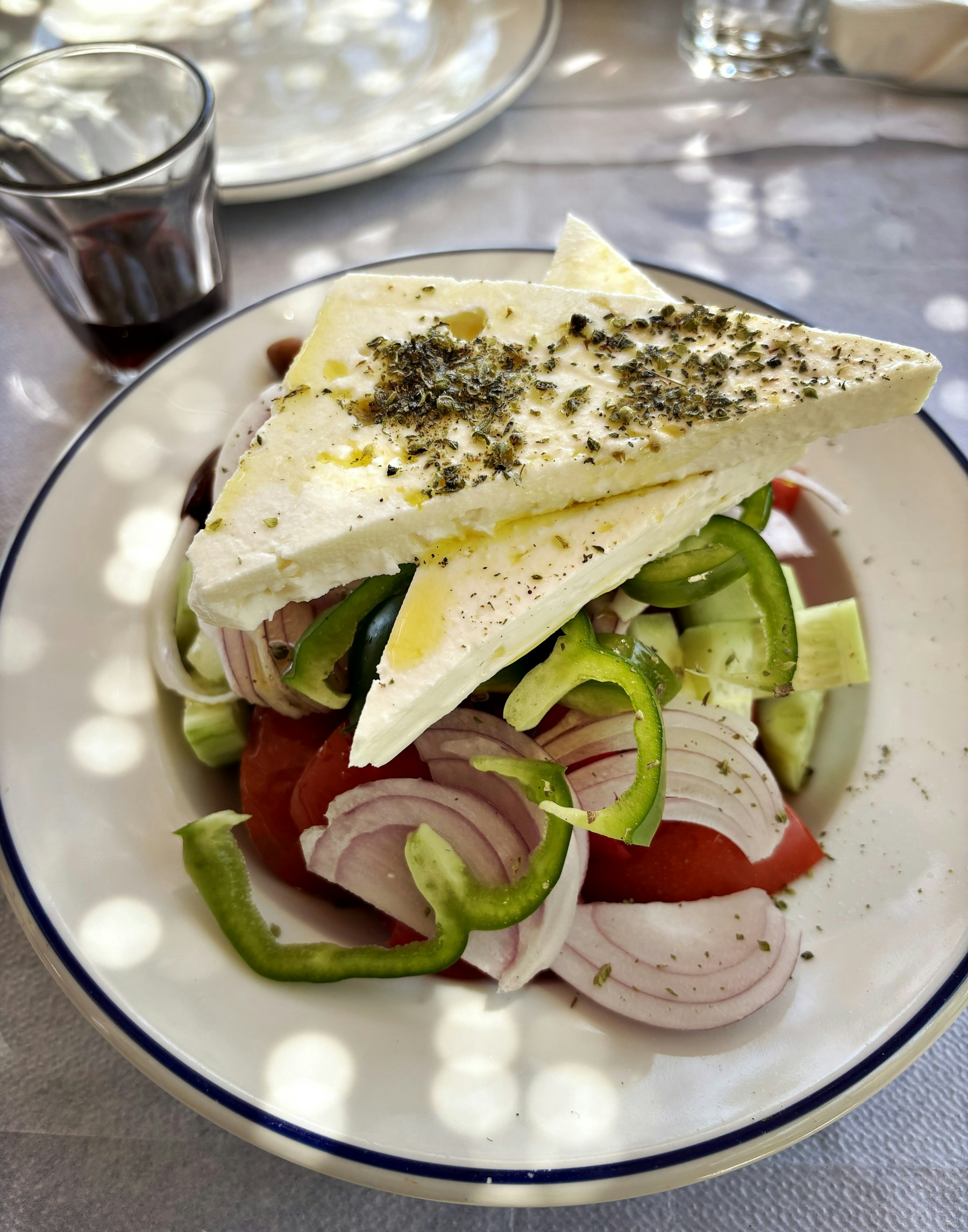
Horiatiki salata takes its name from horio, the Greek word for village, and the village salad is what most of the world calls a Greek salad. The real thing has no lettuce. It is chunks of ripe tomato, cucumber, green pepper and onion, some olives, a slab of feta laid on top rather than crumbled through, dried oregano and plenty of olive oil. It is eaten all over Greece, Ikaria included, and it is nobody's secret. We include it because it is the simplest example of the everyday pattern described on the island: vegetables, made worth eating by olive oil.
It is also the most honest test of a tomato you will ever cook. There is nothing to hide behind, so this is a summer dish first and foremost. Each side serving carries about 250 g of raw vegetables, a 50 g piece of feta and a tablespoon of olive oil. Worked out from USDA FoodData Central values, that comes to about 320 calories, 9 g of protein and 26 g of fat a serving, about half of it monounsaturated. It is also salty, at about 890 mg of sodium, and most of that comes from the feta. The numbers and the ways to bring it down are below.
It fits the island pattern, nothing more. The Blue Zones organisation describes Ikarian eating as a variation of the Mediterranean diet heavy on fruit and vegetables, beans, potatoes and olive oil. A horiatiki is mostly raw vegetables dressed with olive oil, so it belongs to that pattern. It is not an Ikarian speciality, no study has tested this salad on its own, and the feta and olives make it a far saltier plate than a bowl of greens.
The olive oil is linked to lower mortality. In a study of two large US cohorts (Guasch-Ferré and colleagues, Journal of the American College of Cardiology, 2022), 60,582 women and 31,801 men were followed for 28 years, during which 36,856 died. People who used more than half a tablespoon (about 7 g) of olive oil a day had a 19% lower risk of death from any cause than those who never or rarely used it (hazard ratio 0.81, 95% CI 0.78–0.84). They also had lower risks of dying from cardiovascular disease (0.81), cancer (0.83), neurodegenerative disease (0.71) and respiratory disease (0.82). In modelling, replacing 10 g a day of margarine, butter, mayonnaise or dairy fat with olive oil was linked to roughly 8–34% lower risk. This is observational, and the authors write that "the possibility of residual confounding cannot be ruled out": people who use olive oil may differ in other ways. Each serving here has a tablespoon, about 13.5 g, nearly twice the top group's threshold.
The oil helps you absorb what is in the vegetables. Raw tomatoes are a source of lycopene, a carotenoid, and carotenoids need fat to be absorbed. In a small randomised crossover study by Brown and colleagues (American Journal of Clinical Nutrition, 2004), 7 people each ate three salads of spinach, romaine lettuce, cherry tomatoes and carrots, in random order, with dressings containing 0, 6 or 28 g of canola oil. With the fat-free dressing, the appearance of alpha-carotene, beta-carotene and lycopene in chylomicrons, the particles that carry newly absorbed fat in the blood, was negligible. Absorption was higher with the full-fat dressing than with the reduced-fat one. It was tiny, used canola rather than olive oil, and measured a blood marker rather than health, but the lesson for a salad is clear enough: skip the oil and you absorb far less of the tomato's carotenoids, lycopene included. By USDA values, the 150 g of tomato in each serving holds about 3.9 mg of lycopene.
Raw and cooked tomatoes give you different things. In a lab study by Dewanto and colleagues (Journal of Agricultural and Food Chemistry, 2002), tomatoes heated to 88°C lost vitamin C as they cooked: about 11% after 2 minutes, 16% after 15 and 29% after 30 minutes. Over the same times, the measurable trans-lycopene rose by about 55%, then to roughly 2.6–2.7 times the raw level. The authors concluded that heating "enhanced the nutritional value of tomatoes". That was measured in the tomato, not in people. The practical reading is that a raw salad is where tomatoes and peppers keep their vitamin C (about 47 mg a serving here by USDA values, half of it from the pepper), while dishes such as gemista and fasolakia, where tomato is cooked in oil, are the better lycopene source. A Greek table usually has both.
The salt is the catch. By USDA values, feta has 1,140 mg of sodium per 100 g, and the 50 g piece in each serving brings about 570 mg, nearly two-thirds of the total. The olives, capers and a quarter-teaspoon of salt bring the serving to about 890 mg. The FDA sets the Daily Value for sodium at less than 2,300 mg a day, and counts 20% of the Daily Value or more in a serving as high. This serving is about 39%. Leave out the capers and added salt and it falls to about 690 mg; use half the feta as well and it is about 410 mg. In return, the feta brings about 250 mg of calcium a serving, a quarter of the 1,000 mg a day recommended for adults aged 19 to 50 and men up to 70; women over 50 and men over 70 need 1,200 mg. If you have been told to watch your sodium or your blood pressure, talk to your doctor about how a salad like this fits in.
The Ingredients
- 600g (1⅓ lb)ripe tomatoes, about 4 medium-large; in winter, use cherry or vine tomatoes (see the tomato note)
- 200g (7 oz)cucumber, about ⅔ of a standard cucumber
- 1 mediumgreen bell pepper, about 120g (4 oz) once seeded
- 1 smallred onion, about 70g (2½ oz)
- 60g (2 oz)pitted Kalamata olives, about 15; whole olives with stones are more traditional
- 1 tbspcapers, drained (optional)
- 200g (7 oz)feta, in one slab
- 60ml (¼ cup)extra-virgin olive oil
- 1 tspdried Greek oregano
- ¼ tspsalt, or less; taste first
- Optional: 1–2 tsp red wine vinegar. Black pepper if you like. Bread for the juices.
How to Make It
Cut out the core of each tomato and cut the tomatoes into large, uneven wedges or chunks, about bite-sized. Halve cherry tomatoes. Put them in a wide, shallow bowl with all their juice, sprinkle over the salt and leave them while you cut everything else. The salt draws out juice, and that juice is half the dressing.
Peel the cucumber in stripes if the skin is thick, halve it lengthways and cut it into thick half-moons. Seed the pepper and cut it into thin rings or strips. Slice the onion into thin rings. If raw onion is too sharp for you, soak the rings in cold water for 10 minutes and drain them well.
Add the cucumber, pepper, onion, olives and capers, if using, to the tomatoes. Pour over about half the olive oil and turn everything over gently with your hands or two spoons, just enough to coat. Do not stir it hard, or the tomatoes break up and the salad goes watery.
Pat the feta dry and set the whole slab on top of the vegetables. Rub the oregano between your palms over the feta and the salad to release its smell, then pour over the rest of the olive oil. If your tomatoes are a little flat, sprinkle over a teaspoon or two of red wine vinegar now. Plenty of cooks leave it out; others add a splash. Both are fine.
Bring it to the table whole and let everyone break off feta with a fork as they serve themselves. Eat it within the hour, while the vegetables are crisp, and keep bread on the table for the juice and oil that collect at the bottom of the bowl.
Questions People Ask
No. It is eaten all over Greece, including on Ikaria, and doesn't belong to any one island. We call it a Blue Zone recipe because it fits the way of eating described there: the Blue Zones organisation says Ikarians eat a variation of the Mediterranean diet with lots of vegetables and olive oil. This salad is raw vegetables and olive oil, with feta and olives. It is an example of that pattern, not a secret to long life.
The village salad is built from tomatoes, cucumber, pepper and onion, and Greek cooks tend to be firm that lettuce has no place in it. Without it you get a salad that stands up to a heavy pour of oil. Vinegar is a matter of taste. Many cooks dress horiatiki with nothing but olive oil and the tomatoes' own juice. Others add a small splash of red wine vinegar, especially when the tomatoes are less than perfect. Start without it and add a little if the salad tastes flat.
Our figure of about 890 mg of sodium a serving assumes the full 200 g of feta, the olives, the capers and a quarter-teaspoon of salt. By USDA values the feta alone is about 570 mg of that. Skip the capers and the added salt, since the feta and olives season the salad anyway, and it drops to about 690 mg. Use 100 g of feta as well and it is about 410 mg. Olives vary a lot: our sum uses USDA values for canned ripe olives, and if yours are as salty as USDA's figure for green pickled olives, add about 125 mg a serving. Check the label on the jar.
Horiatiki is a summer salad, and it depends on ripe tomatoes. Out of season, cherry tomatoes or tomatoes sold on the vine usually taste better than large supermarket tomatoes; halve them and salt them in the same way. Keep them at room temperature until you use them. If you can't find any good ones, make a plate of horta instead.
It is vegetarian and gluten-free as written, not vegan, because of the feta. If you avoid animal rennet, check the label on your feta. Without the cheese the salad is vegan and much lower in sodium, but it is a different dish. Serve it with gluten-free bread if you need to.
Sources
- Blue Zones. Ikaria, Greece. bluezones.com
- Guasch-Ferré M, et al. Consumption of olive oil and risk of total and cause-specific mortality among U.S. adults. J Am Coll Cardiol. 2022;79(2):101–112. Full text (PMC)
- Brown MJ, Ferruzzi MG, Nguyen ML, et al. Carotenoid bioavailability is higher from salads ingested with full-fat than with fat-reduced salad dressings as measured with electrochemical detection. Am J Clin Nutr. 2004;80(2):396–403. Article
- Dewanto V, Wu X, Adom KK, Liu RH. Thermal processing enhances the nutritional value of tomatoes by increasing total antioxidant activity. J Agric Food Chem. 2002;50(10):3010–3014. Article · Copy (PDF)
- US Food and Drug Administration. Sodium in Your Diet. 2021. fda.gov (PDF)
- NIH Office of Dietary Supplements. Calcium: Fact Sheet for Health Professionals. ods.od.nih.gov
- Mia Kouppa. Greek salad (or Horiatiki salata). miakouppa.com
- USDA FoodData Central, SR Legacy: Tomatoes, red, ripe, raw, year round average (FDC 170457); Cucumber, with peel, raw (FDC 168409); Peppers, sweet, green, raw (FDC 170427); Onions, raw (FDC 170000); Olives, ripe, canned, small-extra large (FDC 169094); Olives, pickled, canned or bottled, green (FDC 169096); Capers, canned (FDC 172238); Cheese, feta (FDC 173420); Oil, olive, salad or cooking (FDC 171413); Spices, oregano, dried (FDC 171328); Salt, table (FDC 173468). fdc.nal.usda.gov


