- Olive oil has some of the best evidence of any single food for a longer life. In the PREDIMED trial, a Mediterranean diet with extra-virgin olive oil cut heart attacks, strokes and cardiovascular deaths by 31% compared with a low-fat control diet
- In 92,000 Americans followed for 28 years, more than half a tablespoon a day went with 19% lower mortality, 29% lower death from neurodegenerative disease and 28% fewer dementia deaths — observational, and olive oil didn't beat other plant oils head to head
- Extra virgin matters. In a trial of 200 men, the more polyphenols the oil had, the more it raised HDL and protected LDL from oxidation. Refined "light" olive oil barely has any
- The morning shot has no evidence of its own. No study has tested it. It's the same oil — plus 119 calories a tablespoon — and the benefits in the research came from using olive oil instead of butter and margarine, with food
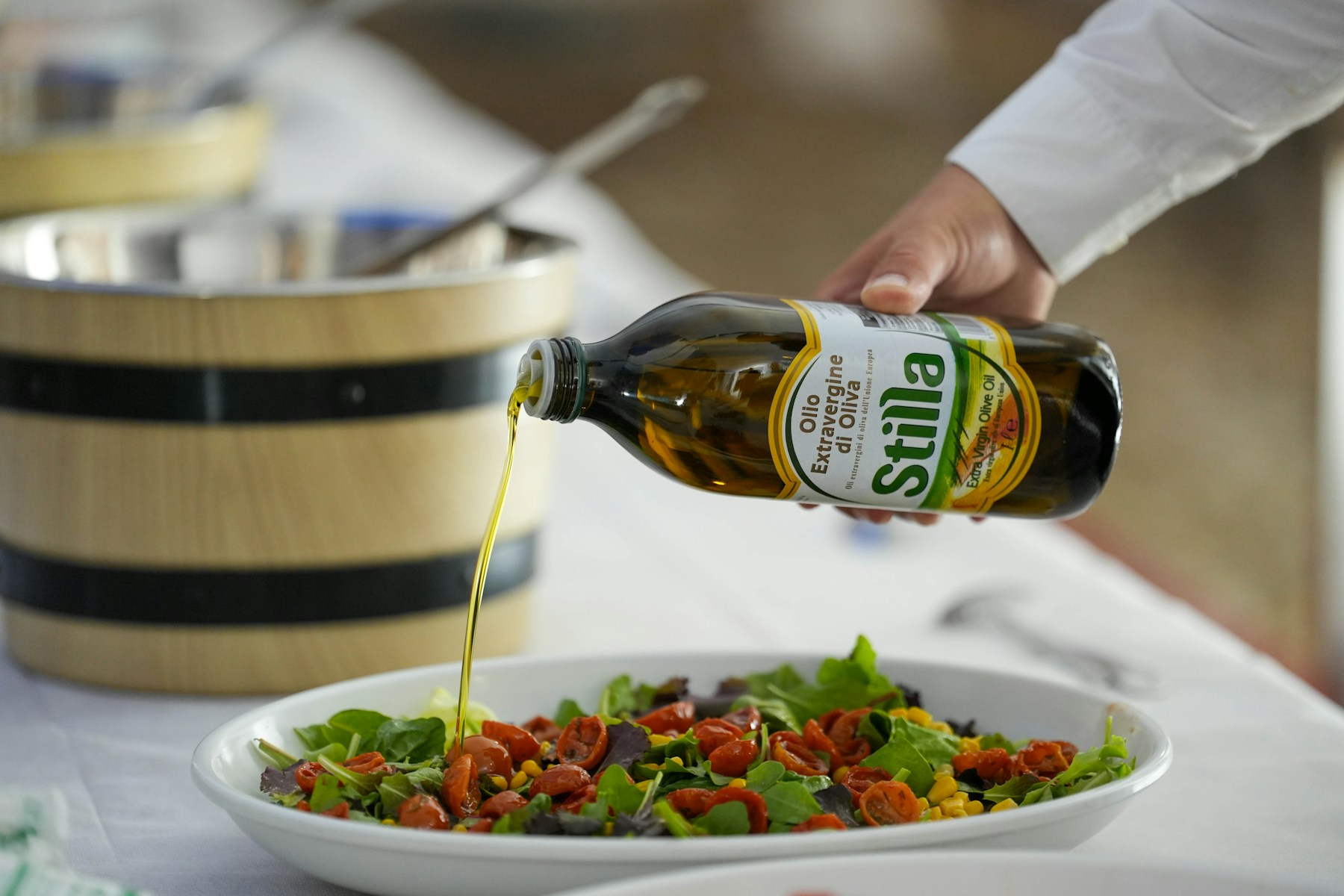
- What to do: 1–3 tablespoons a day of a fresh, high-polyphenol extra-virgin oil, on food, replacing other fats. Check the harvest date and buy it in a dark bottle
At some point in the last few years, a spoonful of olive oil became a wellness ritual. People knock back a shot of it first thing in the morning, sometimes with lemon, on an empty stomach, as if it were medicine. Starbucks built a coffee line around it in 2023, pitching a Sicilian habit of "enjoying a spoonful of extra virgin olive oil each day" — and celebrities followed with testimonials about glowing skin, better digestion and living forever.
Here's the interesting part: the underlying bet is a good one. Olive oil has some of the strongest evidence of any single food for a longer, healthier life — including one of the few large randomised nutrition trials with hard outcomes. What the evidence doesn't support is the shot. This article goes through both: what olive oil actually does, how much, which kind, and whether drinking it neat in the morning adds anything to simply eating it with dinner. Every figure is traced to the study it came from.
It's also not a new idea. When the Rockefeller Foundation surveyed diets on Crete in 1948, fats and oils supplied about 29% of all the calories islanders ate, and nearly four-fifths of that was olive oil (as reviewed by Delarue in the British Journal of Nutrition, 2022). Crete went on to have some of the lowest heart-disease death rates in the famous Seven Countries Study. The Ikarians and Sardinians of the Blue Zones cook the same way. They just never drank it from a shot glass.
PREDIMED: A Litre a Week, Five Years
Evidence: Strong — large randomised trial (with a known flaw)Most nutrition science is observational: researchers ask people what they eat and see who gets sick. PREDIMED, run in Spain, actually assigned diets. It enrolled 7,447 people aged 55 to 80 at high cardiovascular risk and put them on one of three diets: a Mediterranean diet with extra-virgin olive oil — each household was given a litre a week for free, and each person asked to use at least four tablespoons a day — a Mediterranean diet with extra nuts, or a control diet with advice to cut fat (Estruch, NEJM 2018).
Share of people who had a heart attack, stroke or cardiovascular death
109, 96 and 83 events among 7,447 participants. The 31% and 28% are hazard ratios of 0.69 and 0.72 from the republished 2018 analysis. The absolute difference is modest; the relative one is large for a diet change.
After a median of 4.8 years, 3.8% of the olive-oil group had suffered a heart attack, stroke or cardiovascular death, against 4.4% on the control diet — a 31% lower risk once follow-up time and other factors were accounted for. The nut group did similarly well, at 28% lower. That's a large effect for a change in cooking fat, in a trial with thousands of people and hard outcomes rather than blood markers.
Now the caveat, because it matters. The original 2013 paper was retracted after it emerged that some sites hadn't randomised properly — in some cases whole clinics or households were assigned together. The authors reanalysed the data without assuming perfect randomisation, and got similar results even after dropping the 1,588 participants whose assignments were known or suspected to have gone wrong. Most researchers still treat PREDIMED as strong evidence, but it's evidence for the whole Mediterranean diet plus a lot of extra-virgin olive oil — not for olive oil on its own, and not for a shot of it.
One more thing PREDIMED settled: all that oil didn't make people fatter. After five years, the olive-oil group's weight and waistlines were no higher than the low-fat group's — slightly lower, in fact, though the difference wasn't statistically significant (Estruch, Lancet Diabetes & Endocrinology 2019).
Half a Tablespoon, and the Brain
Evidence: Moderate — very large observational cohortsThe best long-term data comes from Harvard's Nurses' Health Study and Health Professionals Follow-up Study: 60,582 women and 31,801 men followed from 1990 to 2018, with diet reassessed every four years. Compared with people who rarely or never used olive oil, those who used more than half a tablespoon (7 g) a day had a 19% lower risk of dying during the study (Guasch-Ferré, Journal of the American College of Cardiology 2022).
Lower risk of death with more than ½ tablespoon a day, by cause
Guasch-Ferré et al., JACC 2022: highest intake (>7 g/day) vs never or rarely, 36,856 deaths. Adjusted for diet quality, smoking, exercise and other factors — but observational, so it shows association, not proof.
The standout was the brain. Deaths from neurodegenerative disease were 29% lower, and a follow-up analysis of the same 92,383 people found 28% fewer deaths from dementia among those using at least 7 g a day — a finding that held regardless of how healthy the rest of their diet was, and after accounting for the APOE4 gene that raises Alzheimer's risk (Tessier, JAMA Network Open 2024).
Two details in these studies are more useful than the headline numbers. First, swapping was what counted: replacing 10 g a day of margarine, butter, mayonnaise or dairy fat with olive oil was linked to 8–34% lower mortality, and replacing just 5 g of margarine or mayonnaise was linked to 8–14% lower dementia mortality. Second, and the part enthusiasts leave out: olive oil did no better than other vegetable oils combined. The advantage showed up against animal fats and processed spreads, not against canola or other plant oils. That points to what you replace as much as what you add.
The usual observational caveats apply. These were mostly white American health professionals, and people who use olive oil may differ in ways no adjustment fully captures. But the direction lines up with PREDIMED, which did randomise, and that combination is about as good as nutrition evidence gets.
It's the Polyphenols — and Most Oils Don't Have Many
Evidence: Moderate — randomised trial on blood markersExtra-virgin olive oil is just the juice of crushed olives, unheated and unrefined, so it keeps the olive's polyphenols — the bitter, peppery compounds that make good oil catch in your throat. Refined and "light" olive oils are processed with heat and chemicals and lose almost all of them. The fat is the same; the chemistry isn't.
The cleanest test of whether that matters is the EUROLIVE trial. Researchers gave 200 healthy men 25 mL a day (about 1¾ tablespoons) of three olive oils that were identical except for their polyphenol content, three weeks each, in random order (Covas, Annals of Internal Medicine 2006).
Same fat, different oil: what three weeks did
Refined
- HDL change
- +1.0 mg/dL
- Oxidised LDL
- +1.21 U/L
Common (blend)
- HDL change
- +1.2 mg/dL
- Oxidised LDL
- −1.48 U/L
Virgin
- HDL change
- +1.7 mg/dL
- Oxidised LDL
- −3.21 U/L
EUROLIVE (Covas et al., 2006): 200 men, 25 mL a day of each oil. HDL converted from mmol/L (+0.025, +0.032, +0.045). Oxidised LDL is the damaged form of "bad" cholesterol that drives plaque; only the high-polyphenol virgin oil lowered it significantly.
HDL rose in step with the polyphenol content, and only the high-polyphenol virgin oil significantly lowered oxidised LDL. The refined oil did the least. The European Union recognises the effect: olive oils can carry a health claim that their polyphenols help protect blood lipids from oxidative damage — but only if they contain at least 5 mg of hydroxytyrosol and related compounds per 20 g of oil, a bar many supermarket oils don't reach.
One polyphenol gets special attention. Oleocanthal, the compound behind the peppery sting, turns out to block the same inflammatory enzymes as ibuprofen (Beauchamp, Nature 2005). It's a real finding, but keep it in proportion: the researchers estimated that about 50 g of oil a day — nearly four tablespoons — would deliver roughly a tenth of an adult pain-relief dose. It's a plausible contributor over decades, not a painkiller.
Does Drinking It Neat Add Anything?
Evidence: None for the shot itselfHere's the plain answer: no study has tested a morning olive oil shot. Not against a placebo, not against the same oil eaten with meals, not for weight, skin, digestion or lifespan. Every benefit in the sections above came from people cooking with olive oil and eating it with food — mostly instead of other fats.
The closest studies involve oil and food eaten close together. In a crossover study of 25 healthy adults, adding 10 g of extra-virgin olive oil to a Mediterranean-style lunch lowered blood sugar two hours later compared with the same meal without oil, and compared with corn oil (Violi, Nutrition & Diabetes 2015). The nearest thing to a shot in the research is a study of six men with type 2 diabetes, in which 30 mL of olive oil taken on its own half an hour before a meal slowed stomach emptying and delayed the rise in blood sugar (Gentilcore, Journal of Clinical Endocrinology & Metabolism 2006). That's an intriguing pre-meal effect, but it's six people and one meal, and the oil went down right before food — not first thing in the morning, hours before breakfast.
There are also two reasons for caution. Calories: a tablespoon of olive oil has 119, so a two-tablespoon daily shot adds about 240 calories — over 7,000 a month, close to a kilogram of body fat if nothing else changes. PREDIMED's participants didn't gain weight, but they were using the oil in place of other fats, not on top of them. Your gallbladder: fat on an empty stomach makes the gallbladder contract hard — it's a classic stimulus doctors have used to test it — so anyone with gallstones or gallbladder trouble should skip the shots.
The morning shot
- Same oil, same polyphenols
- No studies of the ritual itself
- Usually adds 120–240 calories on top of your diet
- Can trigger nausea or gallbladder pain on an empty stomach
- Fine if you enjoy it and it replaces other fats
Olive oil with dinner
- How every study in this article used it
- Replaces butter, margarine and mayo — where the mortality benefit showed up
- Lowers the blood-sugar rise from the meal
- Helps you absorb fat-soluble nutrients from vegetables
- Tastes better on beans, greens and fish than in a shot glass
If you like the shot and it's how you'll actually get olive oil into your day, it isn't harmful for most people — count it in your fat budget and cut back elsewhere. But there's nothing magic about the timing. The Cretans who inspired all this used olive oil the way you'd use salt: on everything, all day, with food.
The Practical Version
How much. The research spans a range. The Harvard benefits started at just over half a tablespoon a day; PREDIMED asked for at least four tablespoons. A reasonable target is 1–3 tablespoons a day, used in place of butter, margarine, mayonnaise and cream — not added on top of them.
Which one. Buying good oil is harder than it should be. When UC Davis tested supermarket oils in California in 2010, 69% of imported samples and 10% of Californian ones labelled "extra virgin" failed the international standards, and a 2011 follow-up found 73% of top-selling imported samples failing (UC Davis Olive Center). Two caveats: the research was funded by California producers, and most failures were quality defects — stale or badly processed oil. Cheap refined oil mixed in was one possible explanation, but fraud wasn't proven. Stale oil has lost the polyphenols you're paying for either way.
Four checks for an oil that's worth drinking
The EU health claim requires at least 5 mg of hydroxytyrosol and related compounds per 20 g of oil — roughly 250 mg/kg. That counts specific compounds, not total polyphenols, so a printed polyphenol figure isn't the same test. Oils that meet the claim often say so on the label.
Cooking with it. The idea that extra-virgin olive oil turns toxic when heated is mostly a myth. In a lab test of 10 common oils heated to 240°C and held at 180°C for six hours, extra-virgin olive oil produced the fewest harmful breakdown compounds, closely followed by coconut oil, and smoke point turned out to be a poor predictor of stability (De Alzaa, Acta Scientific Nutritional Health 2018). The study came from an olive-industry lab, so treat it as supportive rather than final — but Mediterranean cooks have fried in it for centuries. Save your most expensive oil for drizzling, where its flavour and polyphenols survive intact.
Two to three tablespoons a day, without a shot glass
The Blue Zones' answer is to make olive oil part of the food. A few of our recipes that do most of the work for you:
- Horta — Ikaria's most-eaten side dish: wild greens with raw olive oil, lemon and salt.
- Fasolada — Greek white bean soup finished with raw olive oil and lemon.
- Ikarian black-eyed peas — beans, wild fennel and greens with olive oil and lemon, the island way.
- Sardinian minestrone — the slow-cooked bean soup of the Nuoro highlands, home to the world's highest concentration of male centenarians.
- Ikarian baked fish — whole fish, olive oil, lemon and wild oregano in one tin.
Or simply: a drizzle on eggs in the morning, oil and vinegar on a lunch salad, and oil on vegetables or beans at dinner. That's two to three tablespoons, with food, in the way the evidence was built.
Frequently Asked Questions
Keep the olive oil. Lose the shot glass.
The trend has landed on something real. Olive oil — extra virgin, fresh and full of polyphenols — has some of the best evidence of any single food: a randomised trial showing fewer heart attacks and strokes, and 28 years of data linking it to lower mortality and fewer dementia deaths.
But the ritual adds nothing the research can see. The benefit came from cooking with it and eating it with food, in place of butter and margarine. So buy a good bottle, check the harvest date, and use one to three tablespoons a day on beans, greens, fish and bread — the way Crete and Ikaria always have.