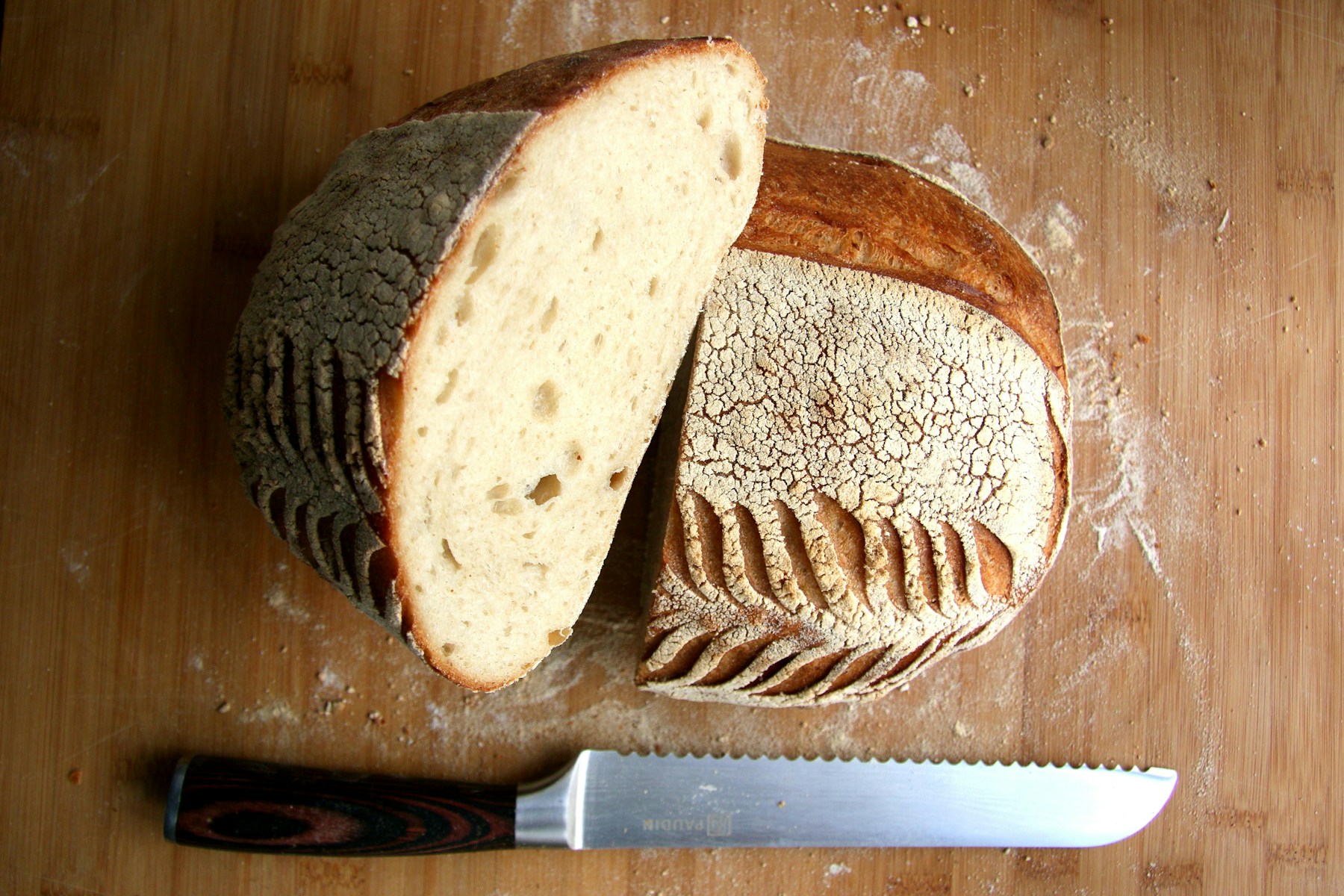
- A 2026 systematic review in Frontiers in Nutrition assessed 27 human studies of sourdough versus yeast-fermented bread using the EFSA health-claim framework. Its verdict on the blood-sugar advantage in healthy adults: "neither sufficient nor convincing"
- The mechanism is real — organic acids can slow starch digestion and gastric emptying — but the trials are small, inconsistent, and most don't separate what sourdough does from what yeast fermentation already does
- The most-cited positive study tested 16 people with impaired glucose tolerance, once. That is where the claim came from, and it was never a claim about healthy people
- What does move the response reliably is the flour: whole grain at about 90 g a day carried 17% lower all-cause mortality across 45 studies, and fibre at 25–29 g a day 15–30% lower. The leaven is not on that list
- Keep baking it. Flavour, keeping quality, phytate breakdown and digestibility all survive this paper. "It doesn't spike your blood sugar" does not
Somewhere in every sourdough thread there is the line: it's better for your blood sugar. It comes up when someone asks whether they should bother with a starter, it's on the chalkboard at the bakery, and it's the health reason people give for a hobby that mostly runs on flavour and stubbornness. This site has a Sardinian sourdough recipe and a strong interest in the claim being true. So this is the article where we check.
The short version: the idea is plausible, a few small studies support it, and when someone finally gathered every human trial and graded them the way a regulator would, the case didn't hold. That's not the same as "sourdough is bad" or "the effect is zero." It's that the specific promise — sourdough handles your glucose better than ordinary bread — has now been tested properly, and it didn't pass.
Twenty-Seven Studies, Graded Like a Health Claim
Evidence: Systematic review, EFSA dossier framework, healthy adultsIn 2026, Starowicz and colleagues published a systematic review in Frontiers in Nutrition with a deliberately dull title — "Effects of sourdough and yeast fermented breads consumption on glycaemia in healthy populations" — and an unusually strict method. They didn't just pool the studies. They assessed them the way the European Food Safety Authority assesses an application to print a health claim on a packet: risk of bias, consistency of effect across studies, and biological plausibility, weighed together. That framework exists precisely because the food industry is full of plausible mechanisms with inconsistent results, and it's the right one for this question.
Twenty-seven human studies met their criteria. The conclusion, in the authors' words: the available evidence for a beneficial effect of sourdough compared with yeast-fermented bread on glycaemic and insulinaemic homeostasis in healthy individuals is "neither sufficient nor convincing." And for the broader question — does fermentation of any kind improve the glucose response — they graded the evidence "very low."
Why did it fail? Three reasons come through. The trials are small — a dozen people eating a slice on two mornings is a typical design. The results point in different directions: some found a lower glucose peak after sourdough, some found none, some found a difference in insulin but not glucose, and the effect didn't scale with anything measurable like acidity or fermentation time. And, the authors note, a lot of the studies compare sourdough with a bread that was fermented differently, made from different flour, or baked to a different density — so any difference could be the flour, the crumb, or the ferment, and the design can't tell you which. Yeast fermentation also produces acids and restructures starch; a study that attributes the whole difference to the sourdough culture has usually not controlled for that.
Sixteen People, One Morning, and a Mechanism
Evidence: Small crossover trials; a specific population; a real but modest mechanismThe claim didn't come from nowhere. The paper that launched it is Maioli and colleagues in Acta Diabetologica (2008): sixteen people aged 52 to 75 with impaired glucose tolerance — prediabetes, in effect — ate sourdough bread on one occasion and baker's-yeast bread on another. After sourdough, plasma glucose at 30 minutes was lower (p = 0.048), as was the incremental area under the curve over the first hour, and insulin at 30 minutes was lower too. It's a genuine result. It's also sixteen people with a metabolic condition, one meal each, and a difference at a single time point. That is a hypothesis, not a finding about the population, and the 2026 review — which covered healthy adults only — is what happened when the hypothesis was tested at scale.
The mechanism behind it is real and worth understanding, because it explains both why the idea spread and why it doesn't reliably work. Lactic and acetic acid — the products of a sourdough culture — can slow the rate at which starch is digested and the rate at which the stomach empties. The cleanest demonstration isn't a bread study at all: Liljeberg and Björck (European Journal of Clinical Nutrition, 1998) fed ten healthy volunteers white bread with and without vinegar and found the vinegar meal produced a glycaemic index of 64 and an insulin index of 65 against the plain bread's 100, with paracetamol tracer levels suggesting delayed gastric emptying as the reason. Acid works. The trouble is that the amount of acid in a slice of sourdough is small, variable, and partly destroyed by baking — which is why the effect that's clear with a spoon of vinegar is invisible across 27 bread trials.
The Flour, Not the Ferment
Evidence: Strong — large dose-response meta-analyses for whole grain and fibreHere's the part that should make bakers feel better, because the health case for bread was never really about the leaven. It's about what the bread is made of, and the evidence there is large and consistent.
Whole grain. Aune's dose-response meta-analysis in the BMJ (2016) pooled 45 studies. For every 90 grams a day of whole-grain intake — roughly three servings — the relative risk was 0.81 for coronary heart disease, 0.78 for cardiovascular disease, 0.85 for total cancer and 0.83 for all-cause mortality, with benefits continuing up to about 210 to 225 grams a day. These are observational cohorts and the usual caveats apply, but the direction, the dose-response and the size are what a real effect looks like — and nothing in the sourdough literature comes within a mile of it.
Fibre. Reynolds and colleagues' series in the Lancet (2019), commissioned by the World Health Organization, found the highest fibre consumers had 15 to 30% lower all-cause and cardiovascular mortality than the lowest, with the greatest reductions at 25 to 29 grams a day, and comparable findings for whole grain. Their grading is the useful part: moderate-quality evidence for fibre, low-to-moderate for whole grain — and low to very low for glycaemic index, where they found "smaller or no risk reductions." In other words, the number the sourdough claim is chasing is the one with the weakest link to health outcomes. The fibre and the grain, which the leaven does nothing to change, are the ones that matter.
| Claim about bread | Evidence | Verdict |
|---|---|---|
| Whole grain lowers mortality | 45 studies, dose-response; RR 0.83 per 90 g/day (Aune 2016) | Holds |
| Fibre lowers mortality | 185 prospective studies; 15–30% lower at highest intake, best at 25–29 g/day (Reynolds 2019) | Holds |
| Acid slows the glucose response | 10 healthy adults, vinegar with white bread: GI 64 vs 100 (Liljeberg 1998) | Holds, for vinegar |
| Sourdough beats yeast bread for blood sugar | 27 studies, EFSA framework, healthy adults (Starowicz 2026) | Neither sufficient nor convincing |
| Sourdough helps in prediabetes | 16 people, one meal each (Maioli 2008) | Open — one small study |
| Low-GI diets lower mortality | Observational; "smaller or no risk reductions" (Reynolds 2019) | Weak |
The international glycaemic index tables (Atkinson, Diabetes Care 2008; over 2,480 foods) make the same point from the other direction: breads appear across the whole range, from low to high, and the authors note that both whole-grain and refined breads come in high- and low-GI versions. The variable that sorts them isn't sourdough versus yeast. It's density, intact grains, fibre, and what's eaten alongside — a slice with olive oil and beans behaves nothing like a slice on its own.
Keep the Starter. Drop the Claim.
Change the flour before you change the leaven
If blood sugar is the reason you're choosing a bread, the lever is whole grain and fibre, and it's a large one. A whole-grain sourdough gets you the grain evidence and the ferment's real benefits together. A white sourdough gets you a very good white bread — which is fine, as long as you know that's what it is.
Use the acid where it's been shown to work
The vinegar result is the one mechanism in this story with a clean human demonstration. Bread with a salad dressed in vinegar, or with pickled vegetables, is the honest way to buy a slower glucose curve. That's also, not coincidentally, how bread is eaten in every Blue Zone kitchen — beside beans, greens and oil, never as a plate of its own.
Bake it for the reasons that survived
A long ferment gives flavour and keeping quality — the Sardinian loaf was baked to last a week. It breaks down some of the flour's phytate, which improves mineral absorption. Many people digest it more comfortably. None of those claims has been tested to the standard the glycaemic one just failed, so hold them lightly too, but they're the reasons the tradition exists.
If you have prediabetes, the question is open — and the answer isn't bread
Maioli's sixteen patients are the reason the question stays open for people with impaired glucose tolerance, and a bigger trial in that group would be worth running. In the meantime, the interventions with real evidence for that population aren't a different loaf: they're the waist, walking after meals, fibre, and total carbohydrate at the meal.
The loaf is fine. The sentence isn't.
Sourdough is a better bread than most, for reasons that have nothing to do with glucose. The blood-sugar claim was built on a sixteen-person study in prediabetes and a mechanism that works with vinegar, and when 27 trials were graded the way a health claim has to be, it came back neither sufficient nor convincing.
So bake it from whole grain, eat it beside beans and something dressed in vinegar, and stop telling people it manages their blood sugar. The bread doesn't need the claim, and the claim doesn't have the evidence.