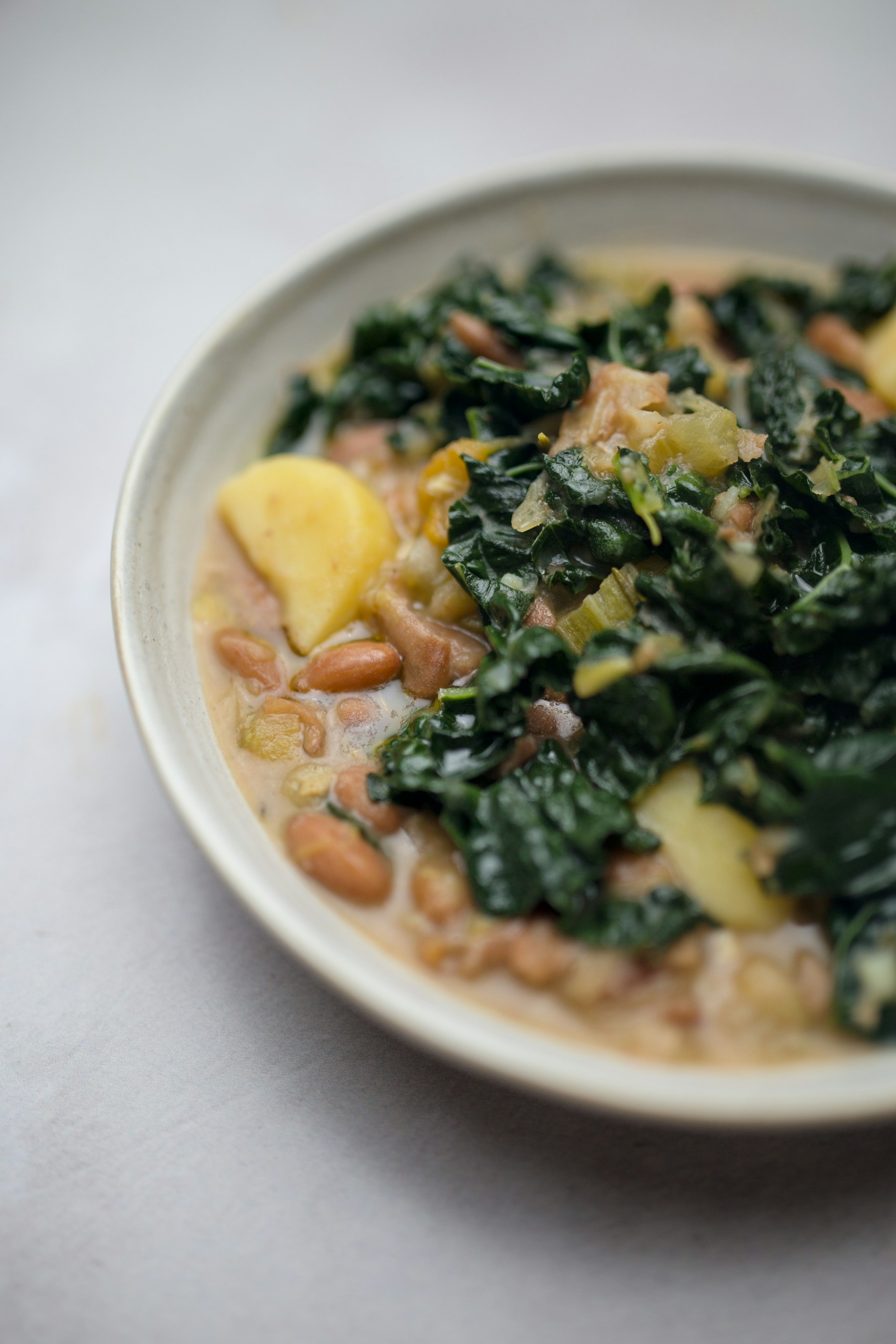
Almost every kitchen around the Mediterranean has a version of this soup: a pot of beans, a few potatoes, a heap of dark greens and more olive oil than seems reasonable. This one is Italian in style. Borlotti or cannellini beans and potatoes simmer on a slow soffritto of onion, carrot and celery with garlic and rosemary, a Parmesan rind gives up its savour to the broth, and cavolo nero goes in near the end. It is not a heritage Sardinian recipe; our fava-bean Sardinian minestrone is the one with that pedigree. It is a bean-and-greens soup that sits squarely in the way the Sardinian Blue Zone eats.
The Blue Zones organisation describes the classic Sardinian diet as whole-grain bread, beans, garden vegetables and fruits, with pecorino cheese from grass-fed sheep, and says meat is largely reserved for Sundays and special occasions. Its own Sardinian minestrone, which it calls a dish eaten every day for lunch by some of the world’s longest-lived families in Sardinia, is made with fava beans, cranberry beans and chickpeas, with potatoes, a soffritto of onion, carrot and celery, plenty of extra-virgin olive oil and a finish of pecorino Romano. Cranberry bean is the American name for the borlotti. This soup shares those bones, without the fregula and favas. That is all “Blue Zone” means here: a dish typical of how people in the region eat, not a secret.
What makes it really good is patience in three places. The soffritto cooks slowly, for 15–20 minutes, until it is soft and sweet rather than browned; that is where most of the flavour comes from. Two ladles of beans and potato are mashed and stirred back in, so the broth turns creamy without cream or flour. And the kale goes in late, once the potatoes are tender, so it ends up silky but still dark green rather than drab. A spoonful of your best olive oil over each bowl does the rest. Like most bean soups, it is better the next day, and it freezes well.
Worked out from USDA FoodData Central values, a bowl, one of six, comes to about 390 calories, 17 g of protein and 15 g of fibre, with about 120 g of beans, 85 g of potato and 40 g of kale (weighed raw) in each. Made with rinsed tinned beans, water rather than stock and the grated cheese on top, it has about 370 mg of sodium before you add any salt.
The beans. The Food Habits in Later Life study (Darmadi-Blackberry and colleagues, Asia Pacific Journal of Clinical Nutrition, 2004) followed 785 people aged 70 and over, in five cohorts in Japan, Sweden, Greece and Australia, for up to seven years, during which 169 died. The authors found that a higher legume intake was the most protective dietary predictor of survival: each extra 20 g a day was linked with a 7–8% lower risk of death (risk ratio 0.92, 95% CI 0.85–0.99, after adjusting for age, sex, smoking and ethnicity; 0.93 without the ethnicity adjustment). It was a small observational study, so it shows a link rather than proof. A bowl of this soup has about 120 g of beans, six times that 20 g step, though the study cannot tell you the benefit keeps adding up at that rate.
The kale. In a prospective study by Morris and colleagues (Neurology, 2018), summarised by the US National Institute on Aging, 960 older adults with an average age of 81 had their thinking tested over an average of nearly 5 years. Those who ate the most green leafy vegetables, a median of 1.3 servings a day, declined more slowly than those who ate the least, a median of 0.09 servings: a difference the NIA describes as equivalent to being 11 years younger cognitively. Kale was among the greens counted, at half a cup cooked a serving. It is observational and needs confirming in trials. By USDA values, the 40 g of raw kale in each bowl brings about 160 µg of vitamin K, more than the NIH’s recommended 120 µg a day for men and 90 µg for women, and about 2.6 mg of lutein and zeaxanthin. If you take warfarin, the NIH advises keeping the amount of vitamin K you eat about the same every day, so talk to your doctor before making this a regular dish.
The fibre. At about 15 g a bowl with borlotti, or about 13 g with cannellini, this soup gets you around half-way to the range that stood out in the review of carbohydrate quality by Reynolds and colleagues (The Lancet, 2019). Drawing on 185 publications from prospective studies, just under 135 million person-years of data, and 58 clinical trials, they found that observational data suggest a 15–30% decrease in all-cause and cardiovascular mortality, and in the incidence of coronary heart disease, stroke, type 2 diabetes and colorectal cancer, when comparing the highest fibre eaters with the lowest. The reduction in risk was greatest at 25–29 g of fibre a day, and dose-response curves suggested that higher intakes may give even more protection against cardiovascular disease, type 2 diabetes and colorectal and breast cancer.
The olive oil. Guasch-Ferré and colleagues (Journal of the American College of Cardiology, 2022) followed 60,582 women and 31,801 men in two large US cohorts, all free of cardiovascular disease and cancer at the start, for 28 years, during which 36,856 died. Compared with people who never or rarely used olive oil, those who had more than half a tablespoon (7 g) a day had a 19% lower risk of death over the study (hazard ratio 0.81, 95% CI 0.78–0.84). Replacing 10 g a day of margarine, butter, mayonnaise or dairy fat with olive oil was linked with 8–34% lower total and cause-specific mortality, though there was no significant difference when olive oil was compared with other vegetable oils combined. These are observational findings, and people who use a lot of olive oil may differ in other ways. Each bowl here has about 11 g of olive oil. There is more in our look at olive oil and longevity.
The Ingredients
- 75ml (5 tbsp)extra-virgin olive oil: 3 tbsp to cook, 2 tbsp to finish, plus more at the table
- 1 large, about 150g (5 oz)onion, finely chopped
- 2 medium, about 120g (4 oz)carrots, finely chopped
- 2 sticks, about 100g (3½ oz)celery, finely chopped
- 4garlic cloves, thinly sliced
- 1 large sprigfresh rosemary, leaves stripped and finely chopped (about 1 tbsp), plus 1 bay leaf
- Pinchdried chilli flakes (optional)
- 2 tbsp (about 30g)tomato paste, no-salt-added if you can find it
- 3 × 400g (14 oz) or 15 oz (425g) tinsborlotti or cannellini beans, drained and rinsed, about 720g (4 cups) drained; or 300g (10½ oz) dried beans, cooked (see the FAQ)
- 500g (1 lb 2 oz)floury or all-purpose potatoes, peeled and cut into 2cm (¾ in) chunks
- 1.5 litres (6⅓ cups)water, or half water and half low-sodium vegetable stock
- 1 piece, 5–8cm (2–3 in)Parmesan or pecorino rind, scraped clean (optional, but worth it)
- 250g (9 oz)cavolo nero or curly kale, weighed after stripping the stems, roughly shredded
- 30g (1 oz)Parmesan or pecorino, finely grated, to serve
- Salt and black pepper
Which beans? Borlotti give a darker, richer soup; cannellini a paler, creamier one. Both work. Floury potatoes break down and help thicken the broth; waxy ones hold their shape. No rind? Be generous with the cheese and oil at the end; for a vegan soup, skip both.
How to Make It
Chop the onion, carrot and celery finely and evenly, into pieces about 5mm (¼ in), by hand or by pulsing them in a food processor. Small, even pieces melt into a sweet base instead of staying as chunks. Slice the garlic, chop the rosemary, and peel and chunk the potatoes. Tip the beans into a sieve and rinse them well under the tap. Strip the kale leaves from their tough stems and shred them roughly. If you have a cheese rind, scrape the outside clean with a knife.
Warm 3 tbsp of the olive oil in a large heavy pot, at least 4 litres (4 quarts), over a medium-low heat. Add the onion, carrot and celery with a small pinch of salt and cook gently for 15–20 minutes, stirring every few minutes, until everything is very soft, glossy and sweet-smelling and the onion is turning pale gold. It should sizzle quietly, never fry hard; if the edges start to brown, turn the heat down and add a splash of water. Most of the soup’s flavour is made here, so don’t rush it.
Add the garlic, rosemary and chilli, if using, and stir for 1–2 minutes, until the garlic smells sweet but has not coloured. Stir in the tomato paste and cook for another 2 minutes, stirring, until it darkens a shade and starts to catch on the bottom of the pot.
Add the beans, potatoes, the 1.5 litres (6⅓ cups) of water or water and stock, the bay leaf and the cheese rind, and scrape up anything stuck to the bottom. Bring to the boil, then lower the heat to a steady simmer, partly cover and cook for 20–25 minutes, stirring now and then so the rind does not stick, until the potatoes are completely tender and starting to fray at the edges.
Scoop out two ladles of beans and potato with a little of the broth, about 400ml (1⅔ cups) in all. Mash them to a rough purée with a fork or potato masher, or blitz them with a stick blender, and stir them back into the pot. You can also crush some against the side of the pot with the back of a wooden spoon. The broth turns thick and creamy without any flour or cream. It should be thick and spoonable, not a purée; if it is too thick, add a splash of water.
Stir in the kale, a handful at a time if the pot is full. Simmer uncovered for 10–15 minutes for cavolo nero, or 8–10 for curly kale, until the leaves are tender and silky but still dark green. Fish out the bay leaf and the rind. A Parmigiano Reggiano rind is edible once softened, so you can chop it small and stir it back in; discard any rind that is waxed or coated. Taste, then season with black pepper, and with salt only if it needs it: the rind and cheese bring some salt, and each ¼ tsp adds about 100mg of sodium a bowl. If you can, take the pot off the heat and let it stand for 10 minutes.
Ladle into warm bowls. Drizzle each with about 1 tsp of your best extra-virgin olive oil, which is the remaining 2 tbsp shared between six, then add a spoonful of the grated cheese and a grind of black pepper. Serve with a slice of wholegrain or sourdough bread, and put the olive oil on the table for anyone who wants more.
Getting It Right
- The soffritto is the foundation. Keep the heat low and give it the full 15–20 minutes. Browned, bitter edges are hard to hide.
- Save your rinds. Keep the hard ends of Parmesan or pecorino in a bag in the freezer (the texture doesn’t matter for soup) and drop one into the pot straight from frozen. Separately, the Parmigiano Reggiano consortium says its rind can be eaten, because the cheese contains no additives or preservatives and the rind gets no preserving treatment, but advises cleaning it well first. Skip any rind that is waxed or coated.
- Too thin? Mash a few more beans and simmer uncovered for 5 minutes. Too thick, especially the next day? Add hot water a splash at a time.
- Season at the end. The rind, cheese and any stock all bring salt. Taste once the kale is in.
Questions People Ask
No, and we don’t want to pretend it is. It is an Italian-style bean, potato and greens soup of a kind made all over Italy; the fava-bean Sardinian minestrone is the bean soup on this site with a Sardinian pedigree. This soup fits the same pattern. The Blue Zones organisation describes the classic Sardinian diet as built on whole-grain bread, beans, garden vegetables and fruits, with pecorino cheese, and says meat is largely reserved for Sundays and special occasions. Its own Sardinian minestrone is made with fava beans, cranberry beans (the American name for borlotti) and chickpeas, potatoes, olive oil and pecorino. That is the honest link: a dish typical of how people there eat, not a longevity secret.
Our figure of about 370 mg a bowl assumes rinsed tinned beans, water rather than stock, the rind and 30 g of grated Parmesan shared between six, with no salt added; the pinch in the soffritto adds roughly 20 mg more. The beans bring about 250 mg of that: USDA lists 208–223 mg of sodium per 100 g for tinned beans that have been drained and rinsed. The grated Parmesan adds about 60 mg a bowl, or about 70 mg for pecorino Romano. The rind gives up some salt as it softens; even if a 30 g piece dissolved completely, by USDA’s values for Parmesan it would add roughly 60 mg a bowl, perhaps a little more, since the rind is saltier than the inside of the cheese. Stock is the big one: by USDA values, making the soup entirely with an ordinary ready-to-serve vegetable broth would add about 740 mg a bowl. Each ¼ teaspoon of salt adds about 100 mg. Rinsing helps: in a study of five bean varieties, draining tinned beans cut their sodium by 36%, and draining plus rinsing by 41%. The FDA counts 460 mg (20% of the Daily Value) or more a serving as high. If you have been told to watch your sodium or blood pressure, talk to your doctor.
Yes. Use 300 g (10½ oz) of dried borlotti or cannellini; by USDA values that gives roughly 735 g cooked, about the same as three drained tins. Soak them in plenty of cold water for at least 12 hours, drain, cover with fresh water and boil them hard for at least 10 minutes, then simmer gently until creamy all the way through, usually 1–1½ hours. That hard boil matters. The Centre for Food Safety in Hong Kong advises soaking beans for at least 12 hours and then boiling them vigorously for at least 10 minutes, and not cooking them from raw at a low temperature, as in a slow cooker. It notes that white kidney beans, another variety of the same species as red kidney beans, contain about a third as much of the natural toxin phytohaemagglutinin, and that commercially tinned beans are safe to eat without further cooking. Keep 500 ml (2 cups) of the cooking liquid to use in place of some of the water; it adds body. Cooked without salt, dried beans bring the sodium down to about 120 mg a bowl before seasoning.
Once the potatoes are tender and you have mashed some of the beans, not before. Cavolo nero needs about 10–15 minutes at a gentle simmer to turn silky; curly kale is a little quicker, 8–10 minutes. Put it in at the start and it turns drab and soft; leave it too late and it stays chewy. Swiss chard works well: chop the stalks and add them with the potatoes, and the leaves for the last 5 minutes. Spinach wilts in a minute or two, so stir it in just before serving.
Very well; like most bean soups, it is better the next day. Cool it quickly by dividing it into shallow containers, and refrigerate it within 2 hours. USDA says leftovers can be kept in the refrigerator for 3 to 4 days or frozen for 3 to 4 months. The soup thickens as it stands, so loosen it with water when you reheat it, and bring it to a rolling boil, as USDA advises for soups. The kale softens a little in the freezer, but the flavour holds. Add a fresh drizzle of olive oil and a little cheese after reheating.
Sources
- Blue Zones. Sardinia, Italy. bluezones.com
- Blue Zones. Sardinian Minestrone (recipe). bluezones.com
- Merriam-Webster. Borlotti bean. merriam-webster.com
- Darmadi-Blackberry I, Wahlqvist ML, Kouris-Blazos A, Steen B, Lukito W, Horie Y, Horie K. Legumes: the most important dietary predictor of survival in older people of different ethnicities. Asia Pac J Clin Nutr. 2004;13(2):217–220. Full text (PDF)
- Morris MC, Wang Y, Barnes LL, Bennett DA, Dawson-Hughes B, Booth SL. Nutrients and bioactives in green leafy vegetables and cognitive decline: prospective study. Neurology. 2018;90(3):e214–e222. Article
- National Institute on Aging. Leafy greens linked with slower age-related cognitive decline. nia.nih.gov
- NIH Office of Dietary Supplements. Vitamin K: Fact Sheet for Consumers. ods.od.nih.gov
- Reynolds A, Mann J, Cummings J, Winter N, Mete E, Te Morenga L. Carbohydrate quality and human health: a series of systematic reviews and meta-analyses. Lancet. 2019;393(10170):434–445. Article · Accepted manuscript (PDF)
- Guasch-Ferré M, Li Y, Willett WC, Sun Q, Sampson L, Salas-Salvadó J, Martínez-González MA, Stampfer MJ, Hu FB. Consumption of olive oil and risk of total and cause-specific mortality among U.S. adults. J Am Coll Cardiol. 2022;79(2):101–112. Full text
- Duyff RL, Mount JR, Jones JB. Sodium reduction in canned beans after draining, rinsing. J Culinary Sci Technol. 2011;9(2):106–112. Journal record · Full text (PDF, hosted by a bean manufacturer)
- US Food and Drug Administration. Sodium in Your Diet. 2021. fda.gov (PDF)
- Centre for Food Safety, Hong Kong. Phytohaemagglutinin Poisoning. Food Safety Focus, issue 208, November 2023. cfs.gov.hk
- USDA Food Safety and Inspection Service. Leftovers and Food Safety. fsis.usda.gov
- Consorzio del Formaggio Parmigiano Reggiano. FAQ. parmigianoreggiano.com
- USDA FoodData Central, SR Legacy: Beans, cranberry (roman), mature seeds, cooked, boiled, without salt (FDC 173736); Beans, cranberry (roman), mature seeds, raw (FDC 175189); Beans, white, mature seeds, cooked, boiled, without salt (FDC 175203); Beans, kidney, red, mature seeds, canned, drained solids, rinsed in tap water (FDC 175243); Beans, pinto, mature seeds, canned, drained solids, rinsed in tap water (FDC 173797); Potatoes, flesh and skin, raw (FDC 170026); Kale, raw (FDC 168421); Onions, raw (FDC 170000); Carrots, raw (FDC 170393); Celery, raw (FDC 169988); Garlic, raw (FDC 169230); Tomato products, canned, paste, without salt added (FDC 170459); Oil, olive, salad or cooking (FDC 171413); Cheese, parmesan, hard (FDC 170848); Cheese, romano (FDC 171249); Soup, vegetable broth, ready to serve (FDC 171583); Salt, table (FDC 173468). Foundation: Beans, great northern, canned, sodium added, drained and rinsed (FDC 2644294). fdc.nal.usda.gov