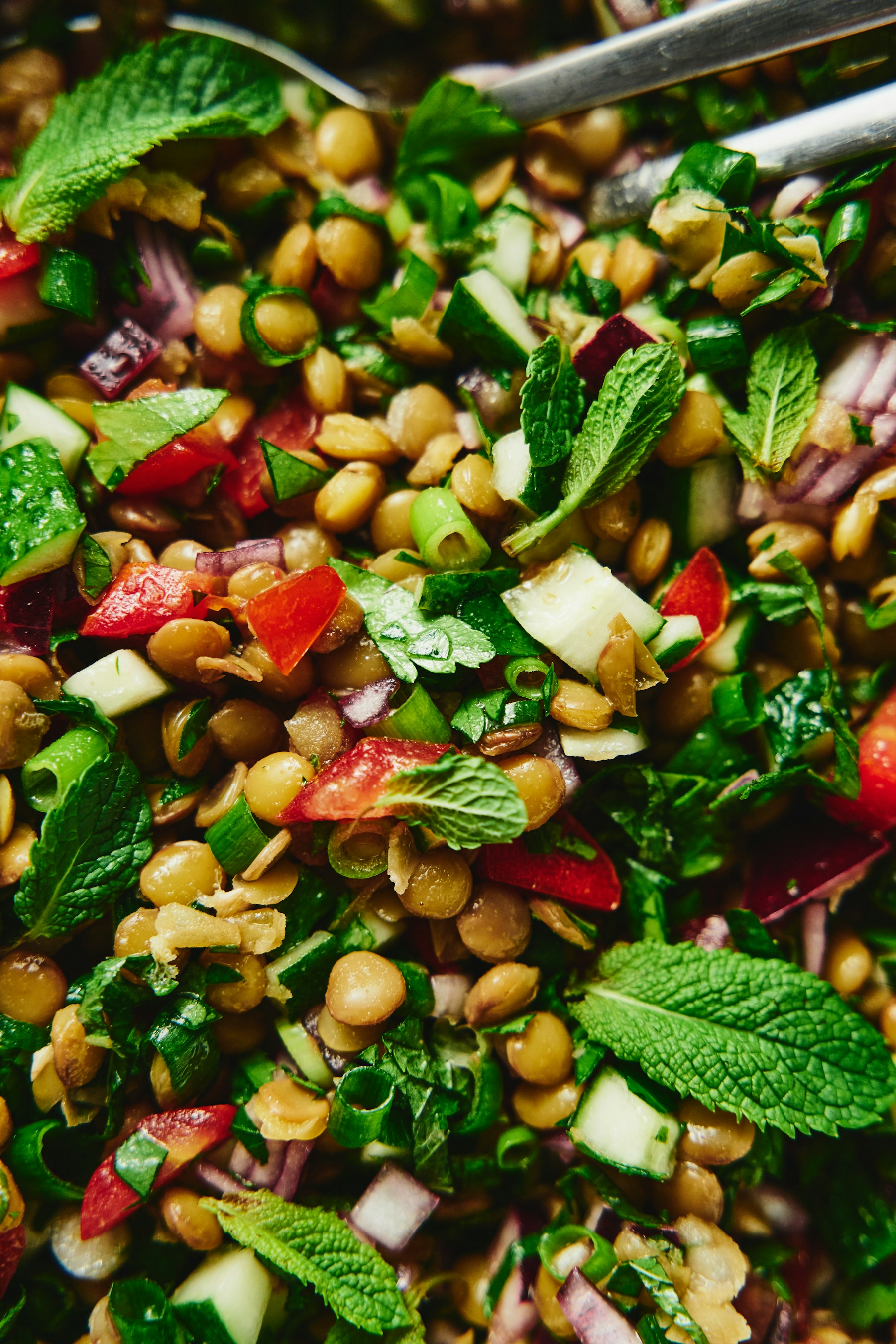
In Greek, chickpeas are revithia, and the cook and writer Diane Kochilas calls them one of the oldest foods continuously eaten throughout the Aegean islands. This salad is not a named Ikarian dish; we looked for a traditional one and couldn't verify it. It is the kind of chickpea salad made all over Greece and the eastern Mediterranean: chickpeas, ripe tomato, cucumber, two kinds of onion, a fistful of herbs and a sharp lemon and olive oil dressing. It fits the way Ikarians are described as eating, with beans, vegetables and olive oil at the centre, and that is the whole of the claim.
A chickpea salad is easy to make badly. Cold chickpeas straight from the tin sit in the dressing like marbles, the tomatoes and cucumber weep until the bottom of the bowl is a puddle, and raw onion drowns out everything else. Four small habits fix all of that: dress the chickpeas while they are warm, salt and drain the tomatoes and cucumber, soak the sliced red onion in cold water, and use far more parsley and mint than looks sensible. Each one is in the method below.
A main serving, a quarter of the bowl, carries about 120 g of chickpeas, just over 200 g of raw vegetables and a tablespoon of olive oil. Worked out from USDA FoodData Central values, that comes to about 335 calories, 11 g of protein and 10 g of fibre, with 17 g of fat, most of it the monounsaturated fat of the olive oil. As a side for six it is about 225 calories. Sodium is about 560 mg a main serving as written, roughly half from the tinned chickpeas and half from the salt, and it is easy to bring down; the numbers are below.
It fits the island pattern, nothing more. The Blue Zones organisation describes Ikarian eating as a variation of the Mediterranean diet, with lots of fruit and vegetables, whole grains, beans, potatoes and olive oil. A chickpea salad is beans, raw vegetables and olive oil, so it belongs to that pattern. It is not an Ikarian speciality, and no study has tested this salad on its own.
Legumes and survival in older age. The Food Habits in Later Life study (Darmadi-Blackberry and colleagues, Asia Pacific Journal of Clinical Nutrition, 2004) followed 785 people aged 70 and over, in five cohorts in Japan, Sweden, Australia and Greece, for up to seven years; 169 of them died. Legumes stood out: every extra 20 g a day was linked with a 7–8% lower risk of death (RR 0.92, 95% CI 0.85–0.99), with or without allowing for ethnicity. The Japanese cohort and the two Greek cohorts, one in Greece and one living in Australia, ate the most legumes, 63–86 g a day on average. It is a small, old observational study and can't prove the beans did the work, or that the benefit keeps growing beyond the amounts people ate.
Pulses and LDL cholesterol. This part comes from trials, not just observation. Ha and colleagues (CMAJ, 2014) pooled 26 randomised controlled trials with 1,037 people and found that diets emphasising dietary pulses, which they define as beans, chickpeas, lentils and peas, at a median of 130 g a day, about one serving, lowered LDL cholesterol by 0.17 mmol/L (about 6.6 mg/dL) compared with control diets (95% CI −0.25 to −0.09). That is a modest drop, and the authors call for longer, higher-quality trials. A main serving of this salad has about 120 g of chickpeas, close to that dose; a side serving has about 80 g.
The olive oil is linked to lower mortality. In a study of two large US cohorts (Guasch-Ferré and colleagues, Journal of the American College of Cardiology, 2022), 60,582 women and 31,801 men were followed for 28 years, during which 36,856 died. People who used more than half a tablespoon (about 7 g) of olive oil a day had a 19% lower risk of death from any cause than those who never or rarely used it (hazard ratio 0.81, 95% CI 0.78–0.84), and lower risks of dying from cardiovascular disease, cancer, neurodegenerative disease and respiratory disease. Compared with other vegetable oils combined, there was no significant difference. The authors note that, as with any observational study, residual confounding cannot be ruled out. A main serving here has about 13.5 g, a tablespoon; a side has about 9 g.
The fibre. At about 10 g a main serving, most of it from the chickpeas, this salad gets you more than a third of the way to the range that stood out in the review of carbohydrate quality by Reynolds and colleagues (The Lancet, 2019). Drawing on 135 million person-years of data from prospective studies and 58 clinical trials, they report that observational data suggest a 15–30% decrease in all-cause and cardiovascular mortality, and in the incidence of coronary heart disease, stroke, type 2 diabetes and colorectal cancer, when comparing people who ate the most fibre with those who ate the least. The reduction in risk was greatest at 25–29 g of fibre a day.
The Ingredients
- 2 × 400g (14–15 oz) tinschickpeas, drained and rinsed, about 480g (3 cups) drained; or about 200g (1 cup) dried chickpeas, cooked (see the FAQ)
- 400g (14 oz)ripe tomatoes; cherry or vine tomatoes out of season, about 2¾ cups cherry tomatoes
- 1 mediumcucumber, about 300g (10 oz)
- 1 smallred onion, about 70g (2½ oz)
- 4spring onions (scallions), about 60g (2 oz), green tops included
- 30g (1 oz)flat-leaf parsley, a big bunch, leaves and tender stems (about ½ cup chopped)
- 15g (½ oz)fresh mint leaves, a big handful
- 60ml (4 tbsp)extra-virgin olive oil
- 45ml (3 tbsp)lemon juice, from 1 large or 2 small lemons, plus the finely grated zest of ½ lemon
- 1 smallgarlic clove, finely grated
- 1 tspdried Greek oregano, or sumac, the tart red spice of the eastern Mediterranean, or half of each
- ½ tspsalt in all, divided; taste first
- Black pepper. Optional: a pinch of chilli flakes; 100g (3½ oz) feta to crumble over the top.
How to Make It
Rinse the chickpeas well in a sieve. Tip them into a small pan with 2 tablespoons of water, cover and warm them over a medium heat for 3–4 minutes, shaking the pan now and then, until they are hot right through. (A covered bowl in the microwave works too.) Meanwhile, grate the garlic into a large serving bowl, add the lemon juice and zest and a good pinch, about ⅛ teaspoon, of the salt, and leave it for 5 minutes; the acid takes the raw edge off the garlic. Whisk in the olive oil, the oregano or sumac and plenty of black pepper. Drain the hot chickpeas, add them to the bowl and turn them in the dressing. Lightly crush a spoonful against the side of the bowl, then leave them to cool and soak for at least 15 minutes. Warm chickpeas soak up the dressing; cold ones from the tin mostly just sit in it.
While the chickpeas soak, cut the tomatoes into bite-sized chunks, or halve cherry tomatoes. Quarter the cucumber lengthways; if the seedy middle is very wet, run a teaspoon down it to scoop it out, then cut the cucumber into chunks a little smaller than the tomatoes. Put both in a colander set over a bowl, toss them with about ¼ teaspoon of the salt and leave them for 15 minutes. They will give up a surprising amount of liquid that would otherwise pool in the bowl. Shake them well before using.
Halve the red onion and slice it as thinly as you can. Put it in a small bowl of cold water for 10 minutes, then drain it and pat it dry. It stays crisp but loses the harsh bite that can take over a salad. Slice the spring onions thinly, green tops included; they don't need soaking.
Pick the parsley leaves and the thin, tender stems and chop them roughly; you want pieces, not a paste. Tear or roughly chop the mint just before it goes in, because cut mint darkens quickly. It should look like too much herb. Here the herbs are an ingredient, not a garnish.
Add the drained tomatoes and cucumber, the red onion, the spring onions and the herbs to the bowl of chickpeas and turn everything over gently. Taste a forkful with a bit of everything. Add more lemon if it is flat, a little more oil if it is sharp, and only then the rest of the salt if it needs it. Let it sit for 5 minutes, toss again and serve, with feta crumbled over the top if you are using it.
Make It Ahead & Pack It for Lunch
This salad improves with time, as long as you keep its two halves apart until the day you eat it: the chickpeas benefit from waiting; the tomatoes, cucumber and herbs don't.
- Make the base up to 3 days ahead. Do step 1, stir in the soaked red onion and the spring onions, and keep the lot covered in the fridge. The chickpeas keep marinating and taste better on day two than on day one.
- Add the watery things on the day. Cut, salt and drain the tomatoes and cucumber, and chop the herbs, the morning you eat it. For a packed lunch, put them in a separate container, or layer them on top of the chickpeas in a jar so they don't sit in the dressing, and mix just before eating.
- Revive it. Olive oil firms up in the fridge, so give the base 15 minutes out of the fridge if you can, or a good stir. Add a squeeze of fresh lemon and a little more salt or herb if it tastes tired.
- Keep it cold. Pack it with an ice pack if it will be out of the fridge for the morning, and don't leave it sitting at room temperature for hours.
Questions People Ask
No, and we couldn't verify a traditional Ikarian chickpea salad to copy. Chickpea salads like this are made across Greece and the wider Mediterranean, and Diane Kochilas calls chickpeas one of the oldest foods continuously eaten throughout the Aegean islands. We call it a Blue Zone recipe because it fits the pattern described on Ikaria: the Blue Zones organisation says Ikarians eat a variation of the Mediterranean diet with lots of fruit and vegetables, whole grains, beans, potatoes and olive oil. This is beans, vegetables, herbs and olive oil. It is an example of that pattern, not a secret to long life.
Our figure of about 560 mg of sodium a main serving assumes rinsed tinned chickpeas and ½ teaspoon of salt for the whole bowl. By USDA values the chickpeas bring about 255 mg a serving and the salt about 290 mg; the vegetables, herbs and dressing add about 15 mg. Some of the salt on the tomatoes and cucumber drains away with their juice, so the true figure is probably a little lower, but we have counted all of it. The FDA counts 20% of the Daily Value (460 mg) or more in a serving as high, so a main portion as written just counts as high, while a side portion, about 375 mg, does not. Our figure already assumes the chickpeas are drained and rinsed, so don't skip that step: in a study of five kinds of tinned beans, chickpeas among them, draining cut sodium by 36% and draining plus rinsing by 41%, though the extra cut from rinsing was not statistically significant. Chickpeas cooked at home without salt cut the chickpeas' share to under 10 mg a serving by USDA values, bringing the bowl to about 315 mg a main serving; no-salt-added tins vary, so check the label. Feta is the big addition: 100 g crumbled over the bowl adds about 285 mg a main serving. If you have been told to watch your sodium or blood pressure, talk to your doctor about how dishes like this fit in.
Yes, and they make the best version. Going by USDA values for raw and boiled chickpeas, about 200 g (1 cup) of dried chickpeas gives roughly 460 g cooked, close to two drained tins. Soak them overnight in plenty of cold water, drain, cover with fresh water and simmer until they are completely tender, about an hour or more depending on their age; the method is in our Ikarian chickpea and spinach stew. Cooked without salt, they have almost no sodium. Drain them and dress them straight from the pot, while they are still hot, which is when they soak up the most dressing.
Yes, it is a good lunchbox salad if you pack it in two parts. The dressed chickpeas, soaked red onion and spring onions keep well for 3 days in a covered container in the fridge, and they get better as they marinate. The tomatoes, cucumber and herbs are what go watery and limp, so add those on the day: either toss them in that morning, or pack them in a separate container and mix at lunch. A fully mixed salad is still good the next day, just softer; tip off any liquid and add a squeeze of lemon. Keep it cold until you eat it.
It is vegan and gluten-free as written, and vegetarian with feta. If you avoid animal rennet, check the label on the feta. As a main for four it gives about 335 calories, 11 g of protein and 10 g of fibre a serving, which is a light lunch rather than a big dinner. To make it more filling, add wholegrain pitta, the feta (about 3.5 g more protein a serving), or a bowl of Greek fava alongside.
Sources
- Blue Zones. Ikaria, Greece. bluezones.com
- Kochilas D. Revithosalata: quinoa-chickpea salad. dianekochilas.com
- Darmadi-Blackberry I, Wahlqvist ML, Kouris-Blazos A, Steen B, Lukito W, Horie Y, Horie K. Legumes: the most important dietary predictor of survival in older people of different ethnicities. Asia Pac J Clin Nutr. 2004;13(2):217–220. Full text (PDF)
- Ha V, et al. Effect of dietary pulse intake on established therapeutic lipid targets for cardiovascular risk reduction: a systematic review and meta-analysis of randomized controlled trials. CMAJ. 2014;186(8):E252–E262. doi:10.1503/cmaj.131727. Article
- Guasch-Ferré M, et al. Consumption of olive oil and risk of total and cause-specific mortality among U.S. adults. J Am Coll Cardiol. 2022;79(2):101–112. Full text (PMC)
- Reynolds A, et al. Carbohydrate quality and human health: a series of systematic reviews and meta-analyses. Lancet. 2019;393(10170):434–445. Article · Accepted manuscript (PDF)
- Duyff RL, Mount JR, Jones JB. Sodium reduction in canned beans after draining, rinsing. J Culinary Sci Technol. 2011;9(2):106–112. Article · Copy (PDF), hosted by Bush's Beans, a canned-bean brand
- US Food and Drug Administration. Sodium in Your Diet. 2021. fda.gov (PDF)
- USDA FoodData Central, SR Legacy: Chickpeas, mature seeds, canned, drained, rinsed in tap water (FDC 173801); Chickpeas, mature seeds, canned, drained solids (FDC 173800); Chickpeas, mature seeds, raw (FDC 173756); Chickpeas, mature seeds, cooked, boiled, without salt (FDC 173757); Tomatoes, red, ripe, raw, year round average (FDC 170457); Cucumber, with peel, raw (FDC 168409); Onions, raw (FDC 170000); Onions, spring or scallions (includes tops and bulb), raw (FDC 170005); Parsley, fresh (FDC 170416); Spearmint, fresh (FDC 173475); Oil, olive, salad or cooking (FDC 171413); Lemon juice, raw (FDC 167747); Garlic, raw (FDC 169230); Spices, oregano, dried (FDC 171328); Salt, table (FDC 173468); Cheese, feta (FDC 173420). fdc.nal.usda.gov


