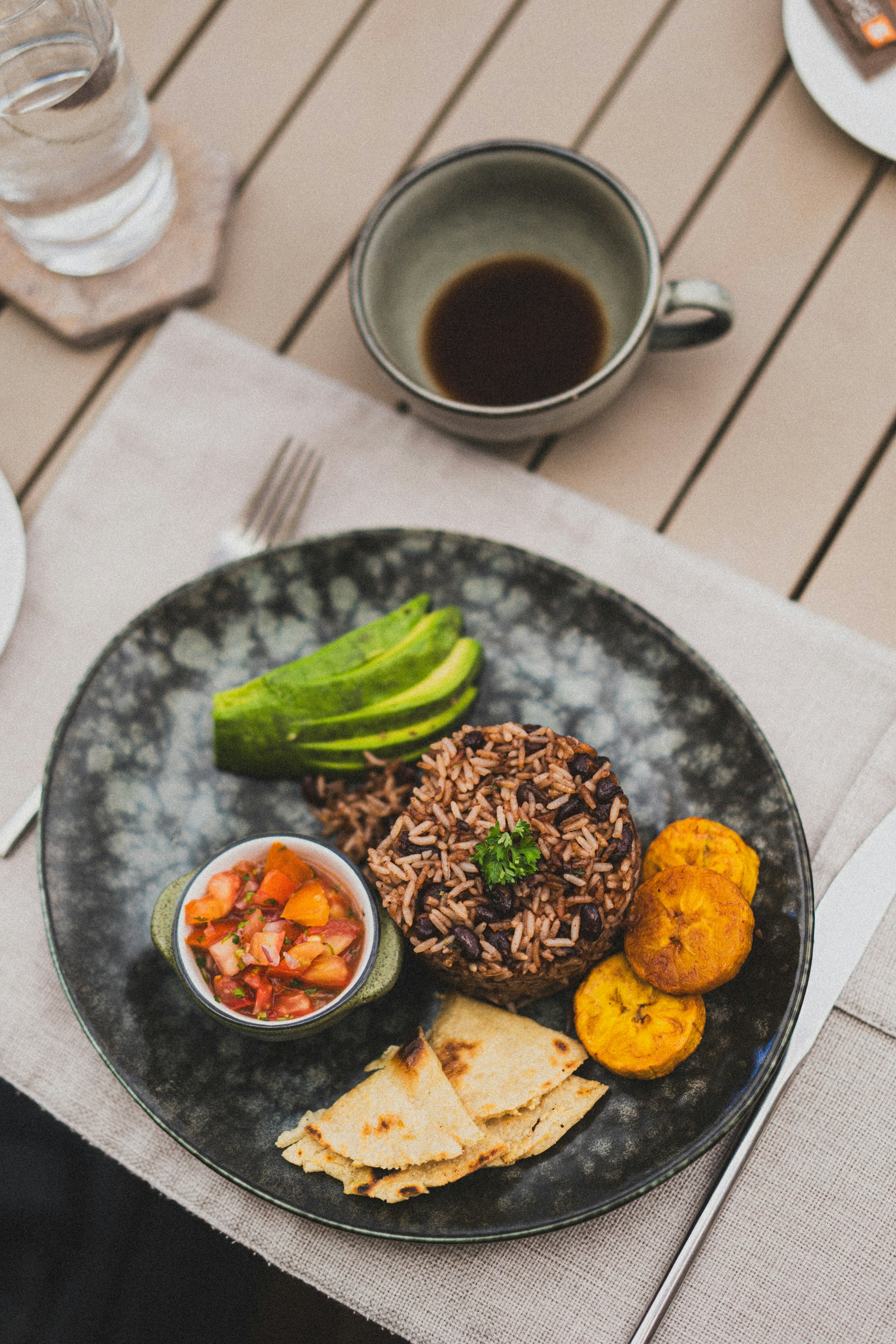
La Voz de Guanacaste, a regional Costa Rican newspaper, puts it plainly: in Costa Rica, “for lunch it is customary to eat a traditional casado”, which it describes as rice and beans “accompanied by some meat and some type of picadillo”, a dish of finely chopped vegetables. The paper says the name, which literally means “married”, has many possible origins. One is that the things on the plate go well together. Another is that it was the first dish married women cooked for their husbands when they went out to work. Either way, it is not a festival dish. It is lunch.
This is not gallo pinto. In gallo pinto the rice and beans are fried together into one speckled dish. A casado keeps them side by side, each cooked properly on its own, and builds a plate around them. Ours is a meatless version for four: fluffy white rice, black beans simmered with onion, sweet pepper and coriander until their liquid turns glossy, sweet plantain roasted in the oven until it caramelises, a sharp cabbage and tomato salad with lime, a fan of avocado, a spoonful of pico de gallo, and an egg on top if you want one.
Worked out from USDA FoodData Central values, a plate without the egg comes to about 665 calories, 17 g of protein and 18 g of fibre, with about 730 mg of sodium. The egg adds about 80 calories and 6 g of protein. That is a proper lunch, and it fits the rhythm the Blue Zones organisation describes in Nicoya, where people eat a light dinner early in the evening. If dinner is light, a big plate at midday makes sense.
Nicoya, honestly. The Blue Zones organisation says that for most of their lives, Nicoyan centenarians ate a traditional Mesoamerican diet highlighted with the “three sisters” of agriculture: squash, corn and beans. The demographic evidence comes from Luis Rosero-Bixby, William Dow and David Rehkopf (Vienna Yearbook of Population Research, 2013). Following 16,300 older Costa Ricans, they found that from 1990 to 2011 older men in Nicoya had a death rate about 20% lower than the national figure (death rate ratio 0.80, 95% CI 0.69–0.93; life expectancy at 60, 23.6 years against 21.1), mainly from fewer cardiovascular deaths. Nicoyan women had no such advantage. Diet data from the CRELES survey showed that Nicoyans ate more plain everyday foods such as rice, beans, beef, fish and chicken, and also light cheese and sodas, and the authors caution against over-interpreting such quirks of diet. So rice and beans sit at the centre of the pattern, but nobody has tested a casado. This is evidence about a place, not a dish.
The beans. In the Food Habits in Later Life study (Darmadi-Blackberry and colleagues, Asia Pacific Journal of Clinical Nutrition, 2004), 785 people aged 70 and over in five cohorts, in Japan, Sweden, Australia and Greece, were followed for up to seven years. Legumes stood out: every 20 g a day more was linked with a 7–8% lower risk of death (RR 0.92, 95% CI 0.85–0.99, adjusted for age, sex, smoking and cohort). The authors concluded that a higher legume intake was the most protective dietary predictor of survival in the elderly. It is a small observational study, so it shows a link, not cause and effect. Each plate here has about 120 g of beans, six of those 20 g steps, though the study can’t say the benefit keeps adding up at that rate.
The fibre. By USDA values a plate has about 18 g of fibre, almost half of it from the beans and the rest from the avocado, plantain, cabbage and tomatoes. In their review of carbohydrate quality (The Lancet, 2019), Reynolds and colleagues drew on 135 million person-years of data from prospective studies and 58 clinical trials. The observational data suggested a 15–30% decrease in all-cause and cardiovascular mortality among people eating the most fibre compared with the least, and the risk reduction was greatest at 25–29 g a day. One plate gets you roughly two-thirds of the way to that range.
The plantain and the avocado. By USDA values a plate carries about 1,600 mg of potassium. Nearly a third comes from the plantain (about 490 mg in 100 g), with about 300 mg from the beans and about 240 mg from the avocado, which also adds about 3.4 g of fibre and 7 g of fat, two-thirds of it monounsaturated. The NIH Office of Dietary Supplements sets the adequate intake at 3,400 mg a day for men and 2,600 mg for women (US adults average about 3,016 and 2,320 mg) and notes that higher potassium intakes may help decrease blood pressure. If you have kidney disease or have been told to limit potassium, ask your doctor how a plate like this fits.
The Ingredients
- For the rice
- 200g (1 generous cup)long-grain white rice
- 1 tspolive oil
- 1garlic clove, finely chopped
- 450ml (scant 2 cups)water
- ½ tspsalt
- For the black beans
- 1 tbspolive oil
- 1 medium (110g / 4oz)onion, finely chopped
- ½ (60g / 2oz)red sweet pepper, finely chopped
- 3garlic cloves, finely chopped
- ½ tspground cumin (optional)
- 15g (1 loose cup)coriander (cilantro), stalks finely chopped, leaves roughly chopped and kept separate
- 2 × 400g (15oz) cansblack beans, drained and rinsed (about 480g / 2¾ cups drained), or the same weight of home-cooked beans
- 250ml (1 cup)water, or bean cooking liquid if your beans are home-cooked
- For the plantains
- 400g (14oz) peeledvery ripe plantains (1½–2, depending on size), skins mostly black (see below)
- 1 tbspolive oil
- For the cabbage salad
- 300g (about 4 cups)green cabbage, very finely shredded (about a third of a medium head)
- 1 medium (120g / 4oz)tomato, diced
- Juice of 1 limeabout 3 tbsp
- 5g (⅓ cup)chopped coriander leaves
- ⅛ tspsalt
- For the pico de gallo
- 2 medium (250g / 9oz)tomatoes, finely diced
- 1 small (70g / 2½oz)white onion, finely diced
- 10g (⅔ cup)chopped coriander leaves
- 1jalapeño, seeded and finely chopped (optional)
- Juice of ½ limeabout 1½ tbsp
- ⅛ tspsalt
- To serve
- 1 very large or 2 smallripe avocados, about 200g (7oz) of flesh
- 4 largeeggs, plus 1 tsp olive oil (optional)
- To servelime wedges, and hot sauce or Salsa Lizano if you like (not counted in the nutrition)
The Timing Plan
Five components, one cook. The trick is to start the two things that look after themselves, the rice and the plantains, and do the rest while they cook. You need a small pan with a lid, a medium pan, a baking tray and a frying pan if you are making eggs.
- 0:00Heat the oven. Rinse the rice and chop all the garlic.
- 0:02Start the rice. Once the lid is on (about 0:06), leave it alone.
- 0:05Peel, slice and oil the plantains. Chop the onion, sweet pepper and coriander stalks for the beans; drain and rinse the beans.
- 0:12Plantains into the oven. Start the onion and pepper for the beans.
- 0:20Garlic and cumin in for a minute, then the beans and water. Shred the cabbage and dress it with the lime and salt.
- 0:23Turn the plantains. Make the pico de gallo.
- 0:24Rice off the heat, lid on, to rest.
- 0:32Crush some of the beans, stir in the coriander leaves, taste. Lid on.
- 0:34Plantains out. Fry the eggs. Finish the salad and slice the avocado.
- 0:40Fluff the rice and build the plates.
How to Make It
Heat the oven to 220°C (200°C fan) / 425°F and line a large baking tray with baking paper. Put the rice in a sieve and rinse it under the cold tap, swirling it with your fingers, until the water runs almost clear.
Warm the teaspoon of oil in a small heavy pan with a tight lid over a medium heat. Add the garlic, stir for 30 seconds, then add the drained rice and stir for 1–2 minutes, until every grain is glossy. Pour in the 450ml of water, add the ½ teaspoon of salt and bring to the boil. Stir once, cover, turn the heat to its lowest setting and cook for 18 minutes without lifting the lid. Then take the pan off the heat and leave it covered for 10 minutes more.
Cut both ends off each plantain, slit the skin lengthwise along its ridges and peel it away; ripe plantains peel easily. Slice the flesh on a sharp diagonal about 1.5cm (⅝ in) thick. Toss the slices with the tablespoon of oil on the tray and spread them out in a single layer with space between them. Roast for 20–25 minutes, turning them halfway, until they are deep golden-brown with dark caramelised edges and soft right through. Check them for the last 5 minutes: the sugar that makes them good also makes them burn. To fry them instead, heat 2 tablespoons of oil in a large non-stick or cast-iron pan over a medium heat and fry the slices in one layer, in two batches if needed, for 3–4 minutes a side, until deep brown, then drain on kitchen paper.
Warm the tablespoon of oil in a medium pan over a medium heat. Add the onion, sweet pepper and chopped coriander stalks and cook for 7–8 minutes, stirring now and then, until soft and sweet. Add the garlic and cumin and stir for a minute. Tip in the beans and the 250ml of water, bring to a simmer and cook gently for 10–12 minutes. Then crush about a quarter of the beans against the side of the pan with the back of a spoon: the liquid thickens into a loose, glossy sauce. Stir in the coriander leaves and taste before you add any salt, because rinsed canned beans still bring some. Keep them warm, lid on.
Put the shredded cabbage in a bowl with the lime juice and ⅛ teaspoon of salt and scrunch it with your hands for 30 seconds. Leave it for 10 minutes to soften, then fold in the tomato and coriander just before serving. For the pico, mix the tomatoes, onion, coriander, jalapeño if using, lime juice and ⅛ teaspoon of salt, and leave it to sit for 10 minutes while the flavours come together.
If you are having eggs, warm the teaspoon of oil in a non-stick pan over a medium heat, crack in the eggs and cook for 3–4 minutes, until the whites are set. Then cover the pan for 2 minutes more, or flip them and cook for another 1–2 minutes, until the yolks are firm: the FDA advises cooking eggs until both the yolk and the white are firm. Halve, stone and peel the avocado and cut it into slices.
Fluff the rice with a fork. On each plate, put a mound of rice and a ladle of beans beside it, not on top, then the plantains, a pile of cabbage salad, a few slices of avocado, a spoonful of pico de gallo and the egg. Put lime wedges and hot sauce on the table.
Picking Ripe Plantains
This is the one ingredient that decides the dish. Sweet plantains need to be far riper than you would ever eat a banana. As the skins go from green to yellow to mostly black, plantains get less starchy and much sweeter, and USDA values show how big the change is: raw green plantain has about 2 g of sugars per 100 g, and raw yellow plantain about 17.5 g. That sugar is what caramelises in the oven.
- Look for black. The skin should be mostly black, or deep yellow with heavy black patches. A plantain that is all yellow will work but tastes plainer; a green one will not caramelise at all and belongs in savoury dishes such as olla de carne.
- Squeeze gently. A ripe plantain gives a little when you press it. Rock-hard means it needs more days.
- Plan ahead. Shops often sell them green or yellow. Buy them a few days early and leave them at room temperature; a paper bag speeds things up.
- Don’t fear the soft ones. A very black, soft plantain is at its sweetest. Cut the slices a little thicker so they hold together, and turn them gently.
The oven method in step 3 uses a tablespoon of oil for the whole tray, about a teaspoon a plate. Frying gives softer, more evenly browned slices but uses more oil, and some of it ends up in the plantain. The nutrition figures here are for the oven method.
Batch & Meal Prep
A casado is built for batch cooking: the slow parts keep, and the fresh parts take minutes.
- Double the rice and beans at the weekend. Cool them quickly in shallow containers and get them into the fridge within 2 hours of cooking. The USDA’s guidance is to eat leftovers within 3 to 4 days, or freeze them, when they keep their best quality for 3 to 4 months.
- Reheat properly. Add a splash of water to the rice and beans, cover, and heat until steaming hot, 165°F (74°C) on a food thermometer.
- Roast a full tray of plantains. They keep in the fridge for the same 3 to 4 days and come back well in a hot oven or a dry frying pan for a few minutes.
- Shred the cabbage, but don’t dress it. Undressed cabbage stays crisp in the fridge. Add the lime, salt and tomato on the day.
- Make the pico and cut the avocado fresh. Pico de gallo turns watery after a day, and cut avocado browns. Each takes five minutes.
- For a lunchbox, pack the rice, beans and plantains together to reheat, and the salad, pico and avocado in a separate tub to eat cold.
Questions People Ask
No. It’s Costa Rica’s everyday lunch, and no study has tested it. Its rice-and-beans backbone matches what older Nicoyans ate, but the researchers warn against reading diet as the cause of a longevity advantage seen only in men.
As written, a plate has about 730 mg of sodium by USDA values, roughly a third of the FDA’s 2,300 mg Daily Value. Draining and rinsing matters: in tests of five bean varieties by Duyff and colleagues (2011), draining cut sodium by 36% on average and draining plus rinsing by 41%, though black beans lost less, 29% and 34%. Low-sodium canned black beans would bring the beans’ share down to about 165 mg a plate or less, and beans cooked from dried without salt to almost nothing. Each ⅛ teaspoon of salt adds about 70 mg a plate. Salsa Lizano and hot sauces add more. If you have been told to watch your sodium or blood pressure, talk to your doctor about what target suits you.
Mostly black skin, or deep yellow with heavy black patches, and a little give when you press it. Green plantains won’t caramelise. See ‘Picking ripe plantains’ above.
Yes. Use about 480 g of home-cooked black beans with 250 ml of their cooking liquid in place of the cans and water, and add them at the same point. Beans cooked from dried without salt bring almost no sodium, so you will need to season them to taste. Our bean method page shows how to cook a big batch.
Yes. Rice, beans and roasted plantains keep 3 to 4 days in the fridge if chilled within 2 hours; reheat to 165°F (74°C). Make the salad, pico, avocado and egg fresh.
Sources
- Blue Zones. Nicoya, Costa Rica. bluezones.com
- Rosero-Bixby L, Dow WH, Rehkopf DH. The Nicoya region of Costa Rica: a high longevity island for elderly males. Vienna Yearbook of Population Research. 2013;11:109–136. Author manuscript (PDF)
- Darmadi-Blackberry I, Wahlqvist ML, Kouris-Blazos A, Steen B, Lukito W, Horie Y, Horie K. Legumes: the most important dietary predictor of survival in older people of different ethnicities. Asia Pac J Clin Nutr. 2004;13(2):217–220. Article (PDF)
- Reynolds A, et al. Carbohydrate quality and human health: a series of systematic reviews and meta-analyses. Lancet. 2019;393(10170):434–445. Article · Accepted manuscript (PDF)
- NIH Office of Dietary Supplements. Potassium: Fact Sheet for Health Professionals. ods.od.nih.gov
- Duyff RL, Mount JR, Jones JB. Sodium reduction in canned beans after draining, rinsing. J Culinary Sci Technol. 2011;9:106–112. Article · Full text (PDF, hosted by a bean manufacturer)
- US Food and Drug Administration. Sodium in Your Diet. 2021. fda.gov (PDF)
- US Food and Drug Administration. What You Need to Know About Egg Safety. fda.gov
- USDA Food Safety and Inspection Service. Leftovers and Food Safety. fsis.usda.gov
- La Voz de Guanacaste. Food Tripping – Food from Costa Rica. 19 December 2014. vozdeguanacaste.com
- Food Network Kitchen. Maduros. foodnetwork.com
- USDA FoodData Central: Rice, white, long-grain, regular, raw, unenriched (SR Legacy, FDC 169756); Beans, black, canned, sodium added, drained and rinsed (Foundation, FDC 2644285); Beans, black, mature seeds, canned, low sodium (FDC 175238); Beans, black, mature seeds, cooked, boiled, without salt (FDC 173735); Plantains, yellow, raw (FDC 169130); Plantains, green, raw (FDC 168215); Avocados, raw, all commercial varieties (FDC 171705); Cabbage, raw (FDC 169975); Tomatoes, red, ripe, raw, year round average (FDC 170457); Onions, raw (FDC 170000); Peppers, sweet, red, raw (FDC 170108); Peppers, jalapeno, raw (FDC 168576); Garlic, raw (FDC 169230); Coriander (cilantro) leaves, raw (FDC 169997); Lime juice, raw (FDC 168156); Spices, cumin seed (FDC 170923); Oil, olive, salad or cooking (FDC 171413); Egg, whole, raw, fresh (FDC 171287); Salt, table (FDC 173468). fdc.nal.usda.gov


